Showing posts with label Compliance. Show all posts

Tuesday, November 8, 2016

Regulated real estate agents

On the weekend, Fair Trading NSW released a list of recommendations to reform the real estate and property services industry. The Minister for Innovation and Better Regulation, Victor Dominello, has called it "the most significant review in 20 years" and said "the profile of the property sector has changed considerably over that period."

"Because only one thing counts in this life: Get them to sign on the line which is dotted."
Alec Baldwin as "Blake", Glengarry Glen Ross (1992)
It certainly has. In fact, even in the last five years, the change to the sector has been pronounced. More and more people are living in rented homes for longer, and - on current housing policy settings, at least - many of us can expect to rent for life.

So we might assume an Industry Reform Paper will have a strong focus on the relationship between real estate agents and tenants, right?

Well, no, actually.

The primary role for a real estate agent is to act in the interests of their client, and that's not you. It's your landlord. But agents do play a role in shaping landlords' expectations and experience of your housing, and this informs their instructions. This in turn affects your expectations, and how you experience your housing as a tenant. So the rules that apply to real estate agents do have an impact on you, in a round-about sort of a way.

And just as there's a growing number of tenants in New South Wales, there's also an increase in landlords and the services that cater to them. So let's take a quick look at the proposed reforms to see what use they might be...

There's a strong focus on licensing and qualifications, and continuing professional development for real estate agents. This would impact agents at all levels, regardless of the work they are engaged in. From the outset, a certificate of registration would require more training than is currently the case - from 4 "units of competency" to 7. Holders of such a certificate would not be able to enter into contracts or authorise trust account transactions, so would not be able to manage tenancies without the assistance of a more qualified supervisor. At the other end of the scale a new "licensee in charge" category would be established, under which all other agents within a real estate business would need to be supervised.

On this, the Reform Paper says:
[A] training review found that, although the Property, Stock and Business Agents Act clearly requires licensees in charge to properly supervise staff, in practise such supervision is often non-existent, and certificate holders frequently work with little or no supervision or support. The review found that the unsupervised activities of certificate holders pose a risk to consumers, and recommended that the education requirements for certificate holders be increased from 4 to 7 units. The review recommended that the extra units should focus on minimising risks to consumers and improving knowledge of and compliance with relevant laws.
Thus, there is potential for real estate agents to become better equipped with knowledge and understanding of tenants' rights. But the downside of that is that tenants' rights could, in many respects, be a whole lot better... so - it's good news, really, but we won't be getting too carried away about it. We'll use it to fuel our advocacy for stronger renting laws.

There's also some focus on greater accountability for real estate agents. This would include requirements to publish and update agency fee structures - good for landlords and home-buyers - as well as improved provisions about disclosing "material facts". This means telling potential buyers about quirks and quibbles with properties they have on their sales lists - such as whether there are any known health and safety risks, whether a property has been the scene of a violent crime within the last five years, or ravaged by fire or flood.

This would make it harder for the landlord of a newly acquired property to breach their obligation to a prospective tenant under the Residential Tenancies Act, not to "knowingly conceal a material fact" of a similar kind - although currently that obligation is not enforceable. We've been given some hope on this after the review of the Residential Tenancies Act recommended a sensible change to fix this, but we're yet to see it introduced... (we've got our fingers crossed that this and some other changes will be introduced sometime in the first half of next year).

Under the rubric of "conduct and accountability" is an interesting suggestion that developers who engage in property sales off-the-plan, but who are not required to be licensed real estate agents, could be regulated by reference to the number of properties they sell in a year. Such an approach could also be applied to self-managing landlords who could be exempt from consumer claims on the basis that, as housing investors, they are not "engaged in business or commerce" and are therefore not subject to consumer claims law beyond the Residential Tenancies Act.

Finally, the proposed reforms would allow Fair Trading to temporarily suspend a real estate agent's license or certificate of registration while an investigation against their conduct is underway. If this one gets through - and we hope it does - it would give each and every real estate agent in New South Wales pause to stop and think about their behaviour before doing something very silly. That's assuming Fair Trading makes full use of their powers, of course.

All in all, the proposed reforms look sensible and sound - as far as this sort of thing goes. We're happy to give them a polite nod on their way through, and we'll keep an eye on what comes of them.

Friday, September 2, 2016

Does complaining make a difference?

Last week Fair Trading's Complaints Register was launched and the first months data is available. Unsurprisingly, four of the top 10 most complained about businesses are real estate agencies and their franchises. Those 4 companies shared 69 complaints about tenancy management, which was 21% of the complaints made about the 20 businesses on the register. Only the wide ranging "retail" category had more, covering computers to baby products across 8 businesses.


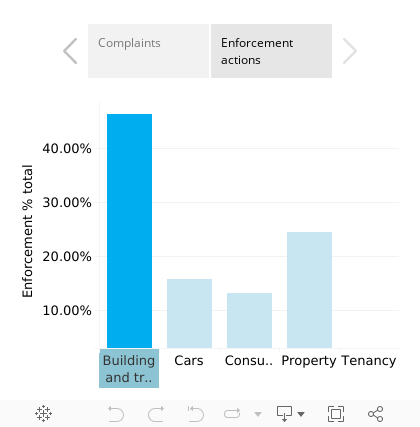
But what does this tell us about the impact of making a complaint to Fair Trading in New South Wales? We've had a look at the enforcement actions taken and total complaints made over the last year, which are also published by Fair Trading. We've had to make some broad assumptions in order to make the two lists comparable - enforcement actions are expressed as belonging to particular pieces of legislation, where complaints are categorised by complaint topic. For instance, there is some potential overlap between the two - a real estate agent misleading a tenant might fall under the Australia Consumer Law as well as the Residential Tenancies Act, and therefore could go under both Consumer and Tenancy topics below.  You can scroll over each column to see how we've categorised complaints and enforcement action.

Although tenancy and consumer issues are two of the most complained about topics, they receive much less attention when it comes to compliance and law enforcement.

The lion's share of compliance action by Fair Trading NSW is carried out in relation to either the Property, Stock and Business Agents Act (which we have labelled Property) or the three laws relating to trades - the Home Building Act, Plumbing and Drainage Act and Electricity (Consumer Safety) Act. Despite only taking up 7% of the complaints made to Fair Trading over the year, they made up 70% of the enforcement action. Conversely, tenancy made up 9% of all complaints to Fair Trading, but only 0.25% of enforcement.

One way of explaining this gap is that there are different methods to deal with different kinds of complaint. For instance the NSW Civil and Administrative Tribunal is the primary way for tenants to address their issues with landlords and, by extension, real estate agents. Unfortunately, the Civil and Administrative Tribunal hasn't been publishing its annual statistics like its predecessor the Consumer Trader and Tenancy Tribunal did, and it misses much of the detail. The Tribunal's 2015-16 report has not been published yet but in 2014-15 we know that 58,360 applications were made concerning these topic areas (and others) and that more than three quarters (46,351) were about renting. What we don't know is who made those applications - but from historic data we know about 85% of Tribunal applications are made by landlords. So perhaps roughly 7,000 applications are made by tenants each year. This exceeds the 4,500 complaints made by tenants to Fair Trading, and dwarfs the 2 enforcement actions taken in relation to the Residential Tenancies Act.

This suggests to us that some people are expected to enforce the law themselves, and some can expect government will enforce the law on their behalf. The difference, it seems, is whether or not you are a renter.

We encourage tenants to make complaints, even if enforcement action is pretty thin on the ground. At the very least, complaints make Government agencies directly aware of the issues that people face. Fair Trading can use their complaints data to help them understand these issues and relate it to their public policy work, including current work around reforming the Residential Tenancies Act.

You can find sample letters that can help with writing complaints to Fair Trading at this link: here.

Tuesday, April 5, 2016

Fair Trading lights damp squib for tenants

As the main regulator of direct trade and commerce in New South Wales, Fair Trading receives over 45,000 complaints from consumers each year. It should come as no surprise that these include gripes from tenants about the behaviour of landlords and real estate agents.


In order to give consumer complaints a meaningful edge, Fair Trading is launching a new “Complaints Register”. This will provide a record of businesses that are subject to multiple consumer complaints received over the preceding two years. According to its guidelines, the Complaints Register aims ”to provide an incentive for businesses to deliver better customer service, and help consumers make informed decisions about where to shop".

We can see how a public 'name and shame file' could drive informed decision-making by consumers (tenants) in their hunt for a new product or service (a home). Avoiding such a register could also be a real incentive towards improved behaviour from service providers (landlords and real estate agents). So far, so good.

But, as with all things, the devil is in the detail. This register is unlikely to be of much use to tenants because a business may only be listed if it is subject to 10 or more complaints in a single calendar month. For the private rental market, this proviso could scarcely be more lenient. Real estate agencies largely operate as small businesses, and well over 90% of landlords own three or less rental properties. Given the modest scale of most operations, and the nature of the service provided, even the most scurrilous operator is unlikely to receive so many complaints in such a short space of time. Incredible though it seems, an agency subjected to over 200 complaints across the two year period could nonetheless avoid a listing.

The prospect of a listing represents the best reason for most tenants to lodge a complaint in the first place. The likelihood that a complaint will result in punitive action or provide a tenant with any direct redress is distinctly slim. Fair Trading will attempt to negotiate an outcome for a complainant - but this process requires the voluntary participation of the other party, and any agreement reached is unenforceable. Fair Trading also has powers to prosecute businesses suspected of engaging in certain types of unlawful conduct, including breaches of some provisions of the Residential Tenancies Act. But these are almost never utilised in tenancy matters: just two prosecutions under the Act took place in 2015, with five occurring the previous year.

But there is another serious shortcoming that many prospective complainants will encounter. Complaints may only be made against a 'business’, which captures real estate agencies, institutional landlords, and possibly some individuals with a large number of investment properties. But 'mum and dad' landlords with a smaller portfolio are considered passive investors, rather than active participants in the shelter business. So most tenants with a landlord that has not engaged an agent need not be disappointed by the new register: they remain entirely excluded.

Still, we'll be the last to tell tenants not to lodge a complaint with Fair Trading. Just make sure you get a good idea of where you stand before taking the plunge...

Fair Trading’s lack of attention to the private rental market might make you wonder just what the New South Wales Government makes of the landlord/tenant relationship in the first place. A light touch on tenancy issues reveals an ongoing misunderstanding of the structural imbalance in the bargain between those who need homes to live in, and those who want to use them for building wealth. Perhaps this is an unhappy sign of things to come, as we await the outcome of a statutory review of our renting laws?