Showing posts with label Law reform. Show all posts

Thursday, January 10, 2019

Do politicans vote with their property interests?

With recent news about Government ministers opposing no grounds reform, we thought it timely to look at whether politicians' votes are affected by their property interests.

Back in August 2014 Dallas Rogers wrote for The Conversation about how property-owning politicians might influence policy. He said:
It is important to note that research doesn’t show a causal link between property holdings and decisions of politicians. But it would be imprudent to assume prima facie that the property holdings of Australian politicians do not play a role in their political thinking, especially as this thinking relates to housing, taxation or even superannuation policy.
In April 2017 both the ABC and The Sydney Morning Herald ran stories about Federal politicians who owned property, many being landlords in the private rental market. They found that Australia's 226 federal MPs declared on the register of interests that they own 561 properties. You can view the ‘Register of Members Interest’ for Federal pollies here. These stories ran at a time when housing affordability was receiving daily coverage in the media and policies on negative gearing and capital gain tax were very much in the public spotlight. Now that these issues appear firmly cemented in the public debate, we might expect to see more articles in the run up to the federal election.

Anyone can check what properties NSW state politicians have disclosed by trawling through the ‘Register of Disclosures by Members of the Legislative Assembly as at 30 June 2018’. The equivalent for the Legislative Council is still hard-copy only but available to look through at Parliament House. Here is a summary. We have excluded two MPs who have not been required to make disclosures since they took their seats.

NSW Parliament
133 Members of the NSW Parliament own 256 properties; average number of properties owned is 1.9 and the highest disclosed is 10. 42 are landlords of residential properties and a further 10 are possible landlords of residential properties: that is, up to 39% of MPs are landlords of residential premises.
Legislative CouncilLegislative Assembly
41 Members of the Legislative Council (excluding 1 new MLC) own 69 properties; average number of properties owned is 1.7 and the highest number owned is 6.
11 are landlords of residential properties and a further 6 are possible landlords of residential properties: up to 42% are landlords of residential premises.
92 Members of the Legislative Assembly (excluding 1 new MLA) own 187 properties; average number of properties owned is 2.0 and the highest number owned is 10.
31 are landlords of residential properties and a further 4 are possible landlords of residential properties: up to 38% are landlords of residential premises.

Party Affiliation
Liberal Party49 MPs average 2.1 properties and 39% are landlords or possible landlords of residential premises.
National Party23 MPs average 2.3 properties and 48% are landlords or possible landlords of residential premises.
Labor Party46 MPs average 1.6 properties and 33% are landlords or possible landlords of residential premises.
The Greens6 MPs (excluding 1 new MLC) average 2.2 properties and 83% are landlords or possible landlords of residential premises.
Shooters, Fishers and Farmers Party3 Shooters, Fishers and Farmers Party own one property each. None appear to be a landlord of residential premises.
Christian Democratic Party2 MPs own one property each. Neither appears to be a landlord of residential premises.
Animal Justice Party1 MP owns one property. They do not appear to be a landlord of residential premises.
Independents3 Independents (excluding 1 new MLA) average 2.0 properties and two are landlords or possible landlords of residential premises.

Unfortunately the information above is not the full story. There are possibly properties we don't know about: undisclosed because they are held by companies, trusts and self-managed super funds. Some, but not all, MPs do declare such properties.

Others keep them out of the public gaze through the disclosure rules. For example, it is clear that properties owned by the spouses of politicians don't generally need to be disclosed, but it is likely to cause some change in the way a politician votes. Whilst most MP’s don’t declare this information because it is discretionary, some (from across the political spectrum) do. At the same time, some assert that when deciding whether they need to declare a property 'income' is interpreted to mean 'net' income - which may end up meaning a negatively geared property held by a trust never needs to be declared at all.

Does owning property affect the way a politician votes?

In NSW we put this question to the test in September and October when Parliament was voting on the Residential Tenancies Amendment (Review) Act 2018
 

A vote in the NSW Legislative Council was very close to passing an amendment abolishing ‘no-grounds’ evictions. That vote ended up dividing along party lines with Labor, the Greens, and the Animal Justice Party supporting change and Liberal, National, Shooters and Fishers and Christian Democratic Party voting against change. The equivalent vote in the Legislative Assembly also divided on similar lines, with the three Independent MPs joining with Labor and the Greens. Counter-intuitively this means the party with the highest percentage of landlords amongst MPs, the Greens, voted for change.

It also means landlords did not uniformly oppose fair renting laws through ending no grounds evictions.  In fact, more than a third (18 out of the 42) of voting landlords in NSW Parliament voted to end unfair evictions- only a little less than the proportion of MPs overall.

So what is going on? We think the nine news story demonstrated it clearly - these decisions are made before the vote, inside parties, and it is there that any influence occurs. We know some within the Liberal and National Parties support ending unfair no grounds evictions - but they were overruled. This is why processes around conflicts of interest are so important!

But on the bright side we also know some landlord politicians do choose to vote for fairer renting laws. We might be optimists, but we also think this means our parties should question any assumption that landlords will never support a party that acts fairly. Just like people who rent their home, we believe there are a range of views. We are confident that, just like some politicians, some voters who are landlords can see past their own particular financial interests and support a fair, balanced renting system. Whether it is their family, their friends, or other members of their community - there is someone who is negatively effected by unfair evictions remaining as they are.


Friday, December 7, 2018

Disrupt landlords

This is a slightly modified version of opening comments I made to the recent AHURI conference Disrupting the housing market in a session called 'New technologies, ethics and regulation'. Check out all the presentations here:

L-R: Sidesh Naikar, DSS; Nerida Conisbee, REA Group; Leo Patterson Ross, TUNSW; Prof Chris Pettit, UNSW City Futures. Photo Credit: AHURI


I frequently find myself arguing both against particular disruptions that show up, while wishing for serious disruption in our housing sector which is failing so many. In my few minutes I’ll make some observations about why we aren’t getting what we need.

We need to examine each change to our housing system with eyes open. It can be obvious to examine who benefits or suffers from change, but sometimes we can forget to also examine the impact of retaining the status quo.

We rightly point out that rent-bidding apps like Rentberry are not nearly as transparent as they claim and forces tenants to compete with other tenants to pay the highest rents possible. What we can miss is that allowing a real estate agent to set the rent based on what they think the market will bear is definitely untransparent and forces tenants to compete with other tenants to pay high the highest rents possible.

Similarly with online platforms which allow ever greater information to be gathered – they allow discriminatory behaviour. But it is naïve and demonstrably wrong to think that pen and paper applications and face to face viewings don’t also facilitate this.

The problem is with our competitive private rental market, which encourages people to use pre-existing biases as a shortcut to choosing a tenant, rather than the particular apps themselves.

It can also be easy to identify issues only within the frame of how a disruption is impacting the system without acknowledging the pre-existing systemic issues the disruption may highlight or exacerbate. This has been an ongoing issue in studies but particularly in media reporting around short-term letting.

In many ways, this relates to the democratisation of data - it is rarely put in the hands of practitioners or people with lived experience who ask different questions of the data.

Most data concerning the private rental sector in Australia has been created by and for the real estate industry, to aid investors who seek to enhance their investment decisions. The data is held in the hands of people who seek to profit from either holding the data or from the decisions which can be made from the data.  Controlling the data helps control the narrative which is a key tool used by all those in power – this is why rent increases are often reported in positive ‘growth’ terms rather than a negative phenomenon of loss.

The government and NFP sectors are not immune from this either, holding great data sets which are not made available to the public, or are made public only after being sanitised and asked the questions which are safe to ask from the data holder’s perspective. Given both the importance of providing shelter, as well as the degree of subsidy the public provides governments, community orgs, private investors and academics, there should be no reason why data created with the benefit of those funds shouldn't be as open as possible.

So, what do we need to do? So far disruption in Auatralian housing has ultimately designed to maintain the status quo. assist landlords and investors not tenants. it's interesting that Airbnb and Uber, as much as they are problematic otherwise, both set out to disrupt the service provider, hotels and taxis, not the traveller or the passenger. In Australia, tenancy disruptors like TrustBond, Snug, and others try and present as being for tenants, but I believe they realised that the power rests heavily with the service provider and since they don't have a plan to disrupt the physical supply of rental housing, they have sought to either reduce service provider costs without any benefit flowing to end user or eke out essentially private taxes from end users. This is particularly been the case with alternative bond loan products which claim to replace cash bond but actually protect current landlord interests by maintaining their current costs and risk profile, while extracting a fee from the end user tenant to access the product.

We need to disrupt landlords, of all sorts. The disruption needs to happen at three levels – first the current legal and social framework needs rewiring by either people or governments. We need to rebalance the relationship between landlords and tenants and recast the provision of housing as an essential service to be delivered to the people who need it when, where and how they need it. This will be the great disruption for many landlords. While we do that, we open up the data and let people ask the questions that need to be asked of our housing system. Those two things open up opportunities for disruptors, whether for profit or not, to seek to improve tenants lives, rather than just joining in the pile-on of people seeking to rake money off them.

Friday, November 2, 2018

What you need to know about renting reform in NSW: Part 3

We're back with more information about the Residential Tenancies Amendment bill which has passed and is now an Act. It will take effect at a so far unannounced date in the future - presumably before the election in March. In this series of posts, we examine what is proposed and what the changes will mean for renters in NSW. If you haven't already, check out Part 1 and Part 2. Many of these proposals are good, or have potential to be so. Whether they strike the right balance will often depend on whether unfair 'no grounds' evictions remain in the Act. Others have short-comings which will need to be revisited in the future.


Condition Reports

Currently the Act mandates that a landlord must give the tenant two copies of the condition report before or when the tenant signs the residential tenancy agreement. The tenant must then complete and give one copy of the condition report to the landlord or landlord’s agent not later than 7 days after receiving it.

The proposal before government is that the landlord must, before or at the time the tenant signs the residential tenancy agreement, give to the tenant two copies, or one electronic copy, of the completed condition report.

This is a positive change as it more clearly places a burden on the landlord to provide the condition report. The report's purpose is largely to support a landlord's claim on a tenants bond.

Information Statements

Currently the Act does not mandate that the landlord sign any statement acknowledging that they are aware of and understand their rights and obligations as a landlord.

The proposal before government is that the landlord or landlord’s agent must not enter into an agreement unless they have signed an acknowledgment on the agreement that the landlord has read and understood the contents of a rights and obligations information statement that sets out the landlord’s rights and obligations under the Act and any other Act or law in relation to the proposed residential tenancy.

We support this amendment - though are skeptical of its effectiveness. A better approach to improving landlord awareness of rental laws may be placing more obligations on real estate agents to prevent their landlord from breaching the agreement or an education system such as Utah's 'Good Landlord' program and a proper registration program to recognise that landlords are providing an essential service, and need to be fit and proper persons for such an important role.

Rent Receipts

Currently the Act is silent on the use of email as a method of supplying rent receipts. In this absence the Electronic Transactions Act 2000 may apply.

The proposal before government will allow rent receipts for rent paid by cheque to be sent by email to an email address specified by the tenant.

We support this amendment. Our only concern is that tenants may feel pressured to supply an email that they rarely access. This will need to be monitored.

Smoke Alarms
Currently the Act is silent on smoke alarms other than being captured in a reference to a landlord’s statutory obligations relating to the health or safety of the residential premises. All residences are required by the Environmental Planning and Assessment Regulation 2000 to have smoke alarms installed. Smoke alarms are likewise mentioned in the Standard Form Agreement as being a statutory requirement for all residential premises.

The proposal before government is that repairs to smoke alarms be carried out as a matter of urgency. The Manner and time frame by which these repairs are to be carried will be prescribed in the regulations. Breach of this section may result in a maximum 20 penalty units. A tenant can undertake urgent repairs to smoke alarms and be reimbursed accordingly as per the regulations.

This amendment came out of a coroner's report into the tragic death of a child. We support this amendment although we are yet to see the regulations. We do not envisage any problems with the drafting of the regulations.

Employee & Caretaker Evictions

Currently the Act treats the eviction of tenants generally equally - 'at fault' evictions occur because of the tenants behaviour, not because of any personal characteristic. 'no fault' evictions occur because of some change within the landlord or the property, and not because of any personal characteristic of the tenant.

The proposal before government is to treat employees differently to other tenants. Tenancy agreements with tenants who are on periodic agreements who also happen to be employees or caretakers (as defined in section 9 of the Act) will be able to be terminated with as little as 28 days notice. It is intended to assist a landlord employer more easily evict their tenant employees and largely justified on a misunderstanding of the range of ways a section 9 agreements can be formed - the amendment was pushed heavily by the farming industry, particularly aimed at seasonal employees, but the implications are much broader.

We do not support this amendment. Employers ending employment agreements and tenancies should be able to plan around the transition. Employee arrangements are broader than just farms, and this will cause unfair outcomes. The arrangements are not fixed contracts with a forseeable end date which mean the tenant does need sufficient time to find a new home – it is not clear why they are deemed to deserve less than the other tenants. If anything they should be afforded extra time to move out given that they are potentially facing not just homelessness but unemployment.

Our recommendation was and remains that employee & caretaker evictions require the same notice period other tenants do - 90 days in a periodic agreement. There has been no reason given why landlord employees can't work around this period - it appears to be pandering to poorly run businesses rather than legitimate issues with the notice period.

Expansion of Rent Arrears Process
Currently the Act treats rent arrears differently to other breaches of the agreement. You must be in breach of the agreement for 14 days before a notice can be served, and generally if you 'rectify the breach' (buy paying the rent owed) before you are evicted, you can prevent that eviction from occurring. This is a sensible difference which gives tenants more time to fix the problem, and means landlords are less likely to suffer rent arrears losses.

The Act is changing to also include water and electricity charges in this different scheme, and we think this is sensible. Rent arrears and water charges often go hand in hand, but currently, if a tenant is given an eviction notice for owing $1000 for rent and $10 for water, and pays off that $1010 they will still be evicted - under this change, they will not.

We think this is a good change however, the rent arrears process currently has a big flaw in it which needs to be corrected. Where a person has a past history of rent arrears, the landlord can ask the Tribunal not to allow them to stay even if they do pay off the current rent arrears. Originally this was introduced to prevent tenants paying 'on the court house steps' and playing games with the system. Unfortunately it was broadened to mean that even minor, and quickly remedied rent arrears can add up to an eviction. It should be amended to apply only to circumstances where tenants wilfully paying late as originally conceived.

Asbestos & Termination

Currently the Act is silent on asbestos other than a being captured in reference to a landlord’s statutory obligations relating to the health or safety of the residential premises. Under clause 458 of the Work Health and Safety Regulation 2011, if more than 10 sqm of bonded asbestos sheets, or any significant amount of loose or crumbling asbestos, is to be removed from the premises, the removal must be conducted by a licensed removalist.

Once these amendments take effect, tenants in properties that have been listed on the Loose Fill Asbestos Insulation (LFAI) Register during the term of the agreement or listed on the Register prior to the agreement being entered into and that fact was not disclosed to the tenant may terminate the tenancy early without compensation to the landlord under section 100 of the Act.

The LFAI system already allows for some compensation from government to landlords, but prior to this amendment tenants can find themselves trapped in potentially unsafe environments with unfair break costs. This is a sensible amendment.

Expansion of use of Rental Bond Interest Account


Part of the deal when the Rental Bond Board was created and tenants bonds started being held in trust there was that the money would be spent on the renting system and particularly in the interests of tenants. Currently the Act mandates that the Secretary may make a grant or loan, on the  recommendation of the Board and with the approval of the Minister, from the Rental Bond Interest Account for the following purposes:
(a) establishing and administering tenancy advisory service,
(b) schemes for the provision of residential accommodation,
(c) education about tenancy laws and the rights and obligations of landlords of landlords and tenants,
(d) research into matters relevant to the relationship of landlord and tenant,
(e) other activities for the benefit of landlords and tenants.

The amendment will allow the Secretary to also make a grant or loan from the Rental Bond Interest Account for 'other consumer protection purposes.'

We have not been given any further information about what, if any, consumer protection services/products the Fair Trading envisage could be funded from the Rental Bond Interest Account. We do not support bond money being spent on anything other than the renting system – otherwise, bonds would be better left in tenants pockets.

Database Listing Offences
Currently the Act mandates that offences can be penalised by fine or imprisonment but is never or very rarely enforced to be act as an effective disincentive.

The proposal before government creates two new offences:

(1) A maximum penalty of $2,200 for a landlord or landlord’s agent who lists personal information about a tenant or co-tenant in a residential tenancy database if that tenant or co-tenant terminated an agreement in circumstances of domestic violence.

(2) A maximum penalty of $1,100 for a database operator who charges a fee for giving a copy of personal information that is in the residential tenancy database to a person who is the subject of the personal information.

We support this amendment on the proviso that there is effective use of enforcement powers from Fair Trading. Currently enforcement through the use of penalties rarely occurs.

Enforcement generally
While not an amendment itself, it is worth a note that a number of amendments have been to add new penalties to the Residential Tenancies Act 2010, with the intention of regulating bad behaviour by landlords. We have mentioned a few times that the rate of enforcement is very low, and this causes us scepticism about the effectiveness of this strategy - but how low is it?

Over the two years 2016-17 and 2017-18, there were more than 5200 complaints by tenants. Around 1000 allegations of offences were investigated and found to have breached the Act, with the vast majority of those being given either a warning or "education". Just 24 people were fined, at an average fine of less than $500. So very few instances of verified breaches of the Act resulted in enforcement action - and very minor enforcements at that.

We have encouraged the Minister and NSW Fair Trading to consider the message that this low level of enforcement sends to landlords and real estate agents who do the wrong thing - that chances are you'll face no consequences for breaking the law. On the other hand tenants are routinely evicted for not following their obligations. Is that a balanced approach?

If the Act is to include these penalties, then we need to have a rigorous and fearless approach to applying them, otherwise their ability to regulate behaviour is unacceptably weakened. Tenants are mostly pushed to enforce the law themselves - but at great personal risk of jeopardising both their current and future homes.

Wednesday, October 24, 2018

The Limits of Rights and Protections: Housing as an Essential Service

This article by Leo Patterson Ross of the Tenants' Union of NSW and Mark Riboldi of Community Legal Centres NSW was published in the September issue of Parity, "Marginal Housing: Where to From Here?". We are pleased to have been given permission to republish here, and encourage you to consider subscribing to Parity for coverage of all aspects of homelessness; its causes and consequences and the policies, programs and services developed to prevent, respond to and, end homelessness.


Public policy relating to renting and tenancy is typically approached through two competing conceptions: consumer protection and human rights - are we regulating an economic exchange or ensuring that everyone has a roof over their heads? The problems resulting from these, governments resistant to enforceable rights mechanisms and not all tenancies being commercial transactions, mean too many people are denied adequate housing. Perhaps it’s time to explore a different way of framing this issue: through the lens of access to housing as public service provision.

Governments across Australia tend to approach tenancy as a subset of consumer protection, with Residential Tenancies Acts across the country being in the consumer affairs portfolio or equivalent. This implementation is inconsistent: under Australian consumer law, most residential tenancy landlords are not recognised as being ‘in trade or commerce’. At the same time, many marginal rental landlords, such as boarding or rooming houses, are recognised under the consumer law, though enforcement is rare.

The way renting is regulated through consumer affairs typically misunderstands the basics of the relationship between landlord and tenant. It generally conceives of two parties with roughly equal incentive coming together to create a contract. In a parallel example, a customer who walks into a TV shop will happily walk back out again without a TV if the price is not right, the product not suitable, or the salesperson not helpful. In terms of renting, landlords have the same financial incentive to make a ‘sale’ as the shop-owner, however tenants have a much greater need for shelter than the prospective TV watcher does for the latest episode of The Bachelor. This imbalance diminishes the ability for landlords and tenants to negotiate on equal terms and therefore to make renting fair government must intervene in the ‘market’ interactions.

Another problem caused by treating housing as a market place is the competition created between multiple parties seeking to live in a particular home. For potential ‘winners’, the lines of 30, 40, or more applicants creates the feeling of intense competition. But the reality is it only ever takes another applicant to be richer, whiter[i], or otherwise less of a ‘risk’ than you, for that home to remain out of reach. This environment pushes the ‘losers’ into increasingly substandard accommodation.

In comparison to this typical legislative approach, most housing advocates take a rights-based approach to housing, building on the right to housing enshrined in the Universal Declaration of Human Rights, and more fully explored in the International Covenants on Economic, Social and Cultural Rights[ii] and Civil and Political Rights[iii].

A key component of the right to adequate housing not implemented in Australia, which is not at all addressed by a consumer affair approach, is legal security of tenure. The Committee on Economic, Social and Cultural rights explains: “Notwithstanding the type of tenure, all persons should possess a degree of security of tenure which guarantees legal protection against forced eviction, harassment and other threats.”[iv]
 
With Australia’s general lack of constitutional or legislative rights frameworks, these rights to housing suffer from being neither recognised nor legally actionable in Australian jurisdictions, except in limited circumstances for public housing tenants in Victoria and the ACT. An unenforceable right is barely a right at all, and it’s questionable how many people think of the right to housing in the same way the think of the rights to freedom of assembly or speech. Framing issues around rights is additionally challenging: advocates and experts tend to talk about rights as individual objects existing on paper, created by lawyers; this is dissonant with the everyday reality of people’s lives, and from the right to housing as something that is innate or enacted by caring communities. From a housing advocate’s point of view, shifting both public opinion and government policy from a consumer affairs to a human rights framework may be a mountain too high and steep.

Another problem is that public discourse and campaigning around ‘renters’ rights’ in Australia focusses heavily on people in more formal residential tenancies – namely standard arrangements between landlords and tenants, typically brokered through real estate agents. Far less attention is given to the rights of residents in other forms of renting, particularly marginal housing forms like boarding and rooming houses, lodgings in private residences, public housing and residential parks tenancies. In every jurisdiction except the Australian Capital Territory multiple forms of marginal housing are not covered by legislation. Even in the ACT, effective coverage is limited.

This unfortunate phenomenon is understandable. Residential tenancies impact a broader proportion of the population, affecting social groups with greater social capital and power than the frequently more marginalised residents of, for example, boarding houses. Broad support is important for successfully shifting public policy and governments, which tend drag behind both academic consensus and popular opinion. In terms of renters’ rights, this makes it crucial for advocates to frame the issue in a way that is inclusive of marginal renters.

To achieve this, and to break the dissonance between housing as consumer affair or human right, an alternate conception may be to refocus on housing as the provision of an essential service, in a similar way that we look at education, health and transport. In the Australian context, all of these to varying degrees operate in a mixed public service / private provider policy environment, where public debate revolves around how much should be accessible free-of-charge. Such an approach may be more palatable to lawmakers turned off by the concept of human rights enshrined in legislation.
Importantly however, it also comes without the degradation of purpose that can accompany pragmatic solutions to thorny issues, such as the current trend towards not-for-profit housing as a response to a public housing approach governments have underfunded into failure.[v]
 
Recognising housing as an essential service offers a number of advantages in terms of advocating for improved conditions for people in marginal housing. While there is fierce political debate about how best to supply essential services, no credible decision-maker in Australia would be willing to argue that simply having a lower income should exclude a person from having access to clean water, healthcare or a high school education.

A public service approach would necessitate state and federal Ministers for Housing to ensure that the housing supply chain was functioning properly, and that the ultimate use of the shelter was regulated appropriately. This would require a realignment of the ministers currently responsible for planning, social housing and renting regulation.

Recognising housing as an essential service means sensible legislative reform to ensure that laws around renting are no longer a patchwork of coverage with cracks for marginalised people to fall through. Under this framework all renting contracts, whether an inner-city boarding house, a lodging in a family home, or a mainstream residential tenancy would then include:
· protection from unfair and arbitrary evictions, and
· requirements that homes be of adequate comfort and safety, and
· effective and accessible dispute resolution mechanisms, including of eviction decisions.

Housing as essential service cuts across the prevailing legislative framework of renting as commercial transaction. If we can reframe housing as an essential service, we will be less likely to accept the current restrictions to access, the arbitrary cut-offs through evictions and the overpricing of supply, particularly in the informal sector. While Australians are generally accustomed to private entities delivering public services, people are becoming increasingly aware that the corporate ‘efficiencies’ and ‘choice’ provided by profit-driven entities do not necessarily equate to quality services, take for example recent criticisms of the private health insurance rebate, the underperformance of for-profit superannuation funds, or the concerns about unscrupulous players in the aged care sector which sparked the recent Royal Commission.

Reframing housing as an essential public service will be a challenge, but it’s clear that we need to find effective ways to shift the political discourse and legislative framework away from housing and renting as simply consumer transactions. Rather than a move away from a rights-based approach, we suggest exploring a different way of advocating for these rights that is both inclusive of marginal renters and builds on the existing support for a various public and community delivered services as foundation stones for fair, vibrant and inclusive communities.

[i] MacDonald H., Nelson, J., Galster G., Paradies Y., Dunn, Kevin M & Dufty-Jones R. (2016) "Rental Discrimination in the Multi-ethnic Metropolis: Evidence from Sydney", Urban Policy and Research, 34(4), 373-385
[ii] Article 11, https://www.ohchr.org/en/professionalinterest/pages/cescr.aspx
[iii] Article 17, https://www.ohchr.org/en/professionalinterest/pages/ccpr.aspx
[iv] Committee on Economic, Social and Cultural Rights: General comment No. 4: The right to adequate housing (art. 11 (1) of the Covenant) (1 Jan 1992). Available at http://tbinternet.ohchr.org/_layouts/treatybodyexternal/TBSearch.aspx?Lang=en&TreatyID=9&DocTypeID=11
[v] Emma R. Power & Tegan L. Bergan (2018): Care and Resistance to Neoliberal Reform in Social Housing. Housing, Theory and Society.

Tuesday, October 16, 2018

NSW is close to ending unfair evictions - how and why we should do it for the economy

This week, the NSW Legislative Council will vote on amendments to the Residential Tenancies Amendment (Review) 2018 bill to decide whether to keep unfair 'no grounds' evictions, or replace them with 'reasonable grounds'. Here's what they'll be arguing about.

The ALP and the Greens both have proposed amendments aimed at the issue of 'no grounds' evictions. The ALP amendments restrict s84 and s85 to a list of reasonable grounds that would be added by regulation. This allows for a consultation process to work out what that list should be.

The Greens amendments approach the issue differently. Their amendments allow for two reasonable grounds - an owner or their close family moving in, and significant renovations - as well as allowing for a landlord to nominate any other reason. This any other reason just needs to be one that requires the use of the premises for something other than a residence - for instance, perhaps they want to convert it into a bed and breakfast - for a six-month or more period.
The Greens amendments also address the issue of landlords dishonestly using a reasonable ground by including a section on 'wrongful evictions' with penalties for the landlord and potential compensation for the wrongfully evicted tenant, and strengthens the retaliatory provisions.

It will be up to the cross-bench to say yes or no to making renting fair. Mark Pearson of the Animal Justice Party has an amendment aimed at allowing pets in rental property and is most likely to support making renting fair.

If both the Christian Democratic Party and the Shooters, Fishers and Farmers Party vote for an amendment that the ALP and Greens also support, then the amendment will pass. The Christian Democratic Party has already flagged their support for addressing the issue, saying that the government reforms fall short for NSW's most vulnerable if ' no grounds' evictions aren't addressed. The Shooters, Fishers and Farmers Party is yet to declare its intentions. These cross-benchers have received more than 1100 emails from people supporting the Everybody's Home and Make Renting Fair campaigns in the last few weeks. These emails come from all across NSW and have really shown how much support these changes have.

We already know older women, and children are being harmed by the ongoing existence of unfair evictions, but there's another big group who are missing out - tradies.

The Unsettled survey last year found that 30% of tenants were living with ongoing maintenance issues, and 8% of had outstanding urgent repairs. The Curtin survey from last week similarly found 35% of properties with internal maintenance issues and we know many tenants don't report repairs because they are scared and many more because they know the work just won't get done. This is costing the NSW economy a significant amount.


There are around 850,000 bonds in the Rental Bond Board. If we apply those outstanding repairs figures, assume very conservative figures of just $500 per regular repair and $1000 for urgent ones that's almost $200million that is currently being held back from tradies' wages, and parts retailers, distributors and manufacturers and flowing on to the broader economy. Some of these repairs will eventually be done, but many won't, and the sooner the government enables the work to be done, the sooner the broader community will feel the benefits. Don't even get us started on unproductive days off work and longer commutes which harm the economy in a number of ways. Unfair evictions hurt us all.

If Parliament doesn't make renting fair tonight, the outstanding repairs, the fear and anxiety, will continue - but now instead of a long-standing piece of legislation it will have been an active vote by Members of Parliament to have it remain so.

We continue to have faith they will make the right decision for the people of NSW. It is most likely the amendments will be debated tomorrow before lunch - we'll be watching!

Thursday, October 11, 2018

Renters can't get no satisfaction - but we try and we try

This week the Bankwest Curtin Economic Centre published a new survey about the private renting sector. The survey reports some important but unsurprising results around the unaffordable and unstable nature of the sector. However it found some unexpected results and it is this which the authors concentrated on.

Let's dig in to these results, but first we invite you to keep in mind this line from the excellent English book of 2016 "The Rent Trap."


This goes a long way to explain how on one hand the survey found that "only" 6% of tenants reported their premises being in poor or terrible condition and 14% were unsatisfied with the experience of renting. On the other hand:
  • 35% reported the place needing maintenance internally,
  • 27% externally,
  • 21% of renters reported their properties were affected by mould, 
  • 30% had inadequate security
  • 12% reported their homes did not even have smoke detectors installed.

26% of those renting from a real estate agent reported either repairs only occurring after constant reminders, or never being carried out by the landlord or agent at all. The discrepancy between such poor results and the satisfaction level demonstrates the adjustment renters have already made to their expectations.

That so many were willing to still describe their relationship with their agent or self-managing landlord (69% and 81% respectively - a good moment for self-reflection from the real estate industry if they felt inclined!) as good or excellent says a lot about how little many tenants expect from the relationship. It also leads in to one of the big issues with the survey methodology - definitions. We could offer feedback on many aspects of the survey, but let's not turn this into a full review!

What is an "average" relationship with a real estate agent? What is a lease? 

Several parts of the survey with "surprising" results are based on language which is not necessarily universal.
An average or even a good relationship with an agent may mean different things to different people. Is an average relationship the colloquial, and largely negative usage? Is it what a person expects everyone else is experiencing, or compared to my previous, really horrible relationships? Or is it, as this scale suggests - a halfway point between good and poor? The different definitions may give quite different results. For some, a good relationship may simply mean they have not yet had a bad experience.

There is a very large drop-off from "average" ratings to "poor" and "terrible". People experiencing poor and terrible relationships are much more likely to have either been forced to move or chosen to move to avoid the relationship. So the current improved relationship masks a previous negative relationship. This would go a long way to explaining the high proportion of positive relationship. Unfortunately the researchers divide people into being forced to move or choosing to move. However, a move by choice does not appear to allow for a person who is informally forced to move because of a poor relationship, lack of repairs, or other issues. 

A lease is probably most commonly understood by tenants to be a formal written contract, and particularly a fixed-term contract. In a legal sense it refers to the temporary transfer of particular property rights from one person to another in exchange for rent. Respondents answering a question about renewing a lease might have been thinking of the fixed term, rather than leaving the home, which would change the way a person would answer the question. In many states it is routine for the fixed term to continue on into a periodic, continuing or non-fixed (language varies across the country!) lease whereas in Queensland almost all tenants are in rolling fixed term contracts.
Some of the questions around leases and decisions conflate the two and ask questions asking, for instance, why a lease was not renewed.  If a respondent was thinking of the initial written contract, again this may throw up odd results.

Are we satisfied?

In many ways, we are left with more questions than answers about the research. Digging a bit deeper into the data would likely do a lot to tease out the meaning behind the responses, but unfortunately it's not really available to do so. One key factor which would seem to have been relevant was responses from different income ranges. Unfortunately none of the responses (not even affordability!) did so. 
Satisfaction is a tricky thing to measure. It may have been better to concentrate on the measurable experiences - how many properties in poor repair, how many tenants left to deal with repairs themselves, how many moves tenants are forced into moves, both formally or informally. This gets away from language differences and would ultimately give a much clearer idea of the renting experience.

Tuesday, October 9, 2018

What you need to know about renting reform in NSW: Part 2

We're back with more information about the Residential Tenancies Amendment bill and what it will mean for renters in NSW. If you haven't already, check out Part 1 and Part 3. Many of these proposals are good, or have potential to be so. Whether they strike the right balance will often depend on whether unfair 'no grounds' evictions remain in the Act. Others have short-comings which will need to be revisited in the future.

Disclosure of information to tenants


Currently the Residential Tenancies Act 2018 mandates that a landlord must not make false representations, must disclose any planned sale and mortgagee repossession actions and give tenants an information statement before they enter into an agreement.
The proposal before government is two-fold. First there is an expansion of the information to be provided so that prospective tenants of strata schemes be given a copy of the by-laws for that scheme and also be advised if a strata renewal committee has been established for the scheme before entering into a residential tenancy agreement. We welcome this proposal.
The second is that a tenant can vacate without penalty if a landlord breaches section 26 - they can either serve a notice of termination and vacate, or seek orders ending the tenancy early from the Tribunal. However, a tenant will not be able to seek any compensation as a result of the landlord's failure to disclose information.

Our recommendation
Our recommendation is that all of section 26 (proposed and existing) be made a term of every agreement and that tenants should be able to seek compensation for the landlord’s failure to disclose in the circumstances outlined in the existing legislation, i.e for false representations, disclosure of sale or mortgagee actions and information statements to be given to tenants before the tenant enters into the agreement, as well as in the above proposed circumstance in regard to strata.
This must be made into a term of every agreement in order for it to have any meaningful impact. Our experience is that currently the disclosure requirements are not well adhered to and where non-disclosure is discovered, tenants often have little option but to accept it. As it stands, whilst a tenant can vacate without penalty if disclosures do not occur, they are unable to seek compensation for the landlord’s failure to disclose. The potential losses to the tenant could be considerable and include – moving costs, reconnection fees and any other losses that would not be recovered under the current proposal.

Access generally by landlord to residential premises without consent

Currently there is no reference in the Residential Tenancies Act 2010 to landlord taking photographs or making visual recordings of tenants’ homes for any purpose. To date the standard advice to tenants has been that if a tenant requests that a landlord desist from taking photographs and they ignore such a request, then the landlord may place themselves in breach of section 50(2) ('Tenant's right to quiet enjoyment') of the Act and face a penalty of up to $1,100 if prosecuted in the Local Court. They may also face a claim for compensation awarded to the tenant in the NCAT.
The proposal before the government is that the landlord can access the residential premises without consent for the purpose of taking photographs or a video recording for the purposes of advertising the residential premises for sale or lease no more than once in the period of 28 days preceding the commencement of marketing the residential premises as long as the tenant is given reasonable notice and a reasonable opportunity to move their possessions out of the frame of the photo or visual recording.
The landlord or agent can publish the photos taken with the tenants written consent - the tenant cannot unreasonably withhold that consent. If in the landlord or agents opinion the tenant refuses consent unreasonably, they will either - apply to NCAT for orders requesting consent be given, evict the tenant for the breach of unreasonably withholding consent, or if they are unsure (or can't be bothered) of whether it was unreasonable, evict the tenant for no grounds. Even tenants with strong reasons to withhold consent for publication will be in a vulnerable spot.
If the landlord or agent goes ahead and publishes anyway, there is a $2200 fine that may be applied. However under current practices Fair Trading is very unlikely to apply such a fine. For the entirety of 2017-18 Fair Trading issued penalties to just 9 people for 10 offences under the Residential Tenancies Act. This lack of enforcement operates to undermine the effect of penalty provisions in the Act.

Our recommendation
We do not support this proposal as it discourages negotiation between the parties and may result in possessions that cannot be reasonably moved out of frame being photographed. Whilst the proposal does take survivors of domestic violence into consideration and allows these tenants to withhold consent in circumstances where domestic violence exists, the definition of domestic violence may be too tight. Even for survivors of domestic violence the proposed system will mean that tenants will most likely need to apply to the tribunal for protection and may not be able to prevent publication of identifiable photographs.

Guidelines relating to reasonable times for repairs

Currently there are no guidelines relating to reasonable times for repairs. Whilst urgent repairs are defined there is no timeframe for these or general repairs and maintenance to occur other than that landlords are required to act with reasonable diligence. ‘Reasonable diligence’ is not defined.
The proposal is to add guidelines for reasonable time frames for repairs to occur. It is not known yet exactly what format but it is likely it will determine time frames based on the seriousness of the needed repair - unsafe electrical work will be a shorter time frame than aged paintwork.

Our recommendation
In the absence of any proposed guidelines it is difficult to comment other than to say that this proposal has the potential to be a very good change if the guidelines are done well and reflect the real time frames for a landlord acting with diligence. If they are not done well the proposal has the potential to be harmful to tenants as it will actually delay required repairs.

Fair Trading inspections and rectification orders

Currently many of the complaints to NSW Fair Trading about renting are in relation to repairs. While Fair Trading can take the complaint and talk to the landlord or real estate agent, there is no mechanism that allows for Fair Trading to either inspect the premises or tell the agent they must carry out the necessary work.
In a nutshell the proposal before the government is that a landlord or tenant can make an application to Fair Trading to investigate a concern about the premises. For landlords this will be because they believe the tenant has caused damage to the residential premises. For tenants, whether the landlord has breached their repairs and maintenance obligations under the agreement. A landlord rectification or a tenant rectification order can then be ordered with time frames for work to be done. This Fair Trading issued order will be used as the basis of an NCAT order for non-compliance.

Our recommendation
This has the potential to be a very good change but operational and funding decisions will determine if the potential is realised. There is a risk of the scheme draining other parts of the renting system by taking funds that could be spent on improving other aspects.
Several years ago Fair Trading implemented a dispute resolution system which has had positive results in relation to repairs - it is amazing how many agents will ignore a tenant asking for repairs, but when the same information comes from the regulator, it is taken seriously. However there is still a number of major hurdles for tenants, including the ever-present threat of eviction.
Fair trading inspections and rectification orders could particularly have good implications for social housing tenants who are not as susceptible to retaliatory evictions but increasingly face other barriers to enforcing their rights - such as limited resources and energy.
Likewise, the new mechanism could have the potential to free up the time of invariably overworked tenant advocates in under-resourced and underfunded services who often end up providing the time and resources to run such cases.
The scheme would be much improved if rectification orders were kept in a register, and were binding on the landlord even if the current tenant leaves. Currently tenants move in to premises with no reliable information about the condition of the premises. The condition report and a visual inspection is rarely a good guide to the real condition and history of the premises. A searchable register of rectification orders made regarding a property would be an authoritative and simple way to begin resolving this information asymmetry.

Minor alterations

Currently the Act provides for tenants to make alterations with the consent of the landlord. A landlord cannot unreasonably withold consent for alterations of a minor nature. These types of alterations are not defined.
The proposal is for regulations to prescribe the kinds of alterations that are of a minor nature in relation to which it would be unreasonable for a landlord to withhold consent.

Our recommendation
Clarifications and the signal sent from government are potentially a good step but it does not substantially change the current system. We await consultation on the changes, though there are some obvious issues which need to be included.
The system would be improved further by allowing tenants to make the minor alterations without needing to first seek landlord's permission, but rather give the landlord opportunity to state what is inappropriate. For instance, an improved disclosure statement or condition report which allows a landlord to state that a particular wall is not appropriate for nails or screws of more than a certain size. Another alternative is for tenants to give a notice of intention of alteration rather than a request, where a landlord must raise an objection for some good reason within a reasonable time frame.

Friday, October 5, 2018

Striking the right balance on evictions in NSW

On the day of debate around the proposed amendments to Residential Tenancies Act 2010 the Hon. Matt Kean, Minister for Innovation and Better Regulation, made a number of statements that formed the basis of an article in the Sydney Morning Herald’s Domain.

In this article, titled, ‘Better Regulation minister Matt Kean hits back at rental law critics’ by Tawar Razaghi the Minister made two statements we'd like to correct.

1. “The data suggests that over 95 per cent of people were not concerned about no-grounds terminations.”
The data the Minister is referring to is the Unsettled report, published by Choice, National Shelter and the National Association of Tenants' Organisations (of which TUNSW is a member). We say it suggests no such thing.

There is very little data on the broader question and this is a big part of the problem for public policy debate. The government also has a proposal we put forward to implement a way to measure eviction rates and the reasons for evictions through the bond claims system, using a simple 3-question survey on the claim form, and we encourage them to take it up.

While the primary fear of renters who took part in the Choice research was rent increases (which is hardly a surprise given the number of tenants currently in rental stress), the secondary fear is not specifically identified in the data but it is there, if you look hard enough:

“Worryingly, we found that renters with more experience in the market were less likely to complain when something goes wrong which illustrates the entrenched culture of fear among renters. This is all the more of a concern when you consider the rising number of long-term renters across Australia,” said Ned Cutcher, then the National Association of Tenants’ Organisations spokesperson.

There is new research from our evictions survey which we have distributed to parliamentarians today that show that the rate of concern is much higher. Here's a sneak peek:


This now sits alongside the lived experience of tenants and academic expertise recommending a course of action to replace no grounds evictions with a reasonable grounds system. Minister Kean and the Government should accept this evidence.

It is clear that the single most important reform to ensure that the renting system is fair and that the right balance has been achieved is by ending no grounds evictions. The parliament should do that now.

2. “I respect the sacrifice that mum and dad investors have made to purchase an investment property, and we’re not going to make it impossible for them to move into their home if they wish to do that.”


Firstly, if a mum and dad investor has purchased an investment property then this is not their home. They already have a home or principal place residence. The concept of private property rights is a bundle - one of which is the right to occupy and use the premises as a home. That right was transferred to the tenant through the lease. So their investment property is somebody else’s home, and removing that person from their home shouldn't be done lightly.

Nonetheless, if an property investor ceases to have another home and needs to make use of their investment property as a home, then the proposed amendments will allow them to do this. One of the Tenants’ Union’s proposed expanded list of grounds for termination includes ‘premises to be used by the landlord or a family member as principal place of residence’. This is a feature in the ACT and Victorian reasonable grounds lists and appears in many international rules as well.

Secondly, respectfully, Minister Kean, mum and dad investors can also be mum and dad renters. The two are not mutually exclusive. But even those mum and dad investors who are not simultaneously mum and dad renters are not necessarily opposed to the removal of no grounds terminations.

Another sneak peek in the evictions survey - 55% of landlords who took part in the survey agree that there should be a reason given when ending a tenancy. As Russell told our recent NSW Parliamentary event:


So the Hon. Minister Matt Kean we implore you to, in your own words, “go back to the drawing board on no-grounds evictions” as the data and evidence is most certainly there to support removing it. Work with Parliament to strike the right balance and make renting fair!

Thursday, September 27, 2018

Renting laws debated in parliament

Yesterday was a huge day for renting law in  NSW.

At lunch together with Everybody's Home, we organised an event today at Parliament bringing together renters, housing academics, campaign supporters, and MP decision makers.


We heard from Keith – a renter who has lived in seven homes over the last ten years.
"I am sick and tired of being forced to move. I’ve figured out that each time we move it has cost us around $3000. No grounds evictions have totally disrupted my family’s life."
Dr Emma Power spoke about her research on the experiences of older women renters and the hardships they face. Russell Rodrigo, a property investor, spoke about how the proposed reforms are actually in landlords' interests - because they will foster better relationships and improved stability.
Russell, Dr Emma Power, Dr Chris Martin and Keith Young.

Then at around 5pm the fun really started. The debate started for the Residential Tenancies Amendment. As expected, the Government spoke to their bill and emphasised the positive steps it is taking.

Labor spoke strongly for the need to end unfair no grounds evictions and made clear that while there other issues in our renting system, that getting the fundamental fix of ending no grounds evictions would be the focus of their work on this bill.

Jenny Leong for the Greens moved 20 amendments to the bill raising a number of issues that so many tenants raise. Her amendments ranged from big ticket items like pets and rent increases, to more focussed improvements to the current bill, like a number of additional minimum standards.

The three Legislative Assembly Greens were joined by Alex Greenwich of Sydney to vote and support these amendments. With independents Joe McGirr of Wagga Wagga and Greg Piper of Port Macquarie. joining them for some issues, like supporting an end to blanket bans for tenants to keep pets.

Labor did not support these various amendments in the current bill, but made several commitments throughout the night to return to many of these issues and we look forward to discussing those issues with them soon.

Once the Legislative Assembly completed their deliberations, the bill was immediately raced over to the Legislative Council. The parties made generally the same points again. But significantly, Paul Green speaking for the Christian Democratic Party stated:
We believe this bill, for the most part, strikes a good balance... However, I encourage the Government to acknowledge the challenges faced by tenants regarding no grounds termination and implore it to approach such terminations based only on reasonable grounds. I have contacted the Government about this matter but is chosen not to go that way. I give an early indication that we will listen very carefully to consideration of amendments moved by Labor and The Greens in Committee. We feel that we are compelled to do so, given the Government has fallen short of supporting some of the State's most vulnerable people.
We applaud the CDP for making this statement. It reminds us all that good law-making is the responsibility of all within Parliament. A commitment to that responsibility is not confined to any one party, or any one approach. 

But with that, the debate was adjourned - it will be back on October 16. This is a crucial time for renters rights in NSW. Get involved with the Make Renting Fair campaign to hear about how you can help bring this thing home.

Monday, September 24, 2018

What you need to know about renting reform in NSW: Part 1

This week saw the introduction of the Residential Tenancies Amendment law reform. Overall it attempts some very positive things, with only a few parts we quibble with. Unfortunately it's effectiveness will be let down as it does not address the fundamental imbalance in our renting laws caused by unfair 'no grounds' evictions. We support the bill being passed, but with amendments to ensure the reforms can do their job. The Make Renting Fair campaign is asking supporters to email key members of the Legislative Council to ensure the reform is effective and fair.


But let's take a closer look at the bill and what it will mean for renters in NSW. Here's five of the biggest changes. We'll return with the remainder of the proposals in Part 2 and Part 3.

Domestic Violence provisions


We will leave this to our phenomenal colleagues at Women's Legal Service who have led the way on these reforms. They said in their media release the following.

These are the ways the Bill will make a significant difference in the lives of domestic violence  victims-survivors:

Victims-survivors of domestic violence will be able to terminate their tenancy immediately without penalty when they provide a domestic violence termination notice to the landlord and each other co-tenant.

The notice must also include evidence of domestic violence which includes:

a domestic violence order, or
a personal protection injunction under the Family Law Act, or
a copy of a certificate of conviction in proceedings against the relevant domestic violence offender for the domestic violence offence, or
a declaration by a ‘competent person’ as prescribed by the regulations. A ‘competent person’ includes only medical practitioners.


Perpetrators of damage to property will be liable for that damage. A victim of violence or another tenant who is not the relevant domestic violence offender will not be liable for damage to residential property caused during the commission of a domestic violence offence.
A victim-survivor of domestic violence who terminates their tenancy by providing a domestic violence termination notice cannot be listed on a residential tenancy data
[base] list.

While we would have liked the reforms to have gone even further with an expanded list of ‘competent persons’ beyond just medical practitioners being able to provide evidence of domestic violence through a declaration, the reforms included in the Bill are a major step forward and we believe will make a significant difference in the lives of domestic violence victims-survivors and their children.

We at TUNSW agree with the Women's Legal Service.

Minimum standards


Currently landlords are required to provide premises in a state that is 'fit for habitation'. However, what constitutes 'fit for habitation' is not defined and it can be quite hard to work out what it does mean.

The proposal before government is a start on clearly defining what fit for habitation might mean. The government's proposal is a good first step and includes some features which moves to reflect a modern understanding of fit for habitation.

Premises must be structurally sound, which means if the floors, ceilings, walls, supporting structures (including foundations), doors, windows, roof, stairs, balconies, balustrades and railings:

(a) are in a reasonable state of repair, and
(b) with respect to the floors, ceilings, walls and supporting structures—are not subject to significant dampness, and
(c) with respect to the roof, ceilings and windows—do not allow water penetration into the premises, and
(d) are not liable to collapse because they are rotted or otherwise defective.

Other requirements are to ensure premises:
- have adequate natural light or artificial lighting in what we might call living spaces, such as bedrooms, living rooms and kitchens.
- have adequate ventilation, and
- are supplied with electricity or gas and have an adequate number of electricity outlet sockets or gas outlet sockets for the supply of lighting and heating to, and use of appliances in, the premises, and
- have adequate plumbing and drainage, and
- are connected to a water supply service or infrastructure that supplies water (including, but not limited to, a water bore or water tank) that is able to supply to the premises hot and cold water for drinking and ablution and cleaning activities, and
- contain bathroom facilities, including toilet and washing facilities, that allow privacy for the user.

Our recommendation

In order to really create homes which are fit for habitation we also recommend including requirements to ensure there are:
- adequate cooking or food preparation facilities,
- adequate laundry facilities,
- adequate waterproofing in bathroom, kitchens, laundry areas,
- free from infestation by vermin, mould or other biotoxins,
- adequate insulation and weatherproofing.

Many people are also often surprised that there is no obligation to ensure premises are safe apart from things which are legislated elsewhere like smoke alarms. This could be fixed up in a number of ways, but one of the simplest is simply to insert safe into the current obligation (section 52) so that it become: “A landlord must provide the residential premises in a reasonable state of cleanliness, safe, and fit for habitation by the tenant”.

As a first step, parliament should pass this current proposal but we would support amendments to the bill to make it even stronger and more effective.

Fairer 'break fees' for leaving tenancies early

Occasionally tenants find that for work, personal or other reasons they can't maintain the contract until the end of the fixed term. When they leave, there is compensation payable for breaking the contract early - known as 'abandonment'. The current system is a confusing, two-tiered one which often has no relationship with the actual costs to the landlord of the tenant leaving early.

Currently landlords choose one of two compensation systems. They can choose a 'break fee' of either 6 weeks or 4 weeks (depending whether abandonment occurs in the first or second half of the agreement) as a fixed compensation.  Alternatively they can rely on a compensation scheme which comprises of rent until new tenant moves in, advertising, any relevant agents re-letting fee. This method involves adjusting the fees depending on how far through the contract the tenant is, as well as 'mitigation of loss' for landlords not attempting to raise the rent or being overly picky about choosing new tenants knowing that the outgoing tenant is picking up the tab while they choose.

Ensuring the proper amount is charged requires a lot of time and effort by the outgoing tenant.  At the moment, landlords choose whichever one they think will get them the most money.

The proposed change is to require the tenant to pay a fee more closely related to how far through the contract they are. Either, 4, 3, 2 or 1 weeks rent as a penalty depending on which quarter of the agreement (up to 3 years) they are in.  This is much closer to the real costs experienced by landlords once costs are considered in Tribunals.

Our recommendation

We think this much better reflects the average costs payable in 'abandonment'. It does have downsides for tenants who are in high demand areas - they may well pay more in break fees than under the 'compensation' scheme. However we think this is a fair trade for the certainty in not having to keep a close eye on the property once you've left and fighting unfair compensation claims in the Tribunal. A tenant's time and energy should be respected!

This proposal should be passed without change.

Changes to rent increases

Currently in NSW the rent can be increased at any time outside a fixed term, and can seek any amount. It is up to the tenant then to dispute whether the increase is excessive. Often this is very difficult as most of the information required to dispute an increase is in the hands of the real estate industry who may well charge for access. Not only is the landlord or agent more likely to have the funds to pay for the information, but this is an expense that can be written off as a tax deduction by the landlord or agent. Tenants on the other hand, are simply out of pocket.

The government is proposing two changes - one representing a little step forward, and one representing a step back.

Rent increases in periodic agreements will only be able to be increased once every 12 months. This is a good step on its own terms as it provides much more certainty about when increases will come. However, there are two issues - first, that it does not address the information asymmetry, and second that it does not apply to fixed term agreements. A landlord wanting to use rolling 6 months agreements will be able to increase the rent every 6 months.

Indeed the second change makes this issue even worse. In some contracts, landlords or agent write a future rent increase into a fixed term contract of less than 2 years. So long as the date and amount of increase is included, the government's proposal is that the landlord will not have to then issue another rent increase later on. Currently, very few landlords offer leases of more than 12 months (other than the state's biggest landlord - FACS - which generally offers 5 or 10 year leases, without break fees).

A landlord who wants to avoid the 12 month restriction on rent increases in periodic will now be incentivised to move to rolling short fixed term leases, which allows more frequent rent increases. The Minister, Matt Kean, claims one reason they have not acted on no grounds evictions is that retaliatory rent increases are the bigger issue for tenants. We might disagree about which has a bigger impact, but if it is true, these two proposals taken together mean tenants are still very much vulnerable to retaliatory rent increases.

Our recommendation 

Rent increases should be more balanced in two key ways. A time restriction on rent increases should apply regardless of the contract term and be restricted to 12 months since the beginning of the tenancy or the last increase.

There also should be a sharing of the onus of proof around excessive increases. Where the landlord wants to increase the rent above a fair marker, like the Consumer Price Index, we think it's reasonable that they should provide the evidence to support the claim. If the increase comes in at or below CPI, then the tenant can choose whether or not they agree with the claim and demonstrate the evidence for why the property doesn't meet that level. This is a far more equitable approach. 

As a first step, Parliament should pass this current proposal but we would support amendments to the bill to make it even stronger.  

Repairs inspectors assess the need for repairs and make rectification orders

This change would see Fair Trading take a much more active role in repairs processes. At either the tenants or landlords request, an investigator will attend the premises to assess the repairs and make rectification orders. If the rectification order is not followed the Tribunal can make further orders and penalties may apply.

While this idea has potential, its success will mostly rely on whether it is adequately funded - especially for tenants in regional areas where wait times could potentially render it unusable. Where the funding comes from will also be crucial - it would be unacceptable for it to come from the Rental Bond Board whilst Tenants' Advice and Advocacy Services remain grossly underfunded and have been told for many years there is simply not enough money (despite there being a $60million surplus!).

Our recommendation 

We really need to see a more concrete details around how this plan will be implemented - it has capacity to be a game-changer or a dead rubber. It is certainly worth giving a chance.

Thursday, September 13, 2018

The sad truth of Aboriginal homelessness in NSW

Today's post written by the Tenants' Union of NSW's Jessica Massa, Legal Officer - Aboriginal Support.

The most recent estimate of the Aboriginal and Torres Strait Islander resident population in Australia was 798,400 people - that’s just 3.3% of the total Australian population. Of this number, an estimated 216,176 are living in NSW, meaning that NSW is home to the highest number of people of Aboriginal and Torres Strait Islander origin.

Shockingly Aboriginal and Torres Strait Islander people could make up over 24% of those accessing specialist homelessness services in 2015–16, and 6% of the entire homeless population in NSW. These alarming and growing rates of Aboriginal and Torres Strait Islander homelessness need to be addressed. But first we must understand how we got here.

There are a myriad of issues and injustices that have contributed towards these figures. Aboriginal and Torres Strait Islander people face:
However it is hard to go past the historic and ongoing injustice associated with the way Australia has treated land and property since it acquired it under a false legal claim in 1770. It isn’t surprising that a people whose land was stolen are now largely excluded from the wealth generated by property ownership on which modern Australia relies so heavily.
ABS Data

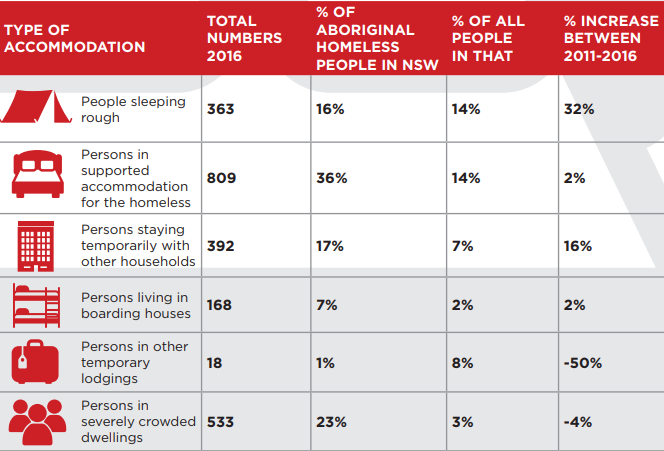
Included in the rising homelessness figures are persons living in boarding houses, persons in severely crowded dwellings and persons in temporary lodgings – all renters in some form. A large number of Aboriginal and Torres Strait Islander people reside in public housing under Family and Community Services, and the Aboriginal Housing Office, largely because they are unable to afford or be accepted in the private rental market. All told, 60% of Aboriginal and Torres Strait Islander people in NSW are renters.

Homelessness NSW

At the Tenants Union, working directly with the four Aboriginal Tenants Advice and Advocacy Services across NSW, we hear first-hand of the myriad of tenancy issues facing Aboriginal and Torres Strait Islander renters. There are continuous instances of illegal lockout, failures to repair, no grounds terminations, retaliatory evictions, domestic violence from co-tenants, and uninhabitable premises. These issues face tenants across the array of Aboriginal Housing in NSW, from public, to community, to private housing, Land Council houses, reserves, and Aboriginal Co-operatives. All contribute towards the increasing percentage of Aboriginal and Torres Strait Islander people experiencing homelessness.

Until these issues can be eradicated, and we can adopt a more just approach to land and housing for Aboriginal and Torres Strait Islander, and for all of us,the sad truth is that the rate of Aboriginal homelessness in NSW will continue to increase.

The Tenants Union is currently working on developing an Aboriginal Renting Policy, in consultation with Aboriginal tenants and Aboriginal organisations, to find out more about what the community feels are the most pressing issues in need of change in tenancy law and policy in NSW. This policy will form the platform for the TU to advocate for change for Aboriginal and Torres Strait Islander tenants in NSW.