Showing posts with label Homelessness. Show all posts

Thursday, September 13, 2018

The sad truth of Aboriginal homelessness in NSW

Today's post written by the Tenants' Union of NSW's Jessica Massa, Legal Officer - Aboriginal Support.

The most recent estimate of the Aboriginal and Torres Strait Islander resident population in Australia was 798,400 people - that’s just 3.3% of the total Australian population. Of this number, an estimated 216,176 are living in NSW, meaning that NSW is home to the highest number of people of Aboriginal and Torres Strait Islander origin.

Shockingly Aboriginal and Torres Strait Islander people could make up over 24% of those accessing specialist homelessness services in 2015–16, and 6% of the entire homeless population in NSW. These alarming and growing rates of Aboriginal and Torres Strait Islander homelessness need to be addressed. But first we must understand how we got here.

There are a myriad of issues and injustices that have contributed towards these figures. Aboriginal and Torres Strait Islander people face:
However it is hard to go past the historic and ongoing injustice associated with the way Australia has treated land and property since it acquired it under a false legal claim in 1770. It isn’t surprising that a people whose land was stolen are now largely excluded from the wealth generated by property ownership on which modern Australia relies so heavily.
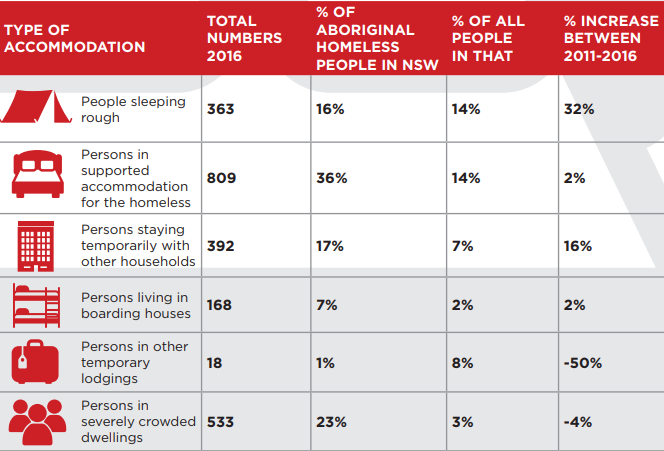
ABS Data

Included in the rising homelessness figures are persons living in boarding houses, persons in severely crowded dwellings and persons in temporary lodgings – all renters in some form. A large number of Aboriginal and Torres Strait Islander people reside in public housing under Family and Community Services, and the Aboriginal Housing Office, largely because they are unable to afford or be accepted in the private rental market. All told, 60% of Aboriginal and Torres Strait Islander people in NSW are renters.

Homelessness NSW

At the Tenants Union, working directly with the four Aboriginal Tenants Advice and Advocacy Services across NSW, we hear first-hand of the myriad of tenancy issues facing Aboriginal and Torres Strait Islander renters. There are continuous instances of illegal lockout, failures to repair, no grounds terminations, retaliatory evictions, domestic violence from co-tenants, and uninhabitable premises. These issues face tenants across the array of Aboriginal Housing in NSW, from public, to community, to private housing, Land Council houses, reserves, and Aboriginal Co-operatives. All contribute towards the increasing percentage of Aboriginal and Torres Strait Islander people experiencing homelessness.

Until these issues can be eradicated, and we can adopt a more just approach to land and housing for Aboriginal and Torres Strait Islander, and for all of us,the sad truth is that the rate of Aboriginal homelessness in NSW will continue to increase.

The Tenants Union is currently working on developing an Aboriginal Renting Policy, in consultation with Aboriginal tenants and Aboriginal organisations, to find out more about what the community feels are the most pressing issues in need of change in tenancy law and policy in NSW. This policy will form the platform for the TU to advocate for change for Aboriginal and Torres Strait Islander tenants in NSW.

Thursday, June 21, 2018

A longer lease on life: issues for older renters

With a surplus of $3.9 billion for 2016-17, the 2018 NSW State Budget had its winners and losers. The latter include seniors and renters. This blog examine some of the issues confronting older renters.

How does one define 'older person'. There is a helpful discussion of the definition of 'age' in the Australian Law Reform Commission's Discussion Paper on 'Elder Abuse'. Paragraphs [1.33] and [1.36] read:
The idea of someone being an ‘older’ person is a relative concept — chronologically, medically and culturally. It does not have a precise definition and specific ages may be used for particular purposes. For example, the Australian Bureau of Statistics (ABS) groups people into population age cohorts, and differentiates between ‘15 – 64’, ‘65 years and over’ and ‘85 years and over’. People over 65 are generally classified as ‘older’ for ABS purposes.
Family and Community Services’ NSW Ageing Strategy 2016-2020 (pp 26-28) identifies older people’s ability to live in affordable, accessible, adaptable and stable housing as a priority of the NSW Government. It asserts:
... older people increasingly prefer to ‘age in place’ and grow older in their own communities – close to friends, family and services.
The NSW Government does not have an explicit ‘ageing-in-place’ policy. Certainly, it would be worthwhile implementing an explicit policy and, further, establish benchmarks against which wider Government policies can be measured regarding consistency. The value of this will become obvious further into this blog.

Nevertheless, a number of significant documents commissioned as part of the NSW Ageing Strategy refer to it, where a basic principle underlying it being that older people know what is best for their own lives and have the right to make decisions on their own behalf. An ‘ageing-in-place’ friendly policy provides the incentives for individuals to remain living in a community to which they have a strong attachment, either in their existing residence or alternate accommodation, with service supports.

Dire circumstances

Alan Morris’s book entitled The Australian Dream: Housing Experiences of Older Australians draws on the stories of 125 Australian pensioners and compares their experiences with the trends and needs of an ageing Australia. He probes the growing divide between older private renters, those who live in social housing and pensioners living in their own home. Here's an excerpt about private renting:
It's like a pressure cooker. You don't know where to go or what to do.' ... 'It was so desperate, the search for affordable accommodation, that I went down with a heart thing and was rushed to hospital.
On 26 October 2016, quoting from Alan Morris's publication, Jennifer Duke says that at least 100,000 older Australians in the private rental sector are living in 'dire circumstances' ... and this figure is expected to grow substantially if current policies and approaches to housing affordability aren’t changed.

On 12 December 2016, Alan Morris penned an article for The Conversation entitled ‘Why secure and affordable housing is an increasing worry for age pensioners’. He writes:
An increasing proportion of older Australians on the age pension will be dependent on the private rental sector in coming decades ... and the prospects for this group are grim.
An increasing number of older women in the private rental market face homelessness and have been described as ‘the new face of poverty. Read an article called ‘Older renters: the new face of poverty’. It reads:
The evidence mounts. The number of older, single women in the private rental market increased by a massive 50 percent between the 2006 and 2011 ABS Censuses.

The private rental sector across Australia has grown in size and significance in the last 30 years. Between 2001 and 2010 about 1.7 million Australians dropped out of home ownership and shifted back to renting. More than one in three did not return by 2010.

Private rental now provides long term tenancy for a growing and diverse number of Australian households. If large numbers of long term renters aged 45-64 years remain in the rental sector, they could swell the number of long-term private renters aged 65 years and above quite substantially in the coming decades.

Many older women experiencing a housing crisis or homelessness have led conventional lives and never previously had a housing crisis. As private renters, especially in tight housing markets like Sydney and some regional centres, they are at great risk of unaffordable rents, insecure housing, eviction and homelessness.
Also, an excellent essay by Anwen Crawford picks up this same theme. She writes about 'Nowhere to go – older women and housing vulnerability’ and finds:
The number of older women who are rental tenants in Australia is growing, and these women ... are increasingly vulnerable to poverty and homelessness ... Housing affordability and security for rental tenants will only become a more pressing issue as Australia’s population continues to age. And with more people unable to afford to buy a home, changes to housing policy now will help to determine the living conditions of tenants in the future.
2016 Census

The 2016 Census found a significant increase in the number of people renting in New South Wales. Indeed, there was a slight shift away from home ownership towards renting. There were 826,922 renter households at the 2016 Census, which was 83,870 more than there were in 2011. To put this into context, that's almost double the increase we saw between 2006 and 2011. It also means our renting population has gone up in percentage terms since 2011, too - from 30.1% to 31.8% in 2016. It also means that more people are renting for longer. Read more here. On top of this, Australia’s population is ageing. Those aged 65 years and over now account for 16% of the total population, compared to 14% in 2011. The median age has increased to 38 years, after remaining at 37 years for the past decade. Read more here.

Following the release of the 2016 Census, there have been a number of reports highlighting the problems of life-long renters.

In March 2017, The New Daily examined the most recent population statistics. Australia is ageing and life expectancy is greater. The stats show that from 2012 to 2016, the proportion of the Australian population aged 65 and over increased from 14.14 to 15.27 per cent.

Kirsten Robb writes: 'Life-long renters face financial stress in retirement'... according to a paper by Swinburne University, which found more Australians are renting in retirement and facing financial stress. The report that she refers to is one by Andrea Sharam, Liss Ralston and Sharon Parkinson of Swinburne Institute for Social Research. They found:
The proportion of aged persons in Australia is set to increase significantly, posing many challenges. Amongst these is the growing number of households who lack housing security in retirement. ... Our findings indicate that social change, and adverse ‘critical life events’ have significant impacts on households by and at midlife, and beyond. Of particular concern is that the housing market itself is a key source of wealth accumulation and dispossession. A very marked outcome is that to be private renter at 45 years of age is likely to mean being a renter and highly impoverished, in retirement.
Teresa Somes of Macquarie University writes for The Conversation: 'More and more older Australians will be homeless unless we act now.'

Eileen Webb and Gill North write: 'Suitable, affordable housing is key to our population ageing well'.

Ben Phillips of the Australian National University writes for The Conversation:
... the more pressing social problem for Australia remains the lack of affordable rental housing for lower-income families that is close to jobs and services in our capital cities. ... An ageing population with potentially lower home ownership rates will add to this problem in future years.
And Ned Cutcher of Shelter NSW writes that more people are renting much later into life.

More recent media

You will find recent media coverage, reports and publications on older renters in this document.


What is the reality for older renters?

Various words have been used to described the plight of older renters: Overlooked, A distinct financial disadvantage, Condemned, Vulnerable and Financial stress … and that’s just for starters.

As discussed above, there are many issues confronting older renters. So here's my summary:
  • Weak security of tenure. True for all renters, but compounded if you are older ... check out Choice’s publication entitled ‘Unsettled’. Read about it and find a link here. Also, check out the ‘Make renting fair’ campaign. Indeed, Australia fairs poorly in an international comparison of security of tenure for renters.
  • Only token acknowledgement of ‘ageing in place’ ... The redevelopment of old public housing estates poses real hardships for many older tenants. The forced relocation of residents of Millers Point in inner Sydney highlights the failings of Government when only lip service is given to ‘ageing-in-place’. Read the blog in The Brown Couch here. In 2015 and 2017 the Tenants' Union of NSW made submissions to Elder Abuse Inquiries of both the NSW Legislative Council and the Australian Law Reform Commission (ALRC) here and here. We argued that a government policy, in itself, may constitute a form of elder abuse. We submitted that the NSW Government’s decision to relocate all the social housing tenants in the suburb of Millers Point is an example of systemic elder abuse.
  • Restricted access to home modifications ... private landlords have little incentive to modify properties to suit the needs of older tenants. Older renters are forced to move as dwellings are no longer appropriate to their needs and residential tenancy legislation fails to adequately address this. Here’s the current state of play.
  • Residential land lease communities (also called ‘residential parks’) as an alternative for older people ... Today business is viewing residential parks as money-making ventures, with some being promoted as an alternative to retirement villages. But, homes in residential parks, once seen as a cheaper option, now are regularly sold for amounts over $300,000. Indeed in 2016, two on the North Coast of NSW sold for over $1 million. Residents may own their home, but they do not own the land and remain vulnerable should the park be sold from under them.
  • Pets is an issue with particular meaning for older tenants. Check out this site. Recently, there has been increased media coverage of this issue in Australia. Read Wendy Squires’ article called 'Landlords, have a heart and let your tenants have a pet'. The Tenants Union of NSW wants to see the decision to keep pets to sit with the tenants rather than the owners.
What can we do?

For an excellent discussion on what to do in order to address the more dire needs of older renters, check out the 'Ageing on the Edge’ report released on 29 November 2017. It contains thirteen recommendations that the NSW Government can act on now. The Tenants’ Union of NSW is represented on the ‘Ageing at the Edge’ Working Group in NSW. You will find a summary of the report here and the full report here.

Postscript on 26 July 2018

Here's three new links which are food for thought ...

Allison Worrall writes: 'Choice of food or rent: Housing crisis deepens.' Read her article here.

Isabelle Lane writes: 'Older Australians are falling off the housing ladder and face spending their retirement as renters, with the situation expected to worsen for coming generations.' Read her article here. You may check out Grattan Retirement Incomes Model (GRIM) here.

AHURI provides an excellent analysis of the situation facing older low income tenants in the private rental sector. This link also points to some current research. Check it out here.

Wednesday, November 16, 2016

Cathy Come Home

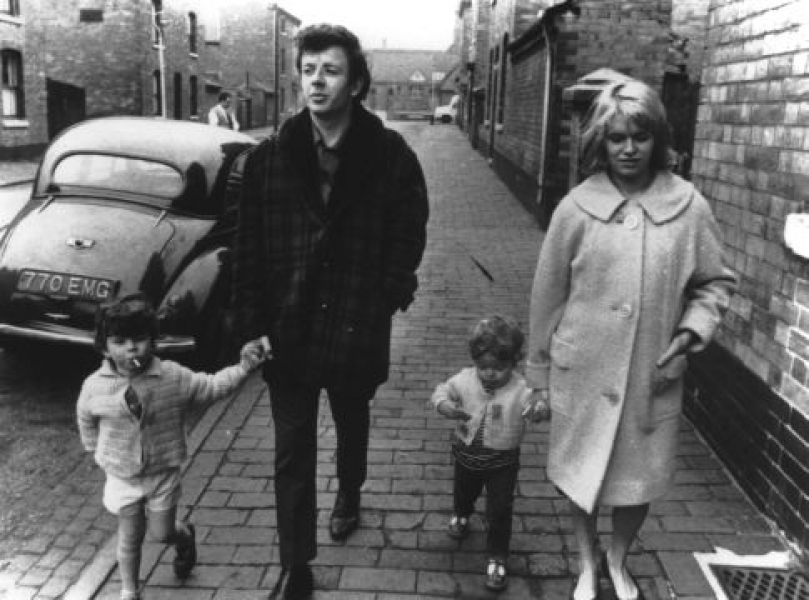
We're all only a few paycheques away from the street, and the Ken Loach directed Cathy Come Home illustrates the point powerfully. Today marks 50 years since it was first broadcast as the BBC's The Wednesday Play on 16th November, 1966 and Cathy Come Home makes a timely addition to the Institute of Tenancy Culture Studies.
Cathy, Reg and the kids
Although it was based in England of the 1960s, the issues resonate strongly here today. Families make up increasing numbers of tenants. Insecure tenancy laws and precarious employment situations mean more families than ever live with the fear and the risk of losing their homes in the private rental market. Housing policies which rely on a poorly regulated private rental sector to house vulnerable people can only exacerbate that vulnerability.

The chief lesson taught by Cathy Come Home appears to remain unlearned 50 years after the film's release. Perhaps it is that we have forgotten it is both unfair and ultimately ineffectual to expect the people surviving the effects of a society's structural failures to simply overcome. This is as true in housing and homelessness as it is in gender issues, employment, or our ongoing relationship with Aboriginal and Torres Strait Islanders. The original owner-occupiers of Australia are now mostly living in rented housing and, recalling the final scenes of Cathy Come Home, children are being removed from Aboriginal families at far higher rates than any others.

The full film is available here, and runs for a little over an hour:


Wednesday, June 22, 2016

NSW budget: homelessness funding

In the third of our blog series regarding tenancy and housing in the budget, we look at two more items concerning homelessness and housing unveiled by the Government for the financial year to come.


The larger of these announcements, from Premier Mike Baird, concerns a $40 million funding package aimed at preventing homelessness among young people. The Government will provide $10 million a year over four years toward 'housing, education, training and jobs support' to young adults leaving out-of-home care. The announcement notes that 60% of young people who enter homelessness services have been in out-of-home care.  

It is provided that specific initiatives to be funded include "more transitional housing properties linked to specialist homelessness or other support providers", and "expanding private rental subsidies and accommodation as well as mentor support to vulnerable young people enabling them to access education and training and transition to jobs and independent living"Though it is not stated explicitly in the announcement, this funding appears to be targeted at persons aged 19-24. 

This constitutes a major spending announcement, relatively speaking. The package is several times larger in terms of expenditure than the announcement covering support for Social Housing tenants - and a full 40 times the size of the veterans' rental subsidy discussed below. We certainly support efforts to provide housing, rent assistance, and related support to young people at risk of homelessness. This is particularly so for young people leaving out-of-home care: both Government statistics and the recent Registry Week report from homelessness peak Homelessness NSW suggest this group is overrepresented amongst our homeless population. 

But as the announcement is light on detail, we do have some questions. Most particularly, does providing 'more transitional housing' and 'expanding accommodation' equate to expanding the Social Housing portfolio? If so, how many new dwellings will be delivered? Who will manage them? Would they be provided in addition to other initiatives to deliver more housing under the 'Future Directions' plan for Social Housing? Alternatively, does the announcement suggest targeted allocation of existing properties to young people leaving out-of-home care? How would this impact upon others in need of Social Housing from outside this cohort? Finally, what does 'mentor support' entail?

The second announcement, from the desk of Family and Community Services Minister Brad Hazzard, provides for the creation of another new rental subsidy. Valued at $1 million over an unspecified period, it will assist homeless war veterans to access the private rental market. This appears part of a pledge in Future Directions to increase private rental subsidies. That forms part of a broader objective to deliver increased opportunity for vulnerable persons to avoid and exit the Social Housing system. 

As Homelessness NSW recently noted on the issue, there is evidence that around 8% of homeless people in inner Sydney identify as veterans. But whilst all these people require housing, around half also require intensive support - sometimes for the rest of their lives. So though targeted rental subsidies represent a good start, more holistic support is clearly needed for these most vulnerable members of the community. 

A Homelessness NSW statement addressing 2016-17 budget measures relating to homelessness welcomed an "improved commitment" from the Government - noting especially the increase in rental subsidies. But the organisation called on the State to commit further to addressing the causes as well as the symptoms of homelessness; "Again, the increased investment in mental health, drug and alcohol services, out of home care and domestic and family violence is welcomed but in the context of a healthy economy, higher employment and a forecast surplus of $3.7 billion the time is right to significantly address the causes of social disadvantage and homelessness at a comparable level to infrastructure investment."

Thursday, March 31, 2016

Stopping the homeless "churn"

Minister for Social Housing Brad Hazzard has today announced "the NSW Government is taking a tough stance on the “churn’’ of people from social housing to homelessness and is driving reform for an automatic rent deduction scheme from Centrelink payments." The scheme would see money handed directly from Centrelink to Social Housing landlords - which sounds remarkably like a form of income management - and could affect up to 90% of Social Housing tenants.

Driving the proposed reform is the Minister's concern for children. “I see too many children who have had their lives upended, their schooling disrupted and their health compromised by their family’s inability to pay rent and maintain a secure home,” Mr Hazzard said. “There are times when Governments have to make decisions for the common good and that is why we are driving this across-the-board reform.”

But there's not a lot of evidence to suggest that children are becoming homeless in great numbers because of rent arrears in Social Housing. The Australian Institute of Health and Welfare's latest report into Australia's Welfare (2015) makes no reference to rent arrears in its discussion about child homelessness, pointing instead to "sexual and physical abuse, parental drug addiction and family violence" as likely triggers.

Still, if this is a problem, there are other ways of responding to it. Working with households to get their rent under control springs to mind, rather than evicting them. Our observation is that Social Housing officers can be quick to take off to the Tribunal for an eviction order without first sitting down to talk through whatever difficulties a tenant may be having - or even just finding out what the hold-up might be with the rent. When you're the tenancy manager for some of the most vulnerable low-income households in the country, this would seem a reasonable place to start. It seems all the more important for struggling households that include children.

It's not the first time a reform agenda of this kind has been driven, either. Here's what we said when a similar scheme was flagged back in 2013:
It might sound like a good idea to the Housing Ministers, because it promises to reduce arrears. And lots of public housing tenants think it's a good idea too – so good, in fact, that they already do it, voluntarily, through Housing NSW's Rent Deduction Scheme. 
But there are people for whom this sort of scheme doesn't fit. For example, we've an acquaintance who lives in public housing who has a few health problems. When he gets paid, he doesn't use the money to pay his rent straight away: he uses it to pay one of his doctors. Then he goes to Medicare, gets paid by them, pays another doctor, goes back to Medicare and gets paid by them again. Then he pays his rent. 
This orderly process of payment and repayment would get stuffed right up if a Housing Payment Deduction Scheme got in and took the money first. 
There's bound to be other examples where individual circumstances make the compulsory deductions a bad fit. Maybe the operational policy for the scheme could be so devised to anticipate them all, and provide for housing officers to make adjustments in those circumstances... maybe. 
Or it might be more efficient and effective to let each person judge for themselves whether the scheme fits their circumstances and whether it suits them to use it. Lots of public housing tenants have already judged yes, it suits them – that's great. And that's probably as far as it should go. 

Saturday, March 5, 2016

Transgender Women and Homelessness

Originally published in our recent International Women's Day Tenant News special, this article was written by Amy Davis, a PhD candidate at University of Wollongong and a staff member at the TU. We post it today as a small contribution to Sydney's Mardi Gras festival.


Transgender and trans are umbrella terms applied to people whose sense of themselves as gendered people (gender identity) is in some way incongruent with the gender assigned to them at birth, where assigned gender is typically based on the medical perception of external genitalia. 
Some (but not all) trans people choose to socially and/or medically transition by changing their name to one that is more appropriate to their affirmed gender, wearing gender-affirming clothing, accessing hormone therapy or undergoing surgical reassignment procedures, among other things. This article specifically addresses the experiences of trans women, being people who were assigned male at birth and who identify as female.
It is difficult to estimate the rate of homelessness among young transgender people since homelessness statistics are not collected in relation to trans status. However, taking same-sex attracted youth and/or transgender youth together, in NSW it has been estimated that although only 7-11% of the population are same-sex attracted and/or transgender they constitute roughly 25% of the young people who are homeless.
Parental rejection and family violence based on gender identity have been cited as causes of homelessness for young trans people in Australia. Homeless can mean sleeping rough on the streets but it can also mean staying in supported accommodation, ‘couch surfing’, or living in accommodation that falls below minimum community standards such as boarding houses. 
Fundamentally, homelessness is about insecurity which can in turn have devastating effects on a person’s mental and physical health. Given that trans people are already four times more likely to have been diagnosed with depression than the general population, the compounding effects of homelessness on trans people can be dire.

Alyssa, 23, who identifies as a bisexual trans woman, has been no stranger to insecure housing and accommodation stress. Her family lived in multiple houses across Australia when she was young and never stayed in one house for more than a year.
However, as she began to medically and socially transition in her early twenties it put more pressure on her relationships with her family members and in turn her housing situation.
“My parents were also not great people to grow up under,” Alyssa says. “In my early twenties I was also briefly homeless and couch surfed for a while until I found my feet living independently.” As Alyssa’s relationship with her father broke down it became necessary for her to leave home. “I was homeless briefly due to moving out of my Dad’s house into my grandfather’s house but he passed away shortly after I moved, so I couch surfed after that point, rather than go back to living with my Dad.”
Alyssa now lives in share housing after spending a year living in transitional, supported accommodation provided by Twenty10, a non-profit organisation which works with young people of diverse genders, sexes and sexualities. She is now partway through a computer science degree at the University of New South Wales and works full time at a software company. While Alyssa’s accommodation situation has improved since leaving home she says that being homeless puts a lot of pressure on the mental health of young trans people.
While Alyssa reached out to support services it took her a long time to find stable accommodation. Research has consistently found trans youth regularly experience harassment, violence and transphobic abuse when accessing accommodation services, both on the part of the workers and other service users. On top of that, staff and residents at some women’s services reject trans women or refuse to acknowledge their affirmed gender. For many trans people this not only means that they do not feel comfortable disclosing their gender identity when accessing services, but that some prefer to sleep rough rather than access accommodation services.
Alyssa says, “I branched out to a number of different places, most of them had negative results (being at capacity already, or not being very willing to help me as I’m a big queer). I found temporary year-long housing with Twenty10 which helped me a ton.”
Alyssa expressed concern around the lack of accommodation services for trans women and other LGBTIQ (lesbian, gay, bisexual, transgender, intersex, queer) people.
“When I was homeless in my twenties I had a few queer youth help groups to reach out to, particularly The Gender Centre and Twenty10, but nothing else aside from that,” Alyssa says. “I think that at the moment there is a big deficit of safe housing in general for queer women, particularly for women without a steady income or on a Centrelink allowance. Having more houses that can house at-risk people can only be a good thing in my mind.“
Research suggests that between an estimated 5,000 and 6,250 LGBTIQ youth are homeless in Australia on any given night, a significant proportion of which would be in NSW. The LGBTIQ youth service package as part of the Going Home Staying Home reforms is funded to accommodate only 140 young people, meaning that LGBTIQ youth homelessness is significantly underfunded in NSW. Alyssa would love to see a place that provides a safe and supportive environment for people like her who have experienced transphobia. In the meantime, however, young trans women like Alyssa are struggling with limited support.

For more info and resources, check out twenty10.org.au and gendercentre.org.au

Friday, December 18, 2015

Homelessness and Renting in Sydney

This week two reports regarding homelessness, from opposite sides of the world - Sydney and England - were released. We explore today what lessons we can learn and use to inform the Residential Tenancies Act 2010 review.
The most striking aspect of the Sydney survey was that of the 516 homeless people surveyed in the inner city, 65% only needed some short term support and housing they could afford. This means that for many people, the solutions for their homelessness lie in resolving our housing affordability issues.
Meanwhile in the UK government figures were released showing that the biggest single trigger for homelessness across England was insecure private rental. Of the 15 000 households (including single people) across England that identified as homeless in Jul-Sept 2015, 31% had become homeless because an "assured shorthold tenancy" (the equivalent of a fixed-term agreement in NSW) had come to an end and the landlord evicted the tenant.
Whilst the Sydney study didn't ask those kinds of questions, it is not a stretch to consider that a significant number of people experiencing homelessness in NSW are in that position merely because they were not able to access stable, liveable and affordable housing.
One easy way to address the stability of our renting system is a change to the Residential Tenancies Act 2010 to remove the option to end tenancies without grounds, and instead provide an expanded list of grounds. This could include circumstances where the landlord requires the property for another legitimate purpose, or where the property is to be renovated such that vacant possession is required. The question should be: does the landlord’s purpose require the recovery of vacant possession, or could it be achieved without displacing a sitting tenant? Given the potential impact of eviction on tenants - as indicated in these surveys - this question should be taken seriously.
Another way of promoting stability in housing is to ensuring that rent increases take into account affordability concerns, as well as ensuring the increase is justifiable when considering the general cost of living and comparative value of dwellings. Our proposal to require the landlord to bear the obligation to prove an increase is reasonable if it is above the CPI increase will make sure these decisions are fair and reasonable.
To read more about the review and our proposals, check out our quick guide to the review!

Friday, September 18, 2015

Government's 'antisocial housing' bill amended and passed

The Residential Tenancies and Housing Legislation Amendment (Public Housing - Antisocial Behaviour) Bill 2015 has finally made it's way through the NSW Legislative Assembly. The debate was long, with many MPs speaking about their experience and understanding of antisocial behaviour within social housing communities before putting it to the vote. You can find what your local MP had to say by scrolling through the hansard documents - but be warned, this stretches out to about 80 pages of reading material.


Both the Government and the Opposition tabled some amendments to the legislation - the Government's amendments were agreed to as it passed through the Legislative Assembly; the Opposition will have to rely on the support of the Greens, the Shooters and Fishers, the Animal Justice Party and the Christian Democrats in the Legislative Council. We've had a quick look at the amendments and they're a bit of a mixed bag.

In a nutshell, the Government's amendments will: return discretion to the Tribunal on making termination orders, but only in a very narrow set of circumstances; give tenants a little bit longer to respond to or appeal a "strike notice"; and clarify that an anonymous "neighbourhood impact statement" may only be used to establish the impact of a tenant's breach on neighbours, not whether a breached has occurred.

The Opposition's amendments will: go further on returning discretion to the Tribunal in cases where it needs it to avoid unjust outcomes; give tenants a little bit longer still to respond to or appeal a "strike notice", and clarify that the timeframe for response or appeal is a minimum, not a maximum; allow tenants to make submissions about the details outlined in a strike notice in the Tribunal if circumstances warrant it; ensure tenants are entitled to see a copy of an anonymous "neighbourhood impact statement" if used in the Tribunal; and ensure that not all termination orders relating to social housing tenancies will require vacant possession to be returned within 28 days, but only those to which the bill relates.

We'll consider the amendments in more detail in a later post. Either way the final legislation will be changed in some form or another from its original form. That, of course, is a very good thing. But we're still not convinced this legislation is the right way to tackle antisocial behaviour in communities where social housing tenants live.


Tuesday, August 4, 2015

Making villains homeless with a 'one strike' eviction rule

Reports today suggest the NSW Government will contribute to Homelessness Prevention Week by introducing 'tough new laws to evict criminals and problem tenants'. Now, we haven't been given a copy of the bill, or properly consulted on its provisions - as is the common practice - so we can't comment on specifics. But we've been given some information about how it will attempt to meet the Government's objective, and we have some very serious concerns based on what we've been told.


The Daily Telegraph - those noble champions of justice and housing - have evidently been given a different brief. They've said:
Community Services Minister Brad Hazzard will introduce laws to the lower house today which allow the immediate eviction of rapists, paedophiles and violent thugs - and anyone convicted of committing a serious offence on public housing property.
Sounds like a pretty easy sell, right? Only the law already does all of that, and more.

A conviction is not required to evict a criminal tenant, and, as we understand it, this wont change. Tenancies can currently be brought to an end where premises are more likely to have been used for an illegal purpose than not - because to use the premise for an illegal purpose is, rightly, a breach of a residential tenancy agreement. Tenants who are accused of criminal conduct may lose their tenancy, and their housing assistance, based on a finding in the Tribunal, which arrives at its conclusions on the civil standard of proof. That standard is 'the balance of probabilities' - or more likely than not, on the evidence. That, of course, is easier to achieve, and requires a lower standard of probity, than a finding at the criminal standard of proof: 'beyond all reasonable doubt'.

So, if that's not going to change, what is? Here's what the Telegraph says:
Under the legislation to go into parliament, the NSW Civil and Administrative Tribunal (NCAT) will have a maximum of 28 days to terminate a tenancy where a person has committed serious illegal behaviour in a public housing property.
That's not quite how we understand it. What we've been told - and what has been reported about these changes in the past - is that NCAT will have its discretion to decline to make orders to terminate a tenancy, where warranted in the circumstances, removed in matters where there has been a breach of a residential tenancy agreement related to certain criminal offences. That means termination in such matters will be mandatory. It will also be immediate. The 28 days the Telegraph refers to is more likely the timeframe in which a tenant will be required to pack up their things and give the property back to the public housing landlord, after the Tribunal has made its mandatory termination order.

But the Tribunal's discretion not to terminate is important. It is a sensible check against the actions of a landlord, and its removal will lead to injustice. In particular, it will lead to severe outcomes for people caught up with the conduct of criminals through mere association - as was the case for Sarah Corrie who we have written about before. But it will also lead to severe outcomes for people who are caught up in petty offences that can, and should, be reasonably resolved through the criminal justice system.

Let's face it - the idea that NCAT would knowingly let a rapist, peadophile, violent thug, or anyone using their property to commit a serious offence remain at large in a tenancy, against the wishes of the landlord, and in the face of evidence that could sustain a criminal conviction, is simply absurd. And even if it would, such tenants might soon find themselves in prison, and their need for housing assistance would be properly deferred. That is, unless they have a family on the outside who still needs somewhere to live.

It is always the difficult cases that lead the Tribunal to even consider its discretion, let alone exercise it. It is not the clear cut case of a bad guy terrorising the neighbourhood and somehow avoiding capture each time the plain-clothes detectives set up another sting; but where someone in a vulnerable condition has done something regrettable, unretractable, and - according to established principles of justice - ultimately redeemable.

The recent case of Ms Jones (unreported) really demonstrates this. After considering four similar matters where it was asked to exercise its discretion, and declined to do so, the Tribunal did decline to terminate Ms Jones' tenancy. The following extract from the written reasons (paragraphs 12-17, used with Ms Jones' permission) explains part of the reasons why.

Trigger warning: the following extract contains information about domestic violence and sexual assault.
The respondent gave evidence and was extensively cross-examined. She also relied upon evidence from her Parole Officer, and support person. Her documents included expert reports from two psychologists, copies of counselling notes, and a number of character references, along with a copy of the Order of the District Court in relation to the criminal proceedings. The respondent was convicted of taking part in the supply of a commercial quantity of a prohibited drug, after a plea of guilty had been entered. She was placed on a two year good behaviour bond.
The tenant gave evidence of a life marked by sexual assault and domestic violence. She said she had first been sexually abused whilst babysitting when she was about 11. The abuse continued for about 3 years. When she was 16, her mother, who has a mental illness, threw her out. She went to live with a foster family. Her co-accused were members of that family. Since then, she had had a number of abusive partners. Most recently, in January 2013, she had been subject to a violent rape in her home. This left her feeling vulnerable and depressed. Whilst she had been drug free since moving to her current premises 7 years ago, she turned to prescription drugs (oxycontin) and marijuana to escape her trauma. Her son had moved out and was living with her mother, with whom she has had a strained and problematic relationship.
At the time of the offence, she had been battling cellulitis, was on crutches, and had been in and out of hospital. She had just returned from staying with her sister when she received a phone call from one of the co-accused, asking to visit. She said that she was relieved to have someone come to stay. When they arrived and asked whether they could bring some marijuana to dry out, she agreed, expecting them to bring a small amount.
The next day she awoke to find a very large quantity of drugs in the house. She said during the hearing that she asked them to take it away but they told her it was not possible. She took the line of least resistance and went to bed. The following day the police burst into the house and executed a search warrant. She and both her visitors were arrested.
Since that time she has again ceased to use illicit drugs. She said that she is very sorry for her actions, being the most stupid thing she has ever done. She realises now that her actions placed everything she had been working on in jeopardy.
The tenant's Parole Officer gave evidence that she was working to develop a plan to assist the tenant. This was put into place after sentencing in March 2015. The tenant has cooperated with everything that has been required of her so far. This has included involvement with a relapse prevention program, and counselling through both her GP and a psychologist. There is a possibility that she may be required to attend a domestic violence program. She can be subjected to home visits without notice, and drug testing if required. The Parole Officer gave evidence that homelessness would make it very much more difficult for the agency to manage the engagement, and for the tenant to comply. She said that evicting the tenant from stable housing would be like "pulling the rug out from under her." "Making her homeless would be creating a problem we are trying all the time to fix."
By exercising its discretion, and declining to terminate Ms Jones' tenancy, the Tribunal has allowed her to continue along a very important process of recovery. If the Tribunal's discretion is removed, as is proposed, the next Ms Jones to come before the Tribunal - and every last one after that - will, quite simply, be destroyed.

The Tenants' Union's briefing on the NSW Government's proposed reforms can be found here.

Monday, August 3, 2015

Stepping up to end homelessness - Tenants Advice and Advocacy Services

Welcome to Homelessness Prevention Week 2015. This year, Homelessness Australia asks "How will you step up to end homelessness in Australia?"

Stepping up to end homelessness sounds pretty daunting, but there are many ways to contribute to this cause. In fact, Homelessness Australia has already suggested a few:
  • raise community awareness and understanding of homelessness
  • increase community connection for those who are homeless, or at risk of homelessness
  • recognise the individuals and groups who help those experiencing, or at risk of, homelessness
  • increase community understanding and connections for those working in the homelessness sector
We like to think we're doing a little of these things each time we cross paths on the Brown Couch - whether we're talking about how our state and federal tax settings contribute to an unaffordable private rental market, banging on about the need to change renting laws for the better, or drawing attention to the good things our friends and colleagues in the community sector do.

Today we'd like to focus on the statewide network of Tenants' Advice and Advocacy Services. We've know we talk about them a lot, but they're important, and it's worth revisiting some of those discussions. In June 2013 we wrote about their quest to save once million tenancies, where we talked about the volume of the work they do, its sometimes adversarial nature (good if you're a tenant who needs help!), and the fact that a large part of their work is driven by landlords trying to end tenancies.
The most common [Tribunal] applications were in fact made by landlords - overwhelmingly, for the termination of a tenancy. In the Tenancy Division, there were 19,373 of these. In the Social Housing Division, there were 9,536. That's a total of 28,909 - almost as many contacts as TAASs had over the year!
And in another discussion we put some numbers on how Tenants' Advice and Advocacy Services prevent homelessness.
To investigate the TAASs' role in preventing homelessness, a six-month project was undertaken by 15 TAAP direct services. The data they recorded highlights the positive impact of support provided to clients whose tenancies were vulnerable.
During the course of the project, 516 tenancies at risk of termination were identified. As a result of the advice and advocacy provided by skilled TAAS workers, homelessness was averted in 424 cases (82.2 per cent).
It's great work, and it should be celebrated.

But it's also getting harder for the Tenants' Advice and Advocacy Services to do this work, because they have not seen a real increase in funding since 2002. Since then, the number of households living in rented accommodation has gone up by 25% in New South Wales. And because these services are funded by the interest on tenants' bonds, there is more than enough money available to invest more in these services.

So... one way you can step up to end homelessness is by stepping up to support Tenants' Advice and Advocacy Services. And you can do that by joining the campaign to get More Bang for Your Bond.

Visit the campaign on Facebook and Twitter, check out the website, and sign the online petition. Grab some of the More Bang for Your Bond postcards* and help build support!

*Let us know where you are and we'll send you as many as you'd like.

Friday, June 5, 2015

The rule of law

There's been a lot of focus on federal politics in the media over the last week. Some of it has been about housing affordability, which has mysteriously found its way into the national political discourse. But there's also been a bit of talk about the "rule of law".


It's the rule of law that has inspired today's discussion. What may or may not have been said about the Australian Government's ability to make a person stateless gives rise to a similar conversation about how a person may be made homeless. The link between statelessness and homelessness is not an entirely tenuous one - both concepts feature, in some way, in international human rights covenants that Australia has signed up to.

During the week, concerns have been raised about whether it should be a Government Minister, or a competent court of law, who can decide to strip a person of their Australian citizenship. It has been suggested that it's sometimes a little tricky to get hold of the evidence one might need to achieve this outcome in court, so it would be better to leave it to the Minister to make an "administrative decision". Others have said "no - that is precisely what courts are for". Their argument is that if you haven't got enough evidence to convince a court then you shouldn't have enough evidence to convince a Minister.

What happens if we apply the same kinds of argument to housing?

First, we need to acknowledge that a person renting in the private rental market can be stripped of their tenancy with little more than an administrative decision - that is, a landlord can decide to end the tenancy without a reason. But that's a different kind of administrative decision than the sort a government Minister might make, because it is not subject to judicial review. Such a decision used to be subject to review, in a way. Under the Residential Tenancies Act 1987 the tribunal had discretion not to end a tenancy if that was appropriate in the circumstances of the case. But when the Act was reviewed and rewritten in 2010, the discretion was removed. Sometimes the rule of law just doesn't go your way.

But things get a little more complicated when the landlord is the government. Tenants in public housing are subject to all kinds of administrative decisions made by workers in the department of Family and Community Services. Many of these decisions have a direct impact on a person's housing - whether they will be housed; whether they can move to another house; whether their rent will be reviewed; whether their housing assistance will be taken away from them. And where these decisions are subject to review it is by the internal processes of the department of Family and Community Services and a Ministerial committee, not by the courts.

Thankfully for tenants in public housing, when Family and Community Services decides to end a person's housing assistance - usually making them homeless - there is a final check on that decision: they issue a notice to terminate the person's tenancy, citing the grounds upon which they say it should end. If the tenant disagrees with those grounds, or has anything to say in response, the matter may go before a tribunal. The tribunal considers the evidence from each side, then determines whether or not the decision should stand.

This is the rule of law in action. But the process may be under threat.

We know that the Government is considering a range of reforms to tackle what they've referred to as 'anti-social behaviour' in public housing. We know that this could include a probationary period for long term tenancies. We don't know that probationary tenancies will not end arbitrarily, by issue of a termination notice without a reason; without regard to the tribunal, or an independent review of all the available evidence.

The rule of law has a long history. It can be traced back to the Magna Carta, the foundational document that established that English kings are not above the law. Parts of the world will celebrate the 800th anniversary of the Magna Carta in just over a week - on June 19th 2015.

For what it's worth, and in so many respects: let's hope our own celebrations are not marred by a diminished rule of law.

Wednesday, October 15, 2014

Storm damage

We hope you got through the storm in one piece.

 
If you need it, you can find our storm damage factsheet here, and your local TAAS can give you further information and advice.

A thought for Anti-Poverty Week: a colleague at Homelessness NSW estimates that about 300 people would have been out in the storm last night, 'sleeping rough'.

Friday, June 6, 2014

Support women's services

Two good causes for women need your support.


For nearly 40 years a network of women-only refuges in inner Sydney has given life-changing shelter and support to women and their children. Under proposed changes to the funding of homelessness services, most of these services will close. They want the NSW State Government to think again. Follow the link above to read more about the campaign.

And for six years the Women in Prison Advocacy Network has given life-changing support to women who have left prison, or who are just about to leave, and who need help transitioning to life outside (help like finding a place to live, after Housing NSW has gotten you to relinquish your social housing tenancy so that homelessness awaits).

Earlier this year, the Federal Government cut WIPAN's National Crime Prevention funding, so it needs your help to keep going. Read WIPAN's campaign brochure here.   

Thursday, October 31, 2013

A slow-burning crisis

When a Blue Mountains landlord allegedly told his agent last week to increase the rent because ‘there will be a lot of people who’ve lost their homes looking for temporary accommodation', Premier Barry O'Farrell stepped forward and slammed the 'bastard'.


Said the Premier:

“This sort of low act will not be tolerated and I warn people even thinking about it that the NSW Government [will] come after you.
“Anyone seeking to cash in on this crisis is a heartless grub. Just don’t do it.
“Not only will they named and shamed, they’ll face a fine of up to $220,000 or $1.1 million for corporations.
“We will have no hesitation in going after these people and I know Minister for Fair Trading Anthony Roberts has ordered his inspectors to be on the ground in the bush fire zones on the lookout for this behaviour.
“Whether you’re a landlord, tradesman, or retailer – don’t try it on because it won’t be worth it.

It appears to us that the Premier and the Fair Minister are contemplating the use of the Australian Consumer Law's 'unconscionable conduct' provisions. We're not aware of any previous instances of these provisions being used against landlords exploiting a crisis like the recent bushfires, and we applaud the NSW State Government for taking this line of response. We've no doubt that most other persons in the community would support it too.

The bushfires are a particular kind of crisis. As a housing crisis, the fires have removed two hundred dwellings from the stock of housing, but there's more to it than just that. They've instantly turned settled lives upside down. They were genuinely, physically frightening. For those of us not in the midst of the fires, they were still an inescapable presence: you couldn't look out of window, or take a breath outside, without of thinking of what was happening in the mountains, or in the fires up and down the coast. The fires also drew a magnificent, courageous effort from hundreds of professional and volunteer firefighters, and a generous response from the wider community too.

For many years, we've been talking about another crisis relating to the supply of housing – the critical lack of rental housing affordable for people on low incomes. This is a different kind of crisis – a slow-burning crisis, so to speak – that has not sprung up in an instant, and is not so insistently noticeable to those outside it. But for those who are caught in it, it wrecks lives.

Some numbers, from the Rental Bond Board. In 2006, across New South Wales 131 929 private tenancies commenced at rents that were affordable to low-income households (ie the rent was not more than 30 per cent of the 40th percentile household income); in 2010, just 82 220 affordable tenancies commenced – almost 50 000 (or 38 per cent) fewer affordable tenancies than four years previously.

Across Sydney,  there were 36 472 (51 per cent) fewer affordable tenancies commenced in 2010 compared with 2006.

In the Blue Mountains, 775 (42 per cent) fewer affordable tenancies were commenced.  

This loss of affordable rental opportunities is a big part of the reason why 65 per cent of low-income renters in New South Wales are in housing stress (ie paying more than 30 per cent of their incomes in rent) and 28 per cent are in housing crisis (ie paying more than 50 per cent). To pay these rents, many skip meals, or go without medical or dental care, or things like school excursions for their children.

Then there are the families who don't get into even unaffordable rental housing. For the human face of this aspect of the loss of affordable rental opportunities, watch this documentary, shot in the Blue Mountains for the ABC's Four Corners program in 2009. 'Last Chance Motel' records the ceaseless stress of lives spent shuttling between real estate agencies, Housing NSW offices, and temporary motel rooms. It is tough viewing – but it absolutely deserves your time.

We've discussed the causes of this problem previously: speculation in housing, encouraged by tax breaks for capital gains and negative gearing, has distorted the rental market, as landlords have brought high-value/high-rent stock into the rental sector, and allowed low-value/low-rent stock to drop out of it. Such low-rent stock as has remained in rental has become scarcer, and landlords are charging more for it.

We're not saying that governments should whack these landlords with unconscionable conduct prosecutions too. Rather, the challenge is to apply some of the emotional response we've all felt to the crisis of the bushfires – the concern and compassion, and some of the righteous anger too – to tackling our slow-burning housing affordability crisis, before it does very much more damage. 

Tuesday, June 11, 2013

Queensland TAASs and the State/Federal rollercoaster

More news just in from Queensland: the Federal Government will fund Tenants' Advice and Advocacy Services north of the Tweed for a further six months.


Perhaps we should back-track a little. You will recall that, only three short weeks ago, the Federal Government offered Queensland TAASs a "life-raft" - $2.5 million for the Queensland Government to keep TAASs going for another six months, on the condition that the State would ensure these services continue into the future.

Queensland rejected the offer, declaring that they would not formulate policy around what money they get from the Federal Government.

Today the Federal Government has announced it will give that $2.5 million straight to the Tenants' Union of Queensland, so that they can administer Tenants' Advice and Advocacy Services for a further six months.

This is great news, and we congratulate the tenants of Queensland for taking such a strong stand in support of their services.

But without a commitment from the Queensland Government - a commitment that they seem determined not to give - Queensland TAASs are still in limbo. All the more so, as the federal election looms.

This commitment from the Federal Government will carry Queensland tenants through the looming electoral storm. What happens next is anybody's guess.

In the meantime, some Queensland TAASs are closing their doors for the last time, as their highly skilled, experienced and committed staff must make tough decisions in the face of an uncertain future.

Follow Save Tenants Services for regular updates on the continuing struggle for funded Tenants Advice and Advocacy in Queensland.

Thursday, May 23, 2013

Federal 'life raft' for Queensland TAASs

Newsflash from Queensland: the Federal Government has today launched a 'life raft' for the Queensland Tenants Advice and Advocacy Services defunded by the Queensland State Government.


Federal Treasurer Wayne Swan and Housing and Homelessness Minister Mark Butler have put $2.5 million on the table to keep the services going for another six months – provided the Queensland State Government makes longer term arrangements to keep the services going.

With the offer of funding also comes a warning. Minister Butler told the media:

'I’ve also made it clear to the Newman Government though that we reserve the right – if they don’t do this – not only to withhold the $2.5 million, but to review other arrangements we have with the Newman Government in the housing area, to ensure that really they look at this again with some common sense'

More from the Treasurer:

'These services are recognised as a core state and territory responsibility — every other jurisdiction in Australia funds tenant advice and advocacy services — and last month all states and territories agreed in principle to continue providing these services.'

And Minister Butler:

'The most effective way to reduce homelessness is to prevent people becoming homeless in the first place and services such as QTAAS help to do exactly that.'

We couldn't put it better ourselves. Bravo to the Federal Government, and to all the Queensland tenants who have spoken up for their TAASs – now it's over to the Queensland State Government.

Monday, May 13, 2013

Down and out in Queensland

Last time we mentioned Queensland, it was good news: after the State Government cut the funding of the Queensland Tenants Advice and Advocacy Services, the Federal Government stepped in with emergency funding through to June this year, and a statement that it would 'ensure that Tenancy Advice and Advocacy Services funding is a condition of any future Commonwealth/State agreements'.

Now it's almost June... and the Queensland State Government is still refusing to fund the services.


There's a Commonwealth/State agreement currently being renegotiated: the National Partnership Agreement on Homelessness. The agreement states that one of the 'core outputs' to be delivered by States and Territories is:


tenancy support for private and public tenants, including advocacy, financial counselling and referral services to help people sustain their tenancies. [Emphasis added]


It is difficult to see how much more plainly the necessity of services like the Queensland TAASs needs to be spelt out.

We expect it will be spelt out soon enough – in mounting tenancies disputes, and in mounting numbers of persons evicted from their homes.

Meanwhile, the Queensland State Government is reviewing that State's Residential Tenancies and Rooming Accommodation Act 2008. To pick out just one of the numerous changes it is considering: in proceedings for the termination of a social housing tenancy, the Tribunal might be expressly prevented from considering whether the termination will result in the tenant becoming homeless.

One wonders what the Queensland State Government thinks it's doing as a party to a National Partnership Agreement on Homelessness at all. 

You can support the Queensland TAASs by signing the petition here, and keep up to date with their struggle here.

Wednesday, April 17, 2013

How TAASs prevent homelessness

We've been talking for a while about the value of Tenants Advice and Advocacy Services. TU Executive Officer, Julie Foreman, reports on their value particularly in preventing homelessness.


New South Wales has the highest rate of low-income households who are in rental stress. Households in this situation are at risk of becoming homeless.

Workers in Tenants Advice and Advocacy Services (TAASs) play an effective role in homelessness prevention by consistent, successful negotiation to save vulnerable tenants from homelessness.

The National Partnership Agreement on Homelessness to which the New South Wales Government is a signatory, has four core outputs, one of which is:
Tenancy support for private and public tenants, including advocacy, financial counselling and referral services to help people sustain their tenancies.
TAASs play a unique role in ensuring that this State meets its obligations under the Agreement.  The Tenants Advice and Advocacy Program is the only program which offers specialised advocacy for New South Wales tenants.  TAASs' work on behalf of tenants who need the support of an advocate to retain and maintain a roof over their head is both cost and outcome effective.

Highly skilled, dedicated TAAS workers provide advice, advocate on behalf of tenants to a range of parties, and make referrals to other services to ensure their support forms part of a holistic approach to tenants’ health, financial and life skills challenges.

The TAASs' six-month project demonstrating effectiveness in preventing homelessness
To investigate the TAASs' role in preventing homelessness, a six-month project was undertaken from July-December 2012 by 15 TAAP direct services.  The data they recorded highlights the positive impact of support provided to clients whose tenancies were vulnerable.

During the course of the project, 516 tenancies at risk of termination were identified. As a result of the advice and advocacy provided by skilled TAAS workers, homelessness was averted in 424 cases (82.2 per cent).

Only tenants at risk of losing their homes were included in the study, that is:
•    a termination threat existed;
•    a tenant had received a notice of termination;
•    a CTTT termination hearing had been listed; or
•    a termination order had already been made.

The tenants were not only vulnerable in terms of losing their homes but they were also challenged by a number of cultural, age and disability related vulnerabilities. 

The data is summarised in the tables below.  All outcomes and results relate to tenancies, which were identified as vulnerable.


It is clear that TAASs not only play an important consumer protection role in providing information and advice to all tenants: they have a significant role in preventing homelessness. 

(This is a revised version of a report appearing in 'Around the House', the newsletter of Shelter NSW.)