Showing posts with label #VoteHome. Show all posts

Tuesday, July 19, 2016

And the new Minister for Housing is...

It's taken awhile for the dust to settle, but after the coalition's re-election to government our Prime Minister has now announced his new federal Cabinet. And the new Minister for Housing is....

Well, this is awkward. It turns out there isn't one. Again.

Instead we'll have to settle for a Minister for Social Services who'll continue to carry responsibility for housing related welfare policies, delivered through our social housing systems and homelessness services. We expect this will include, at some point, the introduction of a compulsory rent deduction scheme for social housing tenancies, which will replace the current voluntary scheme.

So, congratulations to the Member for Pearce, the Hon. Christian Porter, who will continue as Minister for Social Services.
The Hon. Christian Porter MP, Minister for Social Services
Congratulations also to ACT Senator Zed Seselja, who will take on duties as the Assistant Minister for Social Services.
Senator Zeb Seselja, Assistant Minister for Social Services
But, alas, there's still no Minister for Housing. Given that social housing tenancies make up about 5% or less of Australia's total housing "consumption", and that the high cost of housing in the private market is the biggest contributing factor to Australia's chronic conditions of housing stress and homelessness, we're always on the lookout for a Ministerial portfolio that will steer the nation towards an overall housing strategy to improve affordability. Our custom is to consider the Prime Minister and Treasurer as our de facto Ministers for Housing, so congratulations to the Members for Wentworth and Cook, the Hon. Malcolm Turnbull and the Hon. Scott Morrison, respectively.

You might recall the coalition's flagship policy this election was all about investment in small business owners. You might also recall the Brown Couch is full of admiration for those who have weighed up  the value of their borrowing power, realised that unaffordable home-ownership is not the be-all-and-end-all of existence, and decided to fund the development of a big idea into a business that actually produces something new and valuable instead. Of course, one of the best things that could happen for small business owners across Australia is for their housing to become affordable, and their tenancies to become stable and secure.

With this in mind, we'd like to offer our congratulations to the new Minister for Small Business, Member for Riverina the Hon Michael McCormack, too.
The Hon Michael McCormack MP, Minister for Small Business
Congratulations, Ministers. We look forward to working with you.

Friday, June 24, 2016

Will rents rise if Australia votes for tax reform?

We've heard that some people - let's call them real estate agents and a couple of prominent politicians - have been saying rents will rise if Australia votes for tax reform. We thought we'd better check this out.


We've already looked at how negative gearing and capital gains tax discounts distort the rental market at a macro level - you can read about that here - so it's hard to know exactly what these soothsaying ne'er-do-wells are getting at. Affordable rental housing couldn't really disappear from the market any faster than it already does. And if the current reform proposal does get up, existing arrangements will not be affected, so current landlords would not be able to use the old "suddenly I am paying more tax, and I must pass this unexpected cost on to my tenant" excuse.

Still, we can't shake this feeling that, should it come to pass, landlords could try to use a new tax regime as a screen for putting up the rent. Real estate agents' bottom lines would benefit from higher rents, and because they favour the status quo they have nothing to lose from cultivating an expectation that change means rents will increase...

One of the first claims you'll hear a real estate agent fall back on is that rents took off after Paul Keating made some adjustments to negative gearing back in 1985. If it happened then, they say, it will happen again. Never mind that the claim has been contested and discredited time and time again - see, for example, this 2003 article from Ross Gittins, which discusses rents rising in Sydney and Perth in the late 1980's, but not in other parts of the country; or this more recent piece from the ABC's Fact Checker, which reaches a similar conclusion before quoting a 1987 Cabinet Submission:
With the notable exception of Sydney, conditions in the residential rental property market are not unusually tight. The evidence suggests that local influences, rather than tax measures, dominate in metropolitan rental markets.
The Fact Checker article goes on to examine some of the "other influences" that could have been contributing factors. It cites high interest rates as well as high prospective capital gains in other investment classes, making residential property a less attractive option. But one of the influences that hasn't been mentioned is the impact on rents of residential tenancies legislation at the time.

Keen followers of renting law reform will know that tenancy agreements in New South Wales were not regulated by the Residential Tenancies Act 1987 until it commenced in 1989. This means that back in 1985, putting the rent up in Sydney was much easier than it is today. Landlords would simply offer a rent increase, and if the tenant didn't accept it they'd usually get a notice to quit and have to move out. But some other states - notably Queensland, Victoria and South Australia - had brought in new renting laws somewhat earlier. Which means that rent increases were better regulated in other parts of the country while Keating was tinkering with tax, and Sydney rents were doing their thing...

Of course, renting laws still vary from state to state, and tenants in some states may again be better equipped to handle wholesale rent increases than in others. Even so, to the extent that rents are now regulated, they are still very much tied to "the market". Landlords set the rent based on what tenants are prepared to pay, and if a tenant challenges an excessive rent increase it is generally decided by a tribunal with market comparisons in mind. But the important thing is that such a challenge is possible, and tenants should not hesitate to exercise this right if the need arises. This right was not available in Sydney in the mid-1980's.

Landlords who claim they will set rents according to tax policy, rather than market factors, should have cause for caution. Rents continue to reflect a fine balance between vacancy rates and tenants' incomes, and landlords cannot move the market by sheer force of will. Thankfully, those bad old days are over.

Nevertheless, we expect there will still be some landlords, real estate agents and politicians who continue to insist that tax reform will result in rent increases. Here are a couple of useful points to keep handy, just in case you ever find yourself in conversation with one:

Rents are not tied to other costs
Rents increase faster than the general cost of living. We'd have thought this was common knowledge, but SQM Research's recent report suggests perhaps it is not - they've suggested Labor's tax reform proposal could lead to "an acceleration in rents above and beyond the CPI rate". But here's what rents already look like against CPI, over the last quarter of a century:

Rents v CPI, from the TU's Rent Tracker (coming soon!)
There's been plenty of "above CPI acceleration" in there, even without tax reform.

We also know from tax data that rents increase faster than landlords' costs. We explored this in our report 5 years of the Residential Tenancies Act:
... landlords collect significant amounts of income from their tenants each year. In the 2009-10 financial year landlords declared $9.7billion in rental income for properties in New South Wales. This increased to $12.1billion in 2012-13. An increase is to be expected given the growth of the sector, but even so this represents approximately $2,175.00 more rent to landlords in 2012-13, per property, than in 2009-10. The average costs declared by landlords over the same period rose by $880.00 per property.
So we can conclude - rents go up because they can, not because they need to, and certainly not in response to any particular cost factors for landlords.

There's no room in the market for higher rents
Rents go up because they can, unless for some reason they can't. At some point, rents become unaffordable, and tenants cannot continue to pay them. When this happens, tenants are forced to find homes in a more affordable area, or they're forced to share a home with others. In their 2013 report Long term private rental in a changing Australian private rental sector, Stone, Burke, Hulse and Ralston found that families with children now make up the largest group across Australian private rental markets. These households may not be inclined to share, which means landlords need to keep rents within their reach so as not to price them out.

None the less, the report also shows that the fastest growing group is shared households. Tenants are increasingly responding to high rents by pooling their resources and living together. Further research suggests that share housing is not the domain of young people alone, with a marked increase in the number of people over 40 recently using the share house finding website flatmates.com.au...

Meanwhile, the Rental Affordability Index continues to reflect the grim reality of high rents across the country. The RAI reveals that under current conditions, low-income households typically need to pay 50 to 85 per cent of their income on rent. And as we showed in another recent post about rents, even a modest - and much needed - increase to Commonwealth Rent Assistance couldn't open the gate for higher rents.

If tax reform happens and the rent goes up, who's going to pay it?

Landlords really, really need the rent, and so do their banks
Even though rents are no reflection of costs, it's really quite expensive to be a landlord. As we discussed in our Tenants' Guide to Tax Reform, their biggest expense comes from the purchase of a property in the first place. According to tax data, the interest payable on loans amounts to more than all other expenses combined, even with record low interest rates:

Landlords' expenses ($billions) Source: ATO
That's not surprising when you consider that banks have been lending, on average, more than $550million to Australian landlords each month for the last year.

If landlords were to increase the rent beyond what the market could bear, or even beyond what the market can anticipate, many would start to experience periods of vacancy. Even a short-term loss of rental income could have serious consequences for landlords - at best it would affect cash-flow arrangements and compromise their ability to meet a mortgage commitment without making other sacrifices; at worst it would lead to mortgagees calling in bad debts.

So, all things considered, if you come across a landlord, real estate agent or politician who insists tax reform would lead to higher rents, we reckon you should call their bluff.


Monday, June 20, 2016

State Budget 2016: extra duties for foreign purchasers

The NSW Government will hand down its 2016-17 State Budget on June 21. That's... tomorrow!

But announcements on new spending and policy are already finding their way out of Macquarie Street. One matter of some interest to tenants - and more than a few landlords, we bet - concerns changes to stamp duty payable by foreign purchasers.

Investors not ordinarily residing in Australia will be obligated to pay an additional 4% surcharge on the purchase of residential real estate. This is considerable. As The Sydney Morning Herald noted, the duty payable on a home purchased for the median Sydney house price of $995,804 would all but double from $40,305 to $80,137. It is expected to raise an extra $1 billion over four years.

The official rationale is that the surcharge serves the broader community interest by raising funds for public amenities. Or, as Victoria, which recently implemented its own surcharge, puts it: as capital growth in residential property is largely attributable to an area's quality of life, foreign purchasers (who are unlikely to pay much if any tax to Australia on income, consumption, and so on) should make a fair contribution to the public spending that delivers that quality. 

But from a tenant's point of view, the move is less interesting for the official line as what else it might say about our housing market. Office of State Revenue figures show that the NSW Government has been riding high on stamp duty revenue for the last several years - from collecting $3.3 billion in 2011/12 to well over $7 billion in 2015/16. But, of course, this is inexorably linked to sharp growth in sales prices, in Sydney especially. And the latest Rent and Sales Report suggests prices flattening or slightly declining in a number of LGAs across Greater Sydney. Many well-placed commentators are warning of more of the same - including the Reserve Bank, OECD, property analysts CoreLogic, and ratings agency S&P from last week alone. 

Shadow NSW Treasurer Ryan Park said of the surcharge, "We're very concerned that this is a very short-term move based on the fact that the Government knows that the [property] market is cooling, based on the fact that we're all the more reliant on stamp duty."  And tenants may have reason to share that concern. Because a reliance on sharp and perpetual growth in property sales to fund spending is a reliance on housing speculation. That is, the same speculation that has sparked price growth to lock tenants who would be homeowners out of the purchase market - in many cases for good. As we explained in one of our favourite posts on the Brown Couch, those frustrated homeowners are not the only tenants missing out. They also tend to be more competitive in the rental market in which they are forced to remain than those on lower incomes - forcing up rents across the board. 

Of course, restraining this speculative frenzy is not a matter for State Government alone. It's also a major Federal Election issue, and part of the focus of the excellent Vote Home campaign. But you can be sure tenants would benefit much more from efforts to create a more equitable and accessible housing market than from an extra $1 billion skimmed from foreign participants in our speculative housing market.

On the other hand, some developers have declared that the surcharge will actually have the unintended consequence of driving house prices down. There's precious little evidence to support the position.

There's one more thing to consider: we've also heard our share of stories about foreign purchasers buying properties off the plan, only to leave them empty. The alleged practice would allow the dwelling to be sold as new, negating any need for the purchaser to spend on maintenance or property management. It also restrains rental supply - thereby helping to drive up rents even as new homes are delivered to market. There's nothing definite to establish just how widespread the practice might be, but the UNSW City Futures Research Centre has raised concerns about what it says are up to 90,000 unoccupied dwellings throughout Sydney. A surcharge on stamp duty could function as a disincentive against the practice; As most purchasers will be required to pay tens of thousands of dollars more, they could be driven to take the extra steps required to attain a rental income to help cover it.

Thursday, June 16, 2016

The rent (assistance) is too damn low

Sydney, we have a real problem.

The rent in Sydney is so high now that even historic pockets of affordability are way out of reach for people doing it tough. We might have been able to rely on public or social housing if supply had kept pace with the growing population, but it didn't.

That shortfall has combined with pressure from moderate income households - also desperately trying to keep their budgets in check - and landlords taking full advantage to meet their exorbitant interest costs, to squeeze this city dry of affordable rental housing. The most graphic way of seeing the impacts for the last few years has been Anglicare's Rental Affordability Snapshot. Now we have a second way of showing the problem in the form of National Shelter's Rental Affordability Index. Sydney is a sea of red and orange, showing the lack of affordable options.
Sydney's rental housing. The redder it gets, the cheaper it ain't.
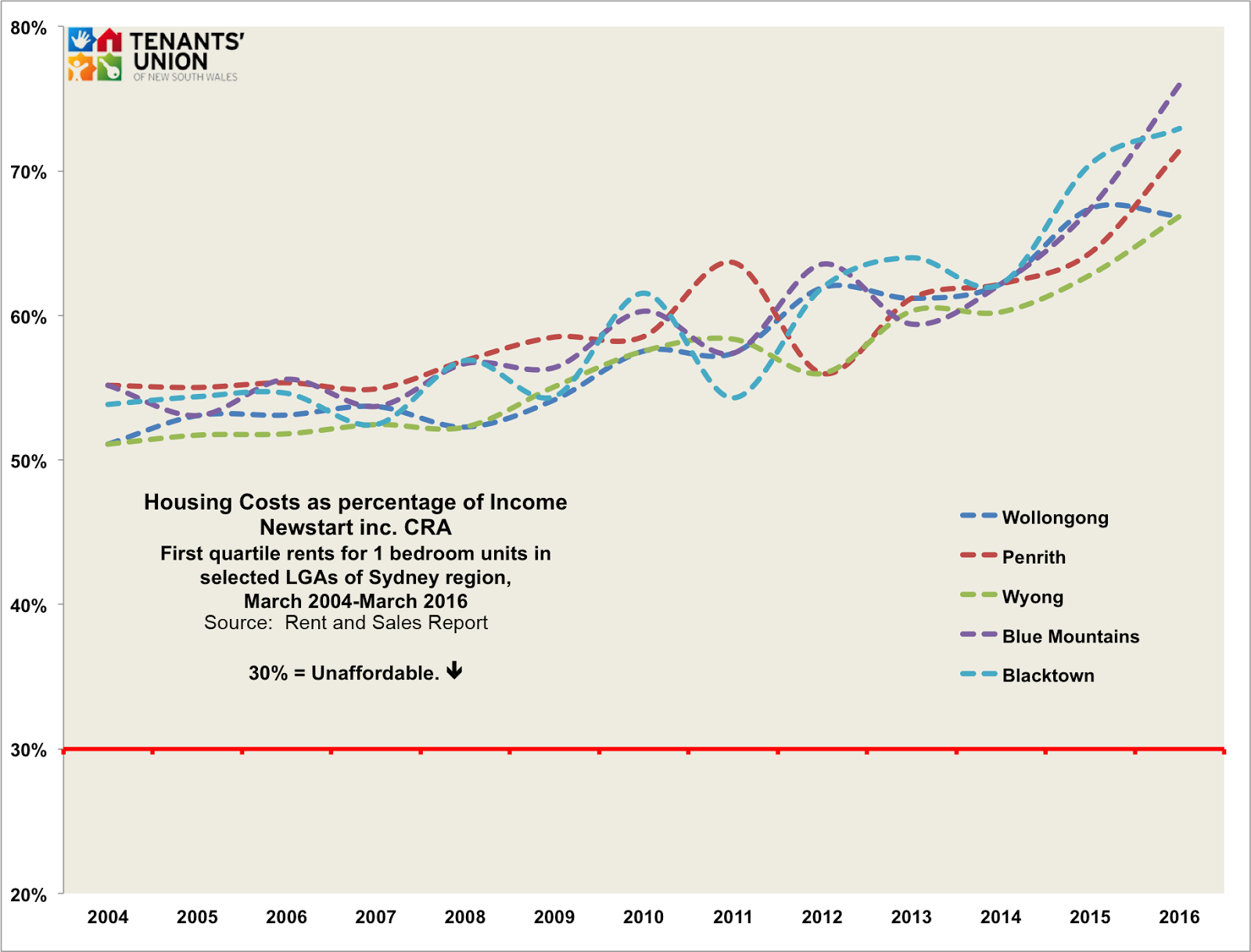
At the fringes there appears to be some hope - green looks promising, if you receive close to a moderate wage. But we wondered about tenants surviving in this city on Newstart, and receiving Commonwealth Rent Assistance (CRA). We crunched some numbers, and the news is not good.

We've looked at how much a one bedroom apartment would cost to rent in some of the more traditionally affordable parts of Sydney and surrounds, and compared it to the income a single person person receives on the Newstart allowance, plus CRA. We can see the numbers going back to 2004 when the Rent and Sales Report began reporting on first quartile rents for each Local Government Area. The "first quartile" in this case is the level of rent halfway between the lowest rent for new bonds lodged in March of each year, and the median, or middle rent.

We chose these five Local Government Areas as being both historically and currently some of the most affordable areas of the Sydney region, as well as representing the northern, southern and western areas within a relatively accessible distance from the city.
Clearly, Rent Assistance has never been about paying the rent in full. But it does make a real difference in bringing a home within reach for a lot of us who would struggle even more without it.

Click image for larger version
Government figures show that more than a quarter of people in NSW who receive rent assistance would pay more than 30% of income if not for CRA, and 15% would otherwise be paying pay more than 50% of their rent. However, in NSW we are still left with 15% of people, or nearly 70,000 tenants, who are paying more than 50% of their income even after receiving CRA.

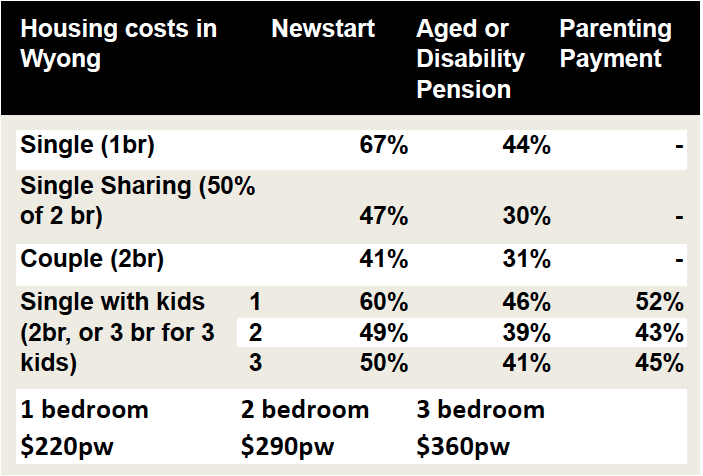
The #votehome campaign is calling for a 30% increase in rent assistance. What would that look like? We've applied that to a few different household types in Wyong, the cheapest LGA for lower quartile rents in Greater Sydney. These figures show what percentage of income is taken up by rent after receiving CRA. Remember, anything over 30% is considered unaffordable if you receive a low income:


With a 30% increase in CRA:


OK, it may not look like much, but it translates into around $20 a week more to spend on food, utilities, clothes or health. While the other income support payments look better, it is important to keep in mind that people living with disabilities, and those with kids do have other expenses that can really stack up. Ultimately, Newstart is just inadequate as a payment and needs to be increased, but an increase in rent assistance will still make a substantial difference.

You can support the increase by signing the #votehome petitions here.

The rent figures were derived from the Rent and Sales Report. We'll be releasing the first edition of Rent Tracker shortly, where we'll dig in to the reality of rent prices in NSW and explore the wealth of knowledge that the tenants of NSW provide simply by paying bond.

Monday, May 30, 2016

Tenants’ guide to tax reform

Housing affordability is a key issue during the 2016 federal election. The presumed impact of reducing tax concessions for landlords has been a strong feature in media discussions, and in commentary from political parties and candidates. Most of these focus on the cost of housing to buy.

But how do negative gearing and capital gains tax discounts affect the private rental market?


What is negative gearing?
An investor is negatively geared if the cost of holding an asset is greater than the income it generates. This occurs where an investor borrows money to purchase an asset, such as a rental property, and the income it produces doesn’t cover the cost of paying back the loan. Investments like this are made in the hope that the asset’s value will rise, and lost income will be rewarded with higher overall wealth.

For tax purposes, the losses that arise through a negatively geared investment are deductable against the income it generates. In Australia, losses on rental property investments are deductable against other income as well. This includes salaries and wages.

What is the Capital Gains Tax discount?
When an investor takes advantage of a rise in their asset’s value, by selling it at a profit, they pay Capital Gains Tax (CGT). This is paid on the difference between the amount they sell it for and the initial price they paid for it, minus some expenses.

CGT is payable on property investments. Exemptions apply to the “family home” and to property that has been used as an investor’s “main residence” within the six years prior to sale.

CGT is halved for any investment that has been held by an individual or small business for longer than 12 months – this is known as the CGT Discount. The CGT Discount applies to residential property, and most landlords pay CGT on only half their capital gains when they sell.

How do these tax concessions affect the housing market?
By allowing investment losses to be deducted against all income, and reducing liabilities for CGT, our tax system encourages Australians to enter into negatively geared investments. The housing market is seen as a safe investment for negative gearers, because of an expectation of continuing capital gains.

The largest part of the market – owner-occupiers – incurs no CGT liabilities upon sale at all. Their housing gains are not taxed like other forms of wealth, so they are prompted to divert spare financial capacity towards capital improvements. They do this by adding value to property through renovation, and/or spending more when upgrading. This increases the likelihood of capital gains across the market, and the expectation of perpetual gains encourages new entrants to pay more when buying in.

Landlords trade in the same market. The tax treatment of negatively geared investments enables them to manage larger debts than owner-occupiers, especially first homebuyers who have not already built up wealth through capital gains. Landlords who negatively gear can afford to pay more than other buyers for the properties they want, and are prepared to pay a premium for well-appointed and well-located properties that have high prospects for rapid capital gains.

How do these tax concessions affect the private rental market?
Proponents of Australia’s current tax settings suggest they increase the supply of housing and put downward pressure on rents by encouraging more investment in the housing market. They also suggest that without this investment, Australian governments would be left to make up the shortfall of affordable rental housing through their public housing systems.

 It is true that the number of Australian landlords continues to grow:
Australia's landlords (millions) Source: ATO
As does the amount of money they borrow in order to make their purchases. But the vast majority of this debt is used to trade already existing dwellings rather than build new homes, so it does not make a meaningful contribution to new housing supply:
Landlords' debt ($billions) Source: ABS
And the cost of servicing this debt is greater than all other costs to landlords combined – even as record low interest rates have reduced the interest payable on loans during recent years:
Landlords' expenses ($billions) Source: ATO
All of this means that our current tax settings are well suited to anyone with residential property to sell, and/or money to lend. But they are doing a poor job of increasing housing supply, so arguments about their impact on rental affordability are completely undermined.

On the contrary, we know they’re not really keeping rents low at all. Negatively geared landlords favour more expensive properties with greater prospects for high capital gains. Properties at the affordable end of the rental market have been in steady decline over the last decade or so, while the number of properties for rent at higher prices continues to grow, because of the type of investments landlords are encouraged to make.
Volume and price ($/2011) of Australian rental properties over time Source: AHURI
How do these tax concessions affect tenants?
Australia’s current tax settings affect high and moderate earning tenants by making it difficult for them to achieve home-ownership, keeping them in the rental market for longer. Landlords can take on higher levels of debt so they can afford to offer more for the properties they want than most first home buyers can. This has a general inflationary impact on prices too, and it has increased the difficulty for those who aspire to buy but are not yet able to. Would-be homeowners have to set themselves increasingly large savings targets in order to raise a deposit for a home loan.

Australia’s current tax settings affect tenants on lower incomes by reducing the number of affordable homes in the rental market, and increasing the number of people hoping to rent the ones that are available. Landlords tend to favour properties that have high prospects for quick capital gains, rather than low-end housing that could be let at affordable rents under long-term tenancy agreements. But where low-end housing is available there is no guarantee that low-income tenants will secure it, as they must compete for tenancies with higher earners who are hoping to minimise their housing costs.

Australia’s current tax settings affect all tenants by making the private rental market chronically insecure, because they encourage landlords to chase rapid gains rather than steady tenancies. They want to realise these capital gains when it suits them, and prefer not to limit their pool of prospective purchasers by selling with a sitting tenant. Tenancies are often brought to an end, and tenants forced to move, when landlords decide to offload their residential property investments.

What are the proposed reforms?
Both the Australian Labor Party and the Australian Greens have adopted policies to reform negative gearing and Capital Gains Tax discounts, raising housing affordability as a key issue for the 2016 federal election.

The Greens propose to end the current tax treatment of any negatively geared investment that is not a “business asset”, which means affected investors would only be able to claim losses against their relevant investment income. This reform would be grand-parented so that existing arrangements are not affected. The Greens would also phase out the CGT Discount over 5 years, by reducing the discount at a rate of 10% each year. These proposals focus on the budgetary impact – costed at $7.028billion in new tax revenue over four years – and The Greens would put this increased revenue towards the construction of new Social Housing.

Labor propose to limit the current tax treatment of negatively geared investments, to apply it only to newly built housing. Landlords who buy established dwellings would no longer be able to claim losses against their salaries and wages as well as their rental income. This reform would be grand-parented so that existing arrangements are not affected. Labor would also reduce the CGT Discount from 50% to 25% for “non-business assets” purchased after July 1 2017. These proposals focus on economic transition and budget reform. Costed at $32.1billion in savings over ten years, Labor says they would use the revenue raised through these reforms to “fund priorities”.

The Coalition does not propose to reform the tax treatment of negatively geared investments, or alter CGT discounts.

We have not conducted any analysis of minor- or micro-parties’ housing and tax related policies.

What would be the impact of the proposed reforms?
There have been many suggestions that reforms to negative gearing and CGT discounts would lead to an increase in rents, because it would reduce the level of investment in the housing market. This is unlikely. Proposed tax reform may have some impact on investors’ strategies, which would be a desirable outcome, but it would be unlikely to change the common preference for investment in residential property.

Significant demand for rental housing would continue, as home-ownership would remain out of reach for many households. Residential property would continue to attract capital gains, as owner-occupiers would remain exempt from CGT liabilities and would continue to make capital improvements to their homes.

But without preferential tax treatment of their negatively geared investments, landlords may be less inclined to take on the large amounts of debt that currently enables them to bid up the cost of housing. They may be less inclined to invest in housing based on the prospect of quick capital gains, and consider more closely the demand factors coming from the rental market itself. They may be more amenable to entering into stable, liveable and affordable agreements with tenants, rather than chasing quick capital gains.

Where can I get more information?
For more detailed information and commentary about the impact of Australia’s tax settings on tenants and rental housing, please visit: http://tunswblog.blogspot.com.au/search/label/Negative%20Gearing

A version of this post is available for download, so you can print it off and share it with your friends.

Friday, May 20, 2016

Battlefield: rent

A number of large and powerful real estate agencies look set to recommend landlords increase your rent if Australia votes for changes to negative gearing and capital gains tax discounts on July 2nd. We're not sure how else to read the "Negative Gearing Affects Everyone" campaign that's recently attracted media attention.

The agents will smite you if you vote for tax reform
The campaign suggests that "should current taxation arrangements for property be changed, as many are suggesting, rents could be expected to rise substantially". It provides nothing to support this theory, other than a couple of lines about supply and demand:
Because the incentive to buy property to rent out will be severely curtailed, fewer people will buy residential investments, meaning the supply of rental stock will contract: fewer houses means higher rents charged to those who don't own their own homes.
Nobody can argue with these fundamentals, right? Well...

When you're thinking about taxes, housing supply and rents, it's important to remember these two things:
1. Where rents and real estate are concerned, supply and demand dynamics get complicated by the tax system.
2. No matter what federal tax settings look like, the only way your rent can go up is if your landlord serves you with a valid notice of increase.

Let's explore this.

This "incentive to buy property to rent out" that the real estate agents' campaign refers to is, of course, capital gains. According to the campaign authors, the way to keep our rents down is to ensure that property values continue to go up. The idea is obvious enough - increasing property values draws more people into the housing market to buy investment properties, so more properties become available to rent. That's supply taken care of, right?

Well, no, because around 90% of money lent to landlords each year goes to purchase established dwellings. The majority of "new" supply into the rental market is actually existing housing that's just being recycled - moving in from the owner-occupier market or just transferring from one landlord to another. Even if it is new to the rental market, it probably isn't a new home, in which case it can't really be considered new supply. It's just borrowing from Peter to pay back Paul.

But even if we pretend not to notice this glaring hole in the real estate agents' logic, they still have a problem with their argument. The idea that rising prices can put downward pressure on rents is not just counter-intuitive - it's also demonstrably wrong. And it's not merely a question of ever increasing prices (landlords' expenses) dragging up rents (landlords' income), it's about which properties find their way into the rental market, who ends up paying to live in them, and how much they are willing to spend.

In short, it's the the type of supply and demand you're getting in the market that matters. Negative gearing and capital gains tax discounts actively distort the market by affecting supply and demand.

This happens in a couple of different ways.

First, these tax settings affect the supply of rental housing, by manipulating investor demand. The "incentive" to buy properties to rent causes landlord's to pick and choose their purchases based on the prospect of gains. Or, as the real estate agents' campaign authors have put it in another part of their website, to make "strategic investments":
If negative gearing is abolished on all but newly-built dwellings, investors will no longer be able to buy strategic investments, looking to acquire high value properties in prime locations that will realise the best gains over time.
We've talked about what this kind of "strategic investment" does to the shape of the rental market before, but here's a quick reprise: landlords don't buy the cheap stuff because the prospects for gains just aren't the same. 15% of 100 is better than 15% of 10, even at the same rate of growth. Rents at the lower end of the market are increasing faster than rents at the top, because affordable rental housing is actually disappearing from the market.
The shape-shifting private rental market: driven by gains
For six long years Anglicare's Rental Affordability Snapshot has told us what this means for low income households. In the latest snapshot there were only 902 properties advertised across Sydney at what could be considered affordable for a family whose income is made up of a minimum wage and some Family Tax Benefits. 902 properties, or 6.4% of what was advertised for rent during the snapshot period. For a single person on Newstart allowance, there was not a single property advertised during the snapshot that could have been considered affordable. Nada. Zip. Nothing.

National Shelter's Rental Affordability Index provides a somewhat more rigorous analysis. In it's inaugural release in November 2015 it noted that New South Wales faces "rental unaffordability across the board, and a dire situation for low income households".

Second, these tax settings affect the demand for rental housing, by reducing the supply of affordable housing to buy. Negative gearing encourages landlords to carry month-to-month losses by reducing their pay-as-you-go tax liabilities, while capital gains tax discounts increase the chances of these losses being fully recovered in the long-run. Thus landlords can afford to take on greater amounts of debt than their competition, the owner-occupier. They outbid would-be owner-occupiers for properties they do not intend to live in, using them instead to build wealth. This pushes prices higher, faster (and encourages more people to follow this investment strategy if they can).

This is generally understood to be a problem for first-home-buyers, and it is this concern that seems to be driving the current political discussions around tax reform. What these discussions fail to address is that most of these frustrated home-buyers are making homes in the private rental market in the meantime, as tenants. They're earning a decent enough income and can manage the high rents, even if they can't keep up with landlords bidding against them at auction. Then there are those who have simply given up on home-ownership: as house prices scale new heights, they simply wonder how they could ever come up with a deposit in the first place. They're still earning decent money, though, and they're contributing to demand for rental housing while dragging up rents because of what they can afford to pay.

Our housing market dynamics have been working to these conditions for many, many years. They are entrenched. Giving our federal tax settings a few necessary tweaks will not result in immediate or drastic change. Fundamentally, tax reform will not reset the incentive for buying and renting out property. Instead, it should alter the way capital gains are achieved, providing for more tenant friendly "strategic investment" by landlords. The system would adjust. New, more functional dynamics would emerge. But this would take time.

Nobody should expect wholesale rent increases in the short term, unless landlords strategically decided to put them up. We'll come back to that soon, for further discussion.


Tuesday, May 10, 2016

Curb negative gearing, increase rents - or not

In awkward news for the Coalition Government, currently seeking re-election on a platform of sensible tax-reform-avoidance, it's been revealed that the Reserve Bank of Australia once suggested curbing negative gearing could be good for financial stability. In awkward news for us, the RBA also wondered whether curbing negative gearing might lead to an increase in rents. Find the RBA's memo on negative gearing here.


It's a common assumption that reforming negative gearing on residential property investments would result in a surge in rents. Indeed, property lobbyists have been dining out on the suggestion for years, hoping to keep the policy in their back pockets. But we've never been captive to such a notion, as we explained back in 2011 with one of our most read blog posts: Negative gearing is not your friend.

Negative gearing does not cause individual landlords to charge less rent, nor does it create additional supply of housing. It has contributed to more higher-income households renting for longer, as they are priced out of buying a home by investors who can afford to borrow just that little bit more. In a competitive market, this pushes lower-income households out of affordable properties, as higher earners tend to be more attractive to landlords regardless of the asking rent. And it has contributed to property investors passing over lower-rent housing stock in favour of properties with potential for higher capital gains, meaning that lower-rent stock has vanished from the rental market.

In short, negative gearing increases demand while reducing supply of rental housing, especially at the affordable end of the market.

Even so, the myth prevails. To be fair, we can easily envisage countless overstretched landlords crying poor if their tax-break rugs were suddenly pulled out from under them. Indeed they might try to put the rent up to compensate. Spend some time talking about tax reform on social media and you'll come across many landlords suggesting they'll do just that.

The problem for these landlords is that their tenants are already maxed out.

For some, putting the rent up might backfire, as tenants leave over-priced properties for more affordable arrangements. Overstretched landlords might then find themselves lacking the cash-flow needed to cover their no longer tax-subsidised debts, while still enjoying all the fine things life has to offer. They might even have to consider selling an investment property or two in order to make ends meet.

We understand such a thing would be completely unAustralian, so we've come up with a few alternative cost-saving measures for your landlord to consider in the event that negative gearing gets a trim.

Here are our top three tips for cash-strapped landlords:

3. Stop using real estate agents. According to the Australian Tax Office, Australian landlords spent more than $2.4billion on property agents fees and commissions in the 2013/14 financial year. Giving agents up might seem hard at first, but as you begin to gain an understanding of what it means to take care of another person's home, you'll find it's not rocket science. Tenants do it all the time.

2. Get your investment properties in good order. Spend up big on repairs and maintenance now, make capital improvements and invest in attractive additions that your tenants will love. The Tax Office says Australian landlords spent over $2.4billion on repairs and maintenance in 2013/14, and claimed over $5billion in deductions for capital works and plant depreciation. Bringing your repairs and maintenance spend forward makes good financial sense - not only could it save you money in future non-subsidised financial years (to a point), it would improve the quality of housing for someone who has been locked out of home-ownership. Just make sure you do everything properly the first time so you won't have to come back and spend the money again...

1. Pay down your debt. The single most useful thing landlords can do to reduce their expenses is to pay down their debt. Tax data shows Australian landlords paid an astonishing $21.1billion to cover interest on loans in 2013/14. This is far and away the most significant cost of being a landlord, so it makes sense to pay down the principal to reduce the interest payments over time. Eventually, you might end up owning the place, so you wont even need to worry so much about capital gains. That would make the housing market more affordable for all, making it an absolute win/win option!

Keep these in mind and remember them the next time you're assured negative gearing is keeping your rent down. The simple fact is that changes to negative gearing won't put your rent up - only your landlord can do that...!