Showing posts with label Aboriginal housing. Show all posts

Thursday, September 13, 2018

The sad truth of Aboriginal homelessness in NSW

Today's post written by the Tenants' Union of NSW's Jessica Massa, Legal Officer - Aboriginal Support.

The most recent estimate of the Aboriginal and Torres Strait Islander resident population in Australia was 798,400 people - that’s just 3.3% of the total Australian population. Of this number, an estimated 216,176 are living in NSW, meaning that NSW is home to the highest number of people of Aboriginal and Torres Strait Islander origin.

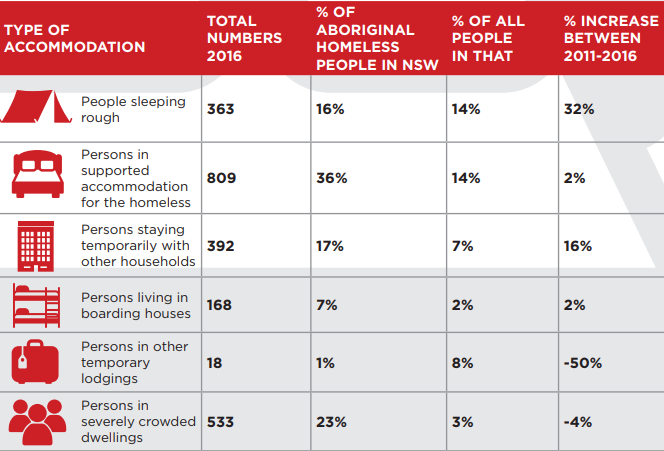
Shockingly Aboriginal and Torres Strait Islander people could make up over 24% of those accessing specialist homelessness services in 2015–16, and 6% of the entire homeless population in NSW. These alarming and growing rates of Aboriginal and Torres Strait Islander homelessness need to be addressed. But first we must understand how we got here.

There are a myriad of issues and injustices that have contributed towards these figures. Aboriginal and Torres Strait Islander people face:
However it is hard to go past the historic and ongoing injustice associated with the way Australia has treated land and property since it acquired it under a false legal claim in 1770. It isn’t surprising that a people whose land was stolen are now largely excluded from the wealth generated by property ownership on which modern Australia relies so heavily.
ABS Data

Included in the rising homelessness figures are persons living in boarding houses, persons in severely crowded dwellings and persons in temporary lodgings – all renters in some form. A large number of Aboriginal and Torres Strait Islander people reside in public housing under Family and Community Services, and the Aboriginal Housing Office, largely because they are unable to afford or be accepted in the private rental market. All told, 60% of Aboriginal and Torres Strait Islander people in NSW are renters.

Homelessness NSW

At the Tenants Union, working directly with the four Aboriginal Tenants Advice and Advocacy Services across NSW, we hear first-hand of the myriad of tenancy issues facing Aboriginal and Torres Strait Islander renters. There are continuous instances of illegal lockout, failures to repair, no grounds terminations, retaliatory evictions, domestic violence from co-tenants, and uninhabitable premises. These issues face tenants across the array of Aboriginal Housing in NSW, from public, to community, to private housing, Land Council houses, reserves, and Aboriginal Co-operatives. All contribute towards the increasing percentage of Aboriginal and Torres Strait Islander people experiencing homelessness.

Until these issues can be eradicated, and we can adopt a more just approach to land and housing for Aboriginal and Torres Strait Islander, and for all of us,the sad truth is that the rate of Aboriginal homelessness in NSW will continue to increase.

The Tenants Union is currently working on developing an Aboriginal Renting Policy, in consultation with Aboriginal tenants and Aboriginal organisations, to find out more about what the community feels are the most pressing issues in need of change in tenancy law and policy in NSW. This policy will form the platform for the TU to advocate for change for Aboriginal and Torres Strait Islander tenants in NSW.

Wednesday, July 11, 2018

Because of her, we can: NAIDOC Week 2018

Here at the Tenants Union, we are lucky to have an incredible network of Tenant Advocates working actively across the state with tenants to help resolve their tenancy issues. They are an incredible bunch of people, who help to keep the wheel of justice running (somewhat) smoothly.

The four Koori Tenants Advice services are dotted across all corners of NSW, with the Western Aboriginal Tenants Advice and Advocacy Service in Dubbo, the Greater Sydney Aboriginal Tenants Service in St Mary’s, the Southern Murra Mia Tenant Advocacy Service in Batemans Bay, and the Northern NSW Aboriginal Tenants Advice and Advocacy Service in Grafton and Newcastle – supported by the Dtarawarra Aboriginal Resource Unit.


These services work tirelessly with Aboriginal and Torres Strait Islander tenants across NSW, managing every range of tenancy issue you could imagine, as well as the intricacies and difficulties that come with the Aboriginal Housing sector.

Each of the services are bolstered by some incredible female tenant advocates, who we are celebrating with our 2018 NAIDOC video, tying into the NAIDOC theme for 2018 being ‘Because of Her, we can’. Some of our advocates are shyer than others about appearing on camera and we couldn’t quite coax them all into filming an interview, but we are very grateful to each of them for the wonderful work that they are doing in supporting and advocating for the rights of all Aboriginal and Torres Strait Islander tenants across NSW.


Thanks to all of the extraordinary women who make up our Koori TAAS network, you are truly remarkable!

Monday, October 23, 2017

Making sense of social housing in NSW

Social housing operates within a complex glob of morphing policies and procedures, prodded by occasional shifts in public policy at both a state and federal level that draw various laws, instruments and agreements into contact with one another in a range of ways. A sound working knowledge of the sector in its entirety can take years to develop, and once established could fall apart within an instant should one glance away at precisely the wrong moment.


A case in point is last year's announcement that the management of large swathes of tenanted public housing properties will be transferred to community housing landlords in New South Wales, in keeping with the Council of Australian Governments' (COAG) National Affordable Housing Agreement (NAHA), which was negotiated during the early days of the Rudd-Gillard-Rudd Government era. The announcement of the Management Transfer Program sparked some discussion here on the Brown Couch, and across the broader sector, about just who these community housing landlords are. How do they come to be in the business of housing people from the public housing waiting list since they're not run by the Government of NSW?

The plot thickens, as the results of the Program's tendering process have now been announced. Over the next couple of years, management of around 14,000 tenanted public housing properties across six different regions is to be handed to nine community housing landlords who are already operating in other parts of the state. So... now is a good time to take a look at what it means to be a "social housing" landlord in New South Wales.

Given we've already mentioned the NAHA, we should note it is the intergovernmental agreement that determines who takes responsibility for what within our housing systems across Australia. As an agreement among the Commonwealth, state and territory governments it is a static document, although it is intended to be renegotiated and updated from time to time. It has been altered quite a bit since its series of predecessors first took form: established in the 1940's as the "Commonwealth State Housing Agreements" as something of a post-war nation building scheme; and it is currently being renegotiated as a "National Housing and Homelessness Agreement".

Regardless of form, or name, these agreements have generally all set out to achieve the same objective: to set the conditions under which the Commonwealth would give funding to the states to run their public housing schemes. These agreements have been broad enough to allow each state and territory to run their housing programs as they see fit, as indeed they do. A strong focus of the current agreement has been to shift the delivery of housing assistance and services away from government to the not-for-profit sector, and successive NSW Governments have responded - indeed contributed - by attempting to consolidate and build our community housing sector. Notably, this included the regulation of the sector in 2010, with a state based scheme that has since been replaced by the National Regulatory System for Community Housing. It also included the establishment of a single waiting list for housing assistance, accessible through a portal known as Housing Pathways, under which any participating landlord could both process applications for and make offers of subsidised rental housing to eligible households.

In this context our language and legislation has come to reflect the idea of "social housing". With this term we could be referencing either or both of its constituent parts: "public housing" or "community housing"; and for practical purposes the only difference is whether the landlord is the government or a not-for-profit agency who has been contracted by government to provide the same essential service. Of course, things become more complicated when we consider the public policy implications of this rhetorical shift, as it gives our still predominantly neoliberal governments easy cover to withdraw from the direct provision of public housing proper, and focus entirely on the setting of policy instead. They do this on the grounds that "community housing landlords are well placed and can do it better", although this is far from an established truth. While we can have no objection to the growth of this community housing sector, the fact that it only ever seems to happen at the expense of our established public housing provider is a simple reflection of the State's entrenched reluctance to pay for and provide social housing. Given the sector has spent the better part of a decade trying to attract private finance to its cause, it reflects a certain level of disinterest in housing-as-shelter from the profit-driven private sector as well - as an aside, it will be interesting to watch how the emerging "build-to-rent" discussion proceeds from here.

Right - so while all of that is going on at the higher level, there is a somewhat consistent legal framework setting the scene in the meantime for social housing landlords and tenants across New South Wales. Although with the right political will the statutes under which social housing policies are determined can be changed - as we have seen throughout the last couple of years with mandatory evictions for social housing tenants and the introduction of concurrent leasing by the Land & Housing Corporation to enable the current Management Transfer Program - keeping tabs on the legislative framework can be a useful way to maintain one's bearings while trying to make sense of social housing.

The Residential Tenancies Act 2010 devotes an entire Part to social housing tenancy agreements, a discrete form of residential tenancy agreement to which a number of additional provisions apply. This Act defines a social housing tenancy agreement as "a residential tenancy agreement where the landlord is a social housing provider", and then defines a social housing provider as:
  • the New South Wales Land & Housing Corporation
  • the Aboriginal Housing Office
  • a registered community housing provider within the meaning of the Community Housing Providers National Law (NSW)
  • an organisation for the time being registered under Part 5 of the Aboriginal Housing Act 1998
  • an organisation or a member of a class of organisation prescribed by the regulations
This immediately brings a number of other statutes into play. There's the Housing Act 2001, under which the Land & Housing Corporation is established as the legal entity that enters into residential tenancy agreements and other related dealings in residential property on behalf of the government; and under which the income based rental subsidy scheme is established. This is the legislation that gives us public housing, and it is amendments to this legislation that has enabled the emergence and establishment of community housing over many years.

There's the Community Housing Providers (Adoption of National Law) Act 2012, under which regulation of the community housing sector is provided by adoption of the Community Housing Providers National Law. This Act brings New South Wales into the National Regulatory System for Community Housing and, in some circumstances, allows the government to conditionally transfer title from the Land & Housing Corporation to a registered community housing provider. Note this has fallen out of fashion as concurrent leasing has come into play, having been made available by amendment to the Housing Act in 2016. For the time being property is being transferred to the community housing sector using this form of head-lease, but transfer of title under the Community Housing Providers (Adoption of National Law) Act remains an option.

Finally there's the Aboriginal Housing Act 1998, under which the Aboriginal Housing Office is established along similar lines to the Land & Housing Corporation, but with a specific remit to develop policy and deliver subsidised housing for Aboriginal households who rent. This Act also allows regulation of a broader Aboriginal Community Housing sector, for whom the National Regulatory Scheme for Community Housing is also being brought into play. By association, we must mention the Aboriginal Land Rights Act 1983, under which Local Aboriginal Land Councils who provide rental housing to their members may register with the Aboriginal Housing Office or the National Regulatory Scheme for Community Housing in order to have the requirements for approval to run a community benefits scheme that includes the provision of residential accommodation to their members waived by the NSW Aboriginal Lands Council.

The policy framework in which social housing operates is likely to keep changing, and where required legislative changes will sometimes follow. But for now, the above provides an overview of social housing in New South Wales. We'll keep an eye on the development of the National Housing and Homelessness Agreement, and take further note of any impact it might make.

In the meantime we'll do our best to answer any questions left in the comments, or sent through to us via the usual channels.

Wednesday, May 31, 2017

National Reconciliation Week


This post written by our Legal Officer - Aboriginal Support, Jessica Hall. Along with an Aboriginal Paralegal, Jessica works to support the Aboriginal Tenants' Advice and Advocacy Services and conduct litigation to advance legal rights of Aboriginal and Torres Strait Islander tenants in NSW.

This week is National Reconciliation Week, recognised each year between May 27th-June 3rd and placed during this time due to two significant milestones in Australia’s journey to reconciliation: the 1967 Referendum (May 27th) and the historic 1992 Mabo decision (June 3rd).

This year in particular, marks important anniversaries of both these events – 50 years since the referendum that amended the Australian Constitution to legally recognise Aboriginal and Torres Strait Islander peoples, and 25 years since the landmark Mabo decision which legally recognised native title rights in Australia for the first time.
Here at the Tenant’s Union, we marked this week with a successful morning tea yesterday organised by our Aboriginal Paralegal John in collaboration with Community Legal Centres NSW, National Association of Community Legal Centres and Justice Connect, to host friends and colleagues in the spirit of reconciliation.

As we commemorate these two milestones with NRW events around the country, we ask that all Australians join together in a unified front to be a part of the journey to reconciliation, mutual respect and a better future for our first Australians.
The motto for this year’s NRW is ‘let’s take the next steps’, reflecting that we are all responsible collectively for the future of reconciliation in Australia. The Uluru Statement from the Heart speaks to the next steps to come, and the long journey to be taken together as Australian people for a better future.

Friday, May 26, 2017

National Sorry Day 2017

Today marks 20 years since the Bringing Them Home report was tabled in parliament. Most Australians know where they come from and where they can be at home, for the Stolen Generations this connection was often shattered. Language, connections to ancestral country and families were lost for many. New relationships had to be established, and old pain still needs to be healed.
National Sorry Day is the first step on the path to reconciliation and tomorrow we start National Reconciliation Week 2017.
Today, we say sorry. We say sorry to all those affected by the Stolen Generations policies, and other historic and current Australian policies which have resulted in significant disadvantage being placed on Aboriginal and Torres Strait Islander communities across New South Wales and the entire country.
Saying sorry doesn’t mean a lot if you don’t also work to address the wrong. For the Tenants’ Union we work with Aboriginal networks such as the Aboriginal Tenants Advice and Advocacy Services, both to address individual tenancy disputes, and systemic issues such as the quality, funding and management of Aboriginal housing in New South Wales.
This artwork was created by Pauline Coxon, former tenancy advocate and Biripi artist living on Ngarigo country. Entitled Making Tracks to your Tenancy, Coming Home. Today it speaks to us of the the value of knowing where your home is, as we work towards ensuring all people can create spaces in which they can feel at home.
See Pauline’s work for the Tenants’ Union here: https://tenants.org.au/news/artwork-aboriginal-artist-pauline-coxon

Friday, April 21, 2017

Public housing amnesty - income, assets and unauthorised occupants

Yes, it's amnesty time again. If you are a public housing or Aboriginal Housing Office tenant this amnesty will cover you.  The amnesty will run from 8am Monday morning (24 April) through until midnight on Sunday 11 June and covers undisclosed income and assets, as well as unauthorised occupants.


The amnesty means if you haven't yet had the chance to update FACS Housing about a change in your income or assets or to tell them that someone has moved in, you can let them know during the amnesty without worrying about having to pay back rent or facing prosecution.

FACS Housing will use the information you disclose about your household income to recalculate your rent and water payments, and you'll be expected to pay this recalculated (likely higher) rent going forward.  They won't, however, raise a debt, prosecute or take action to evict you on the basis of the rent increase.

Providing information about about someone who is living with you that FACS doesn't know about (an "unauthorised occupant") will be treated as an application to approve an additional occupant.  If approved (see FACS policy on this) your rent will be reassessed from the date you provided the new info - again not backdated. If you're trying to figure out when FACS considers someone to be an 'additional occupant' rather than a visitor, this is generally when the person has been or will be staying longer than 28 days in a row (but again see FACS policy for more information).

All public housing and Aboriginal housing tenants will receive some information directly from FACS about the amnesty encouraging them to self disclose.  But it will also be open to members of the public to call in and make 'allegations' about tenants (and unfortunately given past experience we can expect there to be a bit of 'dob your neighbour in' messaging running through mainstream media reports about the amnesty).  Where an allegation is made FACS Housing will provide a tenant with an opportunity to respond to an allegation. If the tenant accepts the allegation at that point they will be protected by the amnesty.  If they challenge the allegation they forfeit protection under the amnesty and FACS will continue to investigate following 'standard business procedures'.

If you are a public housing or AHO tenant and know that FACS has incorrect information about your household's income and assets, or you haven't yet made an application for an 'additional occupant' and someone's already moved in this might be a good opportunity to let FACS know.  Outside of an amnesty FACS Housing will normally vary or cancel a tenant's rebate, raise a debt for rent arrears (sometimes a very significant debt), and then move to terminate on the basis of that debt. So you could be saving yourself a whole lot of hassle ... and perhaps your tenancy.

Some extra detail to consider:
  • If you are a tenant of a Community Housing Provider or an Aboriginal Community Housing Provider you are not covered by the amnesty. Any information you provide, or any information provided as an allegation by someone else, will not be passed on by FACS Housing to your relevant provider. Tenants will be encouraged to contact their provider, but will not be protected from any debts or evictions by the amnesty.
  • If an investigation around income and assets, or about an unauthorised occupant has already commenced and you have received a letter informing you of this (a 'Natural Justice' letter) you will not be given any protection under the amnesty.
  • If you disclose or are found to own/part own property that makes you ineligible for housing assistance, FACS Housing states you will be "required to surrender your tenancy at a time that is agreed"
  • Only disclosures about income & assets and unauthorised occupants will come under protection during the amnesty.  FACS notes "tenants who make declarations that don't fall under the protected amnesty categories will be assessed on a case by case basis and may face prosecution".
If you are thinking about calling up during the amnesty but have any concerns or questions you should first get in touch with your local Tenants Advice and Advocacy Service for free advice.

If you have any extra questions about the amnesty, send them through ... we might be able to help answer them or ask FACS Housing to respond.

The original version of this post included information provided by FACS that any allegation or self-disclosures made about Community Housing tenants would be passed on by FACS to the provider. This information was incorrect and the post has been edited accordingly.

Wednesday, October 12, 2016

Understanding the Housing Legislation Amendment Bill 2016

People often ask us what we mean when we talk about Social Housing. How does it differ from Public Housing? Where does Community Housing come from? Aren't they different names for the same thing? And is there even really such a thing as Affordable Housing? What about housing co-ops or housing that's owned and managed by Aboriginal Housing Corporations or Local Aboriginal Land Councils?


We'd love to write something that sorts all this out once and for all, but there's a problem: the whole kit and caboodle just keeps changing.

Don't look now, but it's about to change again. Yesterday the Minister for Disability Services, Ageing and Multiculturalism, John Ajaka, introduced the Housing Legislation Amendment Bill 2016 into the Legislative Council of NSW.

If passed, the bill will do two things:
... amend the Housing Act 2001 with respect to the entry of concurrent leases; and amend the Community Housing Providers (Adoption of National Law) Act 2012 with respect to the registration of, and provision of assistance to, community housing providers that cannot be registered under the Community Housing Providers National Law (NSW).
So - what does all of that mean?

The first thing - concurrent leases - concerns the transfer of Social Housing tenancy management from Public Housing to Community Housing. The Minister for Social Housing, Brad Hazzard, recently announced the transfer of an additional 18,000 tenanted properties (approximately) "to ensure a better experience for tenants in Social Housing". Critically, Hazzard announced that "tenants' lease length and lease conditions will remain the same, their income after rent will remain the same and FACS will keep tenants fully informed as their areas transition to community housing providers".

But the Housing Legislation Amendment Bill 2016 makes it clear that, under the proposed property transfer scheme, tenants will not be given a choice. Many of their counterparts in previous schemes did have a choice - albeit a limited one. Some tenants were able to decline to participate in an earlier property transfer program, such as a group in South Coogee in 2009. Others were not, and there are now entire areas across New South Wales where FACS Housing no longer operates as a landlord. The properties, and the tenants, remain, but now they have a Community Housing landlord. Returning for a moment to Minister Hazzard's announcement, it looks as though four new areas are to be added to the list: the Shoalhaven, Northern Sydney, Mid North Coast and Hunter/New England (excluding Newcastle and Lake Macquarie LGAs). We expect many tenants in these areas will have found this news unsettling, and the lack of choice to be afforded them insulting.

But the introduction of "concurrent leases" potentially resolves some of the pragmatic concerns that tenants would factor into their choice, if they had one. A concurrent lease allows those property rights and interests that have not been passed on to, say, a residential tenant, to be transferred to a third party. Lawyers would think of it as a division of the "bundle of rights" that are attached to property, in a way that retains a clear hierarchy of interests and concerns - property owner > concurrent lessee/landlord > residential tenant/occupier. Rights that are tied to a residential tenancy agreement are not affected by a concurrent lease, and this is what the Minister is getting at when he suggests "tenants' lease length and lease conditions will remain the same".

Strictly speaking, the Land & Housing Corporation (the Public Housing landlord) has been setting up concurrent leases all over the place, as it has already transferred the management of around 28,000 Public Housing properties to Community Housing landlords since about 2008. But it's not been done in such a clear-cut way before. In the past, tenants have been asked to rip up their residential tenancy agreements with the Land & Housing Corporation, and enter into a new one - perhaps with new, less favourable terms - with the Community Housing landlord.

Concurrent leases may take some of the sting out of the coming property transfer scheme, but that's not the end of the story. Different Social Housing landlords apply different tenancy management policies and, while it is true that the existing terms of a tenant's residential tenancy agreement should remain intact, this application of different policies might make for some startling changes to tenants' experiences. For instance, Community Housing landlords set their rent in a way that requires tenants to claim Commonwealth Rent Assistance, but the Land & Housing Corporation does not. On paper, this will look like a hefty rent increase. In practise, tenants will have to pay 100% of their Rent Assistance to their Community Housing landlord. This is what the Minister is getting at when he says "their income after rent will remain the same".

To add another layer of complexity to our understanding, but perhaps a simplification to the system itself, the Housing Legislation Amendment Bill 2016 will provide that, as a matter of law, Public Housing that is transferred over to Community Housing by way of a concurrent lease will no longer be considered Public Housing. We'll add that to our list of things to write about...

But what of the second thing - "the registration of, and provision of assistance to, community housing providers that cannot be registered under the Community Housing Providers National Law (NSW)"? We won't go into in too much detail on this today, because we've already taken up enough of your time. But as we understand it, it is designed to solve a problem for Local Aboriginal Land Councils who run Social Housing schemes, and who want to register as an Aboriginal Community Housing Provider with the Aboriginal Housing Office. Currently they're unable to. As statutorily constituted bodies who own their own properties they cannot meet the conditions of registration, which would require them to transfer their properties to another registered provider in the event of winding up.

The Housing Legislation Amendment Bill 2016 would solve this issue by requiring the Social Housing Minister to establish a "local system of registration" that would mirror the national system as much as is possible. In other words, the Minister must create a whole new registration system that looks a lot like the existing one, but leaving aside one or two things that prevent some current Social Housing landlords from becoming registered. The trick will be to ensure the "one or two things" doesn't become too broad, giving potential new entrants a sneaky back-door into the Social Housing system and undermining the integrity of the existing registration scheme.

We'll be watching all of this closely as the bill makes its way through the Houses of Parliament.


Wednesday, September 30, 2015

Welcome to Dubbo, please enjoy your stay...

Earlier this week a scanned copy of a letter started doing the rounds on social media . It was said to be from Family and Community Services, delivered to tenants of the Aboriginal Housing Office in the Dubbo area where the 45th Koori Rugby League Knockout is to be held this weekend.

The letter reads:
As the warmer months of the year approach and with school holidays currently well underway it is timely for Family and Community Services (FACS) Housing Services to remind our tenants about the Good Neighbour Policy, particularly in regard to additional persons and visitors. 
FACS is well aware there are a number of activities scheduled to take place in Dubbo. Some of these are occurring right now, and then there are other activities planned for the remainder of the school holidays. One of these activities is the NSW Annual Aboriginal Football Knockout to be held in Dubbo over the long weekend. 
Please be assured that FACS is very supportive of all activities, in particular the football event. However, we are aware that the football, in particular, brings high numbers of visitors into Dubbo to celebrate the event with friends and family and many stay in social housing properties. 
Having visitors is enjoyable however sometimes it may bring stress particularly if you are unsure of how to manage situations that get out of hand. If we can help in any way please contact your CSO on [number] or if there is an emergency please call the police... 
On the other hand if you are disrupted by neighbours or their visitors please also make contact with your CSO or the police.
Quite understandably, the appearance of this letter raised a few eyebrows at the Aboriginal Tenants Advice and Advocacy Services. Was it real? Where did it come from? And why is it written in such a patronising tone?

We contacted FACS Statewide Housing Services to see if we could get some answers. They confirmed this letter was sent from FACS' Dubbo office to all local Aboriginal Housing Office tenants last week. They also confirmed the local office had received numerous complaints about the letter and had gone into a bit of damage control, liaising with local 'Aboriginal representatives' to explain the thinking behind the letter. We're not exactly sure what this means, but we do know that the Western Aboriginal Tenants Advice and Advocacy Services was kept pretty busy with phone calls from local tenants yesterday.

Local FACS offices have got a bit of form when it comes to sending ill-conceived correspondence en masse to tenants. Long-time readers may recall this little piece of Christmas cheer dropped into the letterboxes of tenants on the South Coast a few years back, which assured local tenants that "rent doesn't stop for Christmas".

Now, it's fair to say that the tone of the letter sent by the Dubbo office is, on the face of it, a little less offensive than the one we saw on the South Coast not three years ago. But given the nature of this particular correspondence - directed at tenants of the Aboriginal Housing Office, in anticipation of an annual event that is run by and for Aboriginal people - we have to look beyond what we see at face value. The Koori Knockout is an annual event, which is held in a different location each year, and this is the first time a FACS Housing Services office has seen fit to circulate such a note to all local Aboriginal Housing Office tenants.

Hopefully it will be the last, because - understandably - it hasn't been very well received. To see just how badly this has been seen by Aboriginal people, check out this post to the 2015 Koori Knockout host's facebook page, and the response it has attracted.

There's a pretty clear lesson for FACS in both of these incidents. If you want to alienate yourself from the communities you're supposed to be serving, just whip up a quick letter and send it around to as many people as you can think of without a second thought.

On the other hand... if you want to engage with local communities to have a genuine dialogue about anticipated concerns arising from events like Christmas or a Koori Knockout in your area, don't just whip up a quick letter and send it around to as many people as you can think of without a second thought. This is true for everyone, but it is especially true for communities who have good reason to be wary of the thinking behind a Government agency's activities towards them.

Instead, consult with key folks in your community about what you want to say, and why you want to say it. Talk to 'Aboriginal representatives' before you send your message out into the world, rather than after the damage is done. They'll tell you if it's going to be wide of the mark, and they might even help you put something worthwhile together.

That's exactly what we did - and we came up with a special edition of the Tenant News. It's published with the Koori Knockout in mind, and it's full of great yarns by and for Aboriginal tenants.


There'll be a few printed copies of the Koori Tenant News circulating around Dubbo this week, so keep an eye out for it if you're in town for the Knockout. And it's available to download from our website right now. Let us know what you think!

We reckon it makes for better reading than that letter from the local FACS office.


Monday, January 26, 2015

From dispossession and displacement to eviction without grounds


Map of the First Nations of NSW
borrowed from the Aboriginal Legal Service
www.alsnswact.org.au/pages/nsw

The secret instructions given to Lieutenant Cook on 30 July 1768 tell us much about the foundation of New South Wales. They gave Cook the order to explore the southern oceans in search of Australia - "to proceed southward in order to make discovery of the Continent" and "to employ yourself diligently in exploring as great an Extent of the coast as you can ..."


 Towards the middle of the document, Cook is instructed:
... to observe the Genius, Temper, Disposition and Number of the Natives, if there be any and endeavour by all proper means to cultivate a Friendship and Alliance with them, making them presents of such Trifles as they may Value inviting them to Traffick, and Shewing them every kind of Civility and Regard; taking Care however not to suffer yourself to be surprized by them, but to be always upon your guard against any Accidents. 
You are also with the Consent of the Natives to take Possession of Convenient Situations in the Country in the Name of the King of Great Britain: Or: if you find the Country uninhabited take Possession for his Majesty by setting up Proper Marks and Inscriptions, as first discoverers and possessors. 
The significance of this reference to 'the Natives', and the circumstances in which Cook might take possession of the country should be self-evident. We know Cook and his crew did encounter people of Australia's First Nations, but they took possession of much of the land for England all the same.

Whereas in other examples of English imperial expansion - the United States, Canada and New Zealand - treaties and other arrangements were entered into between the First Nations and the new Colonial arrivals, for better or for worse... - this did not happen in Australia. Quite simply, Cook and his crew did not believe Australia's First Nations occupied or possessed the land such as to claim themselves sovereign under international law.

This law, as articulated by Emer de Vettel in 1758, said:
There is another celebrated question, to which the discovery of the New World has principally given rise. It is asked whether a nation may lawfully take possession of some part of a vast country, in which there are none but erratic nations whose scanty population is incapable of occupying the whole! We have already observed, in establishing the obligation to cultivate the earth, that those nations cannot exclusively appropriate to themselves more land than they have occasion for, or more than they are able to settle and cultivate. Their unsettled habitation in those immense regions cannot be accounted a true and legal possession; and the people of Europe, too closely pent up at home, finding land of which the savages stood in no particular need, and of which they made no actual and constant use, were lawfully entitled to take possession of it and settle it with colonies... We do not, therefore, deviate from the views of nature, in confining the Indians within narrower limits.
... and we can see the employment of such reasoning as the English began to consider the possibilities of a colony in the south. Sir Joseph Banks, the botanist who traveled with Cook on his initial voyage, wrote that the east coast of Australia was "thinly inhabited to the point of admiration". He readily admitted that nothing was known of the inland country, but opined:
... the sea has been universally found to be the chief source of supplies to the Indians ignorant of the arts of cultivation: the wild produce of the land alone seems scarce able to support them at all seasons at least. I do not remember to have read of any inland nation who did not cultivate the ground more or less, even the North Americans who were so versed in hunting sowed their maize. But should a people live inland who supported themselves by cultivation these inhabitants of the sea coast must certainly have learned to imitate them in some degree at least, otherwise their reason must be supposed to hold a rank little superior to that of monkeys. (Sir Joseph Banks journal entry, extracted in The Law of the Land, Henry Reynolds, 1987).
Thus, when Governor Phillip was given his instructions to establish the first British Colony in Australia, they included no provisions for dealing in land with the original inhabitants of the country. The process of dispossession and displacement of Australia's First Nations had begun - Aboriginal people were denied access to colonised land, which often meant they could not visit the rivers and waterways that were their established sources of food.

Note, as well, the casual racism of Banks, which was endemic of the times. Such views underpinned much of the European attitude toward Indigenous peoples of the new world, and these are indeed reflected in de Vettel's written account of the law. That there could be savages who stood in no particular need of land was no mere naive expression of a supply and demand principle; at its heart was the dubious assumption of European superiority.

As well as the dispossession of Australia's First Nations from their land, this assumption of European superiority lead to the erosion of Indigenous culture. The establishment of schools in Parramatta and Black Town, west of Sydney Cove, for the purpose of educating, Christianising and giving vocational training to Aboriginal children, were regarded as a success - although after some time the Parramatta school was closed. In part, this was to save money, but it was also due to the failure of graduates to retain any 'benefit' from their education. On completing their training, the children would return to their families and resume observance of traditional culture and practice.

Photograph by Scott Bird

But as the colony grew, Missionaries continued with attempts to Christianise Indigenous children - and as frontier violence began to spread, the protection and care of Missionaries became harder to turn away from. As the colony pushed outward from Sydney Cove to accommodate ever larger agricultural pursuits, more and more Indigenous people were forced from their country. They tended to move towards the more established urban centres, where food was easier to obtain, or to large 'reserves' run by Missionaries.

Those who tried to remain on country faced open hostilities - it was often said that there was "no more harm in shooting a native than in shooting a wild dog" (see Aboriginal Australians, Richard Broome, 2001). They also faced many European diseases for which they had developed no immunity. Indigenous lives were lost in the tens of thousands - an incredible cost on any account, but all the more devastating for Indigenous systems of customary law and culture based on kinship ties, and the holding and sharing of knowledge through oral traditions.

Perhaps the high water mark of this frontier violence - at least for New South Wales - was the massacre of 28 Indigenous people at Myall Creek in June of 1838. These killings are believed to be payback for the deaths of several colonialists in the region at the time, but most of the Aboriginal people killed were women and children. Eleven colonialists stood trial for these killings, but were acquitted. A later trial saw seven men convicted of murdering one Aboriginal child.

Towards the end of the 19th Century, the large Aboriginal 'reserves' that had been created throughout the colony's expansion came under the management of an Aboriginal Protection Board. For the most part, these reserves were established on the outskirts of townships, in order to keep them apart from the new colonial inhabitants. There were various justifications for this, ranging from the protection of Indigenous people from the 'pernicious effects of contact with the Europeans', to protection of the Europeans from distressing contact with the 'disorderly, poverty ridden and frightening Aborigines in their midst'.

An editorial from The Age newspaper, from January 1888, gives a telling insight into the attitudes of the time, and the ideological considerations behind the appropriation of such reserves:
It seems a law of nature that where two races whose stages of progression differ greatly are brought into contact, the inferior race is doomed to wither and disappear… The process seems to be in accordance with a natural law which, however it may clash with human benevolence, is clearly beneficial to mankind at large by providing for the survival of the fittest. Human progress has all been achieved by the spread of the progressive races and the squeezing out of the inferior ones. It may be doubted whether the Australian aborigine would ever have advanced much beyond the status of the Neolithic races in which we found him, and we need therefore not lament his disappearance. All that can be expected of us is that we shall make his last days as free from misery as we can. (Cited in Colonialism and the Science of Race Difference, Deirdre Howard-Wagner, 2007).
Regardless of the motivation for their constitution, the effect of these reserves for 'Aboriginal protection' is clear: they further diminished the ability of Aboriginal people to move freely across country, and placed incredible restrictions upon them in their day to day lives. Whatever autonomy had remained for Australia's Indigenous people, it was all but gone by the beginning of the 20th Century. Reserves also provided no guarantee of tenure for Indigenous people, with many reserves being seized and sold off or leased in any event, to accommodate growth in agriculture, industry and townships.

By the 1940s government policy had moved from 'protectionism' to 'assimilation'. Minister for Territories during the 1950s, Paul Hasluck, said that "in the course of time, it is expected that all persons of Aboriginal blood or mixed blood in Australia will live like white Australians do..." It was not until the liberal social movements of the 1960s & 1970s that the concept of 'self-determination' took hold, and the means of delivering land rights to Indigenous Australians began to inspire a movement.

Self-determination was not to be mistaken for sovereignty, but could be more accurately expressed as 'self-management' or 'self-sufficiency'. It was not an easy thing for Indigenous communities to embrace. Having now spent a number of generations dispossessed, displaced, and lacking in all autonomy, Indigenous communities simply lacked the capacity to pick themselves up and run things for themselves in any meaningful kind of a way - at least not without some support. And where support was offered, it was usually conditional on adopting policies and procedures that had been developed elsewhere, by non-Indigenous people.

It is in this context that Aboriginal Housing, as we know it in New South Wales today, began to emerge. Aboriginal Corporations were established for the purposes of acquiring significant land, and the passing of the Land Rights Act in 1983 lead to Local Aboriginal Land Councils claiming rights to land such as the old Aboriginal reserves, which they could put to socially beneficial use for their communities. Thus many Aboriginal Corporations and Land Councils became landlords. Because of the age and poor condition of the housing stock they acquired, and the generally low incomes of their members to whom these properties are let, they've struggled to keep themselves on sustainable ground. High maintenance and infrastructure costs, with relatively low rental revenue, have been the norm.

The NSW Government established the Aboriginal Housing Office (AHO) in 1998. On the one hand, the AHO is a means to fill Indigenous housing shortfalls - occurring due to the uneven distribution of land acquired by Indigenous groups, in terms of both value and geography - through specific funding streams within the public housing system. On the other hand, it provides an administrative body, with an Indigenous Board of Directors, to oversee policy development and the regulation of non-government Indigenous housing.

The relationship between these government and non-government Indigenous housing bodies continues to evolve. For the past five years or so, the AHO has sought to ameliorate the cost/revenue dilemma Indigenous landlords face, by offering funds for repairs and maintenance in exchange for 'sustainable' rents. To be eligible, providers must either opt into a system of registration, or hand their properties over for management by a registered provider. But, we're told, a recent internal review of this strategy - and the processes by which it is being implemented - has shown that there are things that could be done better. The AHO is in the process of developing a new strategic plan.

From what we know of the deliberations thus far - which is limited, to say the least - the new strategy won't be dramatically different from the old. We may see a shift of management of Aboriginal Housing properties from government to non-government providers, but the trade-off may well be tighter regulation of the non-government providers. The proposal is that Aboriginal Community Housing Providers will subject themselves to the National Regulatory Scheme for Community Housing, as opposed to the current scheme that was developed and overseen by the AHO.

Given all that we've discussed about Indigenous dispossession and the loss of autonomy, it's hard to get excited about a move from a scheme that's been developed and implemented by Indigenous people to a scheme that's been developed and implemented in the mainstream. But the AHO's scheme has not been without its critics from within the Indigenous housing sector itself. Certainly the Aboriginal Tenants' Advice and Advocacy Services (ATAASs) have raised a number of concerns over a the years.

But in discussing the AHO's change in strategic plan, the ATAASs keep coming back to one major, pressing concern: the fact is, non-government Indigenous tenancy managers have been known to use no-grounds notices of termination. Such notices are an affront to fairness, as they provide no opportunity for tenants to discuss the real reason behind their tenancy being brought to an end.

The AHO's current tenancy manager, FACS Housing, does not use no-grounds notices of termination. A change of management from FACS Housing to non-government Indigenous housing providers could result in a significant reduction in rights for many Indigenous tenants. The AHO would do well to bear this in mind while developing its new strategic plan.


Monday, July 28, 2014

The big stick

Legendary tenants advocate and TU Older Tenants Project Officer, Dr Robert Mowbray, looks at who's using the 'big stick' in tenancy – that is, the Tribunal.

 *
Big stick: a policy of acting or negotiating from a position backed by a show of strength. Origin from ‘speak softly and carry a big stick’, portion of African proverb quoted by Theodore Roosevelt.


Who were the big users of the Consumer, Trader and Tenancy Tribunal (now amalgamated into the NSW Civil and Administrative Tribunal) in the twelve months to 30 June 2013?

Well, landlords of course …in sheer numbers. They lodged 23,888 applications in the Tenancy Division (75% of all applications) and 16,897 applications in the Social Housing Division (95% of all applications). 

But it's not as simple as that. Park residents lodged 1,739 applications in the Residential Parks Division and, indeed, this is 88% of all applications in that Division.

Looking a little deeper at the market share of each type of housing provision, a simple analysis shows that the biggest users of the Tribunal are community housing providers, with 14.5 applications for every 100 premises managed by community housing providers. They are followed by Aboriginal housing providers (13.0), Housing NSW (10.5) and park residents (7.7). And social housing tenants (including community housing tenants) are the least likely of all groups to use the Tribunal.

This can be visualised in the column chart below.


Why might this be the case? 

Let’s look first at community housing providers. There are a number of possible explanations as to why community housing providers are heavy users of the Tribunal – and in particular, why they are heavier users than Housing NSW.

Compared with public housing, community housing has fewer elderly tenants, who tend to have a stable fixed income, such as Age Pension, and also relatively stable expenditures. More of these tenants can pretty much ‘set and forget’ their rent payments which, of course, means fewer problems for Housing NSW.

Another explanation is the practices of community housing providers when dealing with rent arrears and disputes.

Housing NSW’s ‘Community Housing Access Policy’, February 2012, states:

4.4. Termination of Resident and Tenancy Agreements

Community housing providers must have fair and transparent processes in place to determine the termination of any resident agreement or a residential tenancy agreement under the Residential Tenancies Act 2010. This must include a process to advise residents and tenants about the circumstances in which a resident agreement or residential tenancy agreement may be terminated. Following a decision to terminate a residency agreement or a residential tenancy agreement, a community housing provider must issue, in writing, a notice to the resident or tenant explaining the termination and setting out a reasonable timeframe for the resident or tenant to vacate the premises. The termination of a residential tenancy agreement must be accordance with appropriate provisions under the Residential Tenancies Act 2010.

So, there is discretion for each community housing provider to decide in what circumstances they might initiate an application to the Tribunal. The policy of one Sydney-based community housing provider suggests that it uses the Tribunal as a ‘big stick’. This community housing provider applies to the Tribunal for a termination order, even though it is their expressed intention to obtain a performance order. And, they do this regularly, forking out the application fee each time.  This may or may not be common practice amongst other community housing providers.

In relation to managing rent arrears, this community housing provider’s ‘Policy and Procedures’, published on-line, states:

If a tenant is more than 14 days in rent arrears they will be served a letter for non-payment of rent, giving them 7 days to amend the arrears.
If the tenant does not respond and the arrears fall further behind, after 7 days, the Manager will issue a Notice to Terminate.
If the arrears are not cleared by the end of the Notice Period we will apply to the [NSW Consumer and Administrative Tribunal] for a Specific Performance Order where tenants have entered into a formal repayment agreement.
Where tenants have not signed a formal repayment agreement we will apply to the [NSW Consumer and Administrative Tribunal] for an order giving us vacant possession of the property and an order that the tenant pay all rent owing.
[However] at the Tribunal hearing we will not pursue an order for possession if the tenant consents to a Specific Performance Order to repay all arrears owing. If the tenant breaches this order we will apply to the Tribunal for vacant possession of the property.

The same community housing provider states:

Any Notice to Terminate issued for breach of the lease agreement will follow the same principles applied in the Eviction for Rent Arrears policy.

It is probable that community housing providers have a lower ratio of tenancies to tenancy managers compared to Housing NSW. Accordingly, they have more time to vigorously pursue disputes. This, in itself, is worth further investigation. However, in tandem with an explicit policy such as above, it will inevitably lead to a greater number of applications before the Tribunal. 

The figures for Aboriginal housing combine both properties owned by the Aboriginal Housing Office (but managed by Housing NSW) and Aboriginal community housing organisations. Their numbers are of the same order, with around 4,500 to 4,700 properties respectively. This would explain why their use of the Tribunal also is mid-way between that of Housing NSW and community housing providers.

Now let’s look at residents of residential parks. There are a number of possible explanations as to why residential park residents are heavy users of the Tribunal. 

Seventy-six percent of applications in the Residential Parks Division were about excessive rents and excessive rent increases. Because it is so costly for park residents to move, park owners have disproportionate market strength and therefore are in a position seek to extract a higher rent than may be justified. 

However, the park residents live in close proximity and enjoy solidarity in numbers. As a general rule, notices of rent increases are issued to all residents at the same time and this leads to their banding together to dispute excessive rent increases.   

Also, the more residents that dispute the rent increase then the greater the chance of success, because of the ‘comparable site fee’ argument and park owners saying things like 'we have 96 residents and only 20 of them are here – the other 76 are happy to pay the increase’.  The fact that a successful challenge often depends on numbers pushes the numbers up.

Also, unlike tenants of residential properties, residents of residential parks are not subject to no-grounds eviction and therefore are less vulnerable to retaliatory eviction for exercising their rights.

The low rate of applications from private tenants and social housing tenants requires a comment. A major reason for the smaller number of applications by private tenants would be their fear of retaliatory notice of termination. This interpretation is reinforced by results in the ‘Affordable Housing and the New South Wales Rental Market, 2014 Survey Report’, published by the Tenants’ Union of NSW on pages 11 and 12:

77% of respondents have put up with a problem or declined to assert their rights as a tenant because they were worried about adverse consequences.


It may be that social housing tenants hold the same fear. This shouldn't be the case, however, because social housing landlords are required to be more transparent. Nevertheless, in the case of social housing tenants, they may be discouraged because they are up against a big authority in their lives and a repeat player in the Tribunal. They may feel that they lack the information and skills to make their case. This is one reason why Tenants Advice and Advocacy Services are so important.  

Having said this, the higher rate of applications from private tenants than from social housing tenants is probably is probably at least partly explained by claims for return of rental bond at the end of tenancies. In the 12 months to 30 June 2013, there were 4,543 bond disputes in the Tenancy Division, compared to just 48 in the Social Housing Division. 

When considering the use of the Tribunal, we should keep in mind that Tribunal applications mean different things between different types of applicants. Applications cover a wide range of types of applications. A few examples will suffice:

       42% of applications in the Tenancy Division were lodged by private landlords seeking orders for termination for non-payment of rent.
       2% of applications in the Tenancy Division were lodged by tenants seeking orders for repairs.
       54% of applications in the Social Housing Division were lodged by social housing providers seeking orders for termination for non-payment of rent.
       1% of applications in the Social Housing Division were lodged by tenants seeking orders for repairs.
       9% of applications in the Residential Parks Division were lodged by park owners seeking orders for termination.
       76% of applications in the Residential Parks Division were lodged by park residents for orders relating to rent / excessive rent increases.

So, what's at stake is very different, depending on who is applying. When a group of park residents apply against a rent increase, what's at stake? The park operator might end up getting the same rent as as they currently get, or perhaps more (but not quite as much as they had wanted). When a landlord applies for termination, a tenants' home is at stake. Many orders sought by social housing providers for termination for non-payment of rent would have led to performance orders without the tenancy being terminated. This is the ‘big-stick’ interpretation cited above on how some community housing providers use the Tribunal.

Monday, July 14, 2014

Aboriginal Tenants' Services, serving country

During NAIDOC Week 2014 we've recognised the contribution Indigenous Australians make to our country and our society. Specifically, we've talked about Serving Country, marking the centenary of World War I and paying tribute to Australia's Indigenous service men and women throughout the years.
As NAIDOC Week wraps up today, we'd like to pay tribute to another kind of service: the Aboriginal Tenants' Advice Services in New South Wales. These services are run by Aboriginal people for Aboriginal people, and they do an incredible job. Recently the TU's Aboriginal Legal Team paid a visit to one of these services, where they spoke to Legendary Tenants' Advocate and service Coordinator, Jim Allen.
***
INSIGHTS FROM JIM ALLEN, COORDINATOR OF MURRA MIA ABORIGINAL TENANTS ADVICE SERVICE 
Interviewed by Galit Aflalo and John Mewburn during the Tenants’ Union Service Visit of 4 July 2014

Why did you first decide to be a tenants’ advocate?
It wasn’t a decision to become a tenants’ advocate, I have always been involved in Aboriginal affairs, whether it be Land Rights movements or trying to work through the issues to get more and better housing for Aboriginal people. A position became available in tenancy advocacy and it was a bridge between my work at a community level and paid employment.
Housing has always been one of the basic human rights that Aboriginal people have been denied for as long as occupation of Australia has taken place. Aboriginal people have been made to be fringe dwellers, their own land has been taken from them. Aboriginal people have been put onto missions, segregated from the white community and denied the basic human right of housing. Aboriginal people are still being denied the basic right of proper housing today in 2014.

In your view, how and why have Aboriginal people been the denied the basic right of proper housing?
It goes back to the original white settlement of Australia, the colonialisation of this country. White settlers expelled Aboriginal people from this land. In doing that, they segregated Aboriginal people away from the white development that took place in the 200 years that followed.
If you segregate people away from a developing economy, leave them out of a financial system, leave them out of the education system, steal their wages, steal their children, push them onto missions, put them into homes, incarcerate them and don’t allow them to be a part of the overall development, at some point in time there is going to be poverty amongst that segregated group of people.
The segregated ‘White Australia’ policies of government have left Aboriginal people without employment, without education and higher education, without positions in medicine, science, agriculture, mining and has left Aboriginal people out of the wealth and financial system.
All of the things that white people enjoy have been denied to Aboriginal people over 200 years.
Racism has denied Aboriginal people the same choices as other Australians. Racism has allowed Aboriginal people to be left behind.
When you leave Aboriginal people out of the financial and legal system, it is easy to stigmatise Aboriginal people for not being able to read or write, not being able to own or care for a house, not being able to abide by white man’s law. Aboriginal people have been stigmatised for their disadvantage over 200 years.
If we had walked together side by side as a country, walked together as equals, we would have developed in step with each other. Instead, today we have high rates of suicide, alcoholism, high infant mortality, suicide, poverty and disadvantage amongst Aboriginal people
If we had walked together side by side as a country, we would have all had the same standards of living today. If we had walked together as a country, there would be less racism and disadvantage today.

Could you describe some of the policies that have impacted on the state of repair of Aboriginal Housing in NSW?
It is a fact that the vast majority of Aboriginal people now are reliant on social housing and that can be government managed social housing or Aboriginal managed social housing. The two systems have not walked side-by-side in their development.
Where government managed social housing is financially supported by the government, Aboriginal managed social housing has been left without financial support for 40 or 50 years.
The locations where most of our Aboriginal communities have been able to acquire housing are usually on the former reserves and missions. The former reserves and missions do not receive local shire council support or funding for roads, the delivery of power, garbage collection, water or sewerage and therefore the liability falls with the local community, a local community that has minimal government support.
Once again, Aboriginal housing is now in a state of wholesale disrepair. Governments are still saying that they will not financially support further development or capital growth for Aboriginal housing even when all of the statistical data states that we need thousands of more houses across the country to meet the homelessness, the overcrowding and the aging stock of some of the housing that is 40, 50 and 60 years old.

What do you see as the three key tenancy issues for Aboriginal tenants in NSW?
The three key issues would be:
(i)              Repairs and maintenance issues;
(ii)            Overcrowding;
(iii)          Policy around housing that addresses the uniqueness of Aboriginal culture.
Aboriginal people often get into difficulty because of their close kinship ties and the visitors that may come and go during the course of the tenancy. This could be seen as breaching public housing policy regarding noise and overcrowding. This could also lead to a tenant’s rent subsidy being cancelled because there are constantly other people staying at the social housing property.
All Aboriginal people still have strong associations through family, clans and their tribes that have evolved over thousands of years. Those associations still exist today. Our people will travel from one end of the coast to the other and stay with their relatives and they are passing through many many towns. This happens constantly. This places a burden on those people they visit who are living in social housing. Social housing managers don’t understand it, neighbours don’t understand it and it becomes a crisis point in most tenancies at one point or another. Housing policy doesn’t allow for extended family and the relationships that we have with the extended family, our clans and our tribal history.
For example, if there is a funeral in Wilcannia, there are no motel rooms around so all visiting family members will stay in the tenancies of their relatives. If there are a lot of funerals in Wilcannia over a particular period, there will be a lot of Aboriginal people staying with their relatives and you will see a lot of notices of termination issued for overcrowding. There is no understanding of that cultural difference in public housing policy.

What have been some of your most rewarding moments as an Aboriginal tenants’ advocate?
My most rewarding moments have been when I have been able to save an Aboriginal family from an unjust outcome. When I say unjust, I mean when all of the facts become available and it might be through a Tribunal, that we save a tenancy that was definitely going to be ended because the social housing provider had not really fulfilled what they should have done in trying to sustain a tenancy and have unjustly taken action that they shouldn’t have taken. In terms of an Aboriginal family, I mean a mum and dad and children.
When I walk away from the house, when I know them people are going to have a place to stay and all them little children are not going to be homelessness tonight, that makes me really happy.

What has been your most disappointing moment as an Aboriginal tenants’ advocate?
The most disappointing moment is when good people in social or public housing management don’t do the right thing and allow unjust treatment of our people.

What are some of the key challenges that Murra Mia encounters in advising Aboriginal tenants?
A major challenge is our lack of resources. We only have 5 workers and we cover a geographical area that you could fit France, Belgium, Switzerland, England, Ireland and Wales into.

What is the value of community partnerships and relationships to the outcomes that Murra Mia achieves?
Without community partnerships or working agreements with all involved in housing, Murra Mia would be unable to provide not only advocacy at a basic level but advocacy at a policy and tenancy management level.
Murra Mia highly regard the strong networks, the working partnerships that we have developed over 17 or 18 years with social housing providers, Housing NSW, community housing providers, the Aboriginal housing sector and land councils right across our geographical area. Those partnerships and working networks allow us to advocate for Aboriginal tenants in every part of our working region.

What key development would you like to see in the Aboriginal tenancy sector in the next year?
Housing NSW, the Aboriginal Housing Office, the Aboriginal Tenants Advocacy Services and other associated agencies and NGOs need to work towards developing an in-depth policy document around sustaining Aboriginal tenancies in social and public housing.

What key messages would you like to give to Aboriginal tenants before they first enter into a tenancy agreement?
Keep any documents relating to your tenancy and have them stored in a secure place.
You need to keep your lease, ingoing report and any letters from your landlord. You need to reply to the letters from your landlord. Most of all, you need to keep all documentation and rent receipts.
Try and maintain a positive, secure home.
Any Aboriginal person who gets into a conflict in their tenancy needs to contact their local Aboriginal Tenancy Service. We have got extensive networks and we are highly professional advocates. We are experienced representatives at the Tribunal and through conciliation and mediation with Housing, real estate agents and all landlords.
The TAAS network has the highest reputation and does an incredible job around sustaining tenancies for Aboriginal people in the rental system.