Showing posts with label Rent Assistance. Show all posts

Monday, June 27, 2016

NSW Budget: Private rental subsidies

With NSW budget night behind us, the fourth and final entry in our series on the 2016-17 State budget looks at a suite of new and expanded rental subsidies for targeted groups in the community.

Rent money features heavily in the 2016-17 budget

The largest announcement is that funding for 'Start Safely' will be increased dramatically - from $43 million to $100 million over four years. The Start Safely rent subsidy assists women leaving domestic violence to move from crisis accommodation to the private rental market. The additional funding will allow the Department of Family and Community Services to extend the maximum length of the subsidy from 2 to 3 years, and raise the income eligibility threshold - though by what amount is not clear. It should also free up spaces in crisis accommodation in turn. 

Also prominent is the creation of two new rental subsidies. 'Rent Choice' is a medium-term subsidy that will require recipients to engage with education/or employment, as well as unspecified 'relevant supports'. The 'Youth Private Rental Subsidy' will be available to persons aged 16-24 and at risk of homelessness, and may also require engagement with education and/or employment programs. The full value of these new subsidies is not yet clear.

Both Start Safely and the new rental subsidies were flagged in the 'Future Directions' roadmap for Social Housing from 2016-2026.

Thirdly, the Government has allocated $1.1 million in 2016-17 for rental assistance products to support the Commonwealth Government's one-off increase to Australia's refugee intake. The Family and Community Services budget briefing provides that these funds will support the existing 'Rentstart Bond Loan' and 'Rentstart Advanced Rent' programs. Respectively, these provide recipients with interest free loans for payment of a rental bond, and assistance with rent payments to establish a tenancy. Though this initiative was not canvassed explicitly in Future Directions, it is reflective of the plan's intention to 'promote the uptake of existing rental assistance products'.

Though exact figures are nebulous, it's clear that tens of millions of dollars towards helping prospective tenants establish and keep tenancies will leave these most deserving groups markedly better places. This should not be discounted nor understated.

Nonetheless, question marks remain. Most notable is an issue of overarching policy direction - is the private rental market best-placed to be doing the 'heavy lifting' of housing especially vulnerable, low income groups? Certainly, there is a strong argument on value for public expenditure. That land and construction costs are exceedingly high in NSW is well-established; though it indexes national prices, The Economist's global house price index reflects this as starkly as any source. In this respect, rent subsidies are an easy fix, given they require no State investment in land or capital works. But as we have noted time and time again, the private rental market lacks stability, liveability, and affordability - including in comparison to Social Housing, which has traditionally housed many in these groups. This particularly impacts tenants that are already vulnerable for other reasons. To use an obvious example, will a landlord that issues a no-ground notice of termination consider that their rent-subsidised tenant may be particularly affected as a result? And though NSW Fair Trading's review of the Residential Tenancies Act may deliver some improvements, it appears it will be a case of incremental rather than revolutionary progress. 

There is also the question of how precisely Rent Choice and its youth-oriented offshoot will function. If participants fail in their obligations to engage with supports and 'opportunities', will subsidies be decreased or even removed? Available information suggests this is a distinct possibility. Though educational and employment opportunities for these groups should certainly be welcomed, jeopardising their security of tenure in this manner should not. 

Finally, we note that it appears possible that NSW will house the majority of the 12,000 refugees arriving in Australia as part of the on-off increase in the national intake, and resettlement could occur over a period of 1-2 years. Accordingly, we hope that the modest allocation of $1.1 million for refugee-specific programs is sufficiently large - and will be carried over if arrivals are staggered over future budget cycles. 

Wednesday, June 22, 2016

NSW budget: homelessness funding

In the third of our blog series regarding tenancy and housing in the budget, we look at two more items concerning homelessness and housing unveiled by the Government for the financial year to come.


The larger of these announcements, from Premier Mike Baird, concerns a $40 million funding package aimed at preventing homelessness among young people. The Government will provide $10 million a year over four years toward 'housing, education, training and jobs support' to young adults leaving out-of-home care. The announcement notes that 60% of young people who enter homelessness services have been in out-of-home care.  

It is provided that specific initiatives to be funded include "more transitional housing properties linked to specialist homelessness or other support providers", and "expanding private rental subsidies and accommodation as well as mentor support to vulnerable young people enabling them to access education and training and transition to jobs and independent living"Though it is not stated explicitly in the announcement, this funding appears to be targeted at persons aged 19-24. 

This constitutes a major spending announcement, relatively speaking. The package is several times larger in terms of expenditure than the announcement covering support for Social Housing tenants - and a full 40 times the size of the veterans' rental subsidy discussed below. We certainly support efforts to provide housing, rent assistance, and related support to young people at risk of homelessness. This is particularly so for young people leaving out-of-home care: both Government statistics and the recent Registry Week report from homelessness peak Homelessness NSW suggest this group is overrepresented amongst our homeless population. 

But as the announcement is light on detail, we do have some questions. Most particularly, does providing 'more transitional housing' and 'expanding accommodation' equate to expanding the Social Housing portfolio? If so, how many new dwellings will be delivered? Who will manage them? Would they be provided in addition to other initiatives to deliver more housing under the 'Future Directions' plan for Social Housing? Alternatively, does the announcement suggest targeted allocation of existing properties to young people leaving out-of-home care? How would this impact upon others in need of Social Housing from outside this cohort? Finally, what does 'mentor support' entail?

The second announcement, from the desk of Family and Community Services Minister Brad Hazzard, provides for the creation of another new rental subsidy. Valued at $1 million over an unspecified period, it will assist homeless war veterans to access the private rental market. This appears part of a pledge in Future Directions to increase private rental subsidies. That forms part of a broader objective to deliver increased opportunity for vulnerable persons to avoid and exit the Social Housing system. 

As Homelessness NSW recently noted on the issue, there is evidence that around 8% of homeless people in inner Sydney identify as veterans. But whilst all these people require housing, around half also require intensive support - sometimes for the rest of their lives. So though targeted rental subsidies represent a good start, more holistic support is clearly needed for these most vulnerable members of the community. 

A Homelessness NSW statement addressing 2016-17 budget measures relating to homelessness welcomed an "improved commitment" from the Government - noting especially the increase in rental subsidies. But the organisation called on the State to commit further to addressing the causes as well as the symptoms of homelessness; "Again, the increased investment in mental health, drug and alcohol services, out of home care and domestic and family violence is welcomed but in the context of a healthy economy, higher employment and a forecast surplus of $3.7 billion the time is right to significantly address the causes of social disadvantage and homelessness at a comparable level to infrastructure investment."

Thursday, June 16, 2016

The rent (assistance) is too damn low

Sydney, we have a real problem.

The rent in Sydney is so high now that even historic pockets of affordability are way out of reach for people doing it tough. We might have been able to rely on public or social housing if supply had kept pace with the growing population, but it didn't.

That shortfall has combined with pressure from moderate income households - also desperately trying to keep their budgets in check - and landlords taking full advantage to meet their exorbitant interest costs, to squeeze this city dry of affordable rental housing. The most graphic way of seeing the impacts for the last few years has been Anglicare's Rental Affordability Snapshot. Now we have a second way of showing the problem in the form of National Shelter's Rental Affordability Index. Sydney is a sea of red and orange, showing the lack of affordable options.
Sydney's rental housing. The redder it gets, the cheaper it ain't.
At the fringes there appears to be some hope - green looks promising, if you receive close to a moderate wage. But we wondered about tenants surviving in this city on Newstart, and receiving Commonwealth Rent Assistance (CRA). We crunched some numbers, and the news is not good.

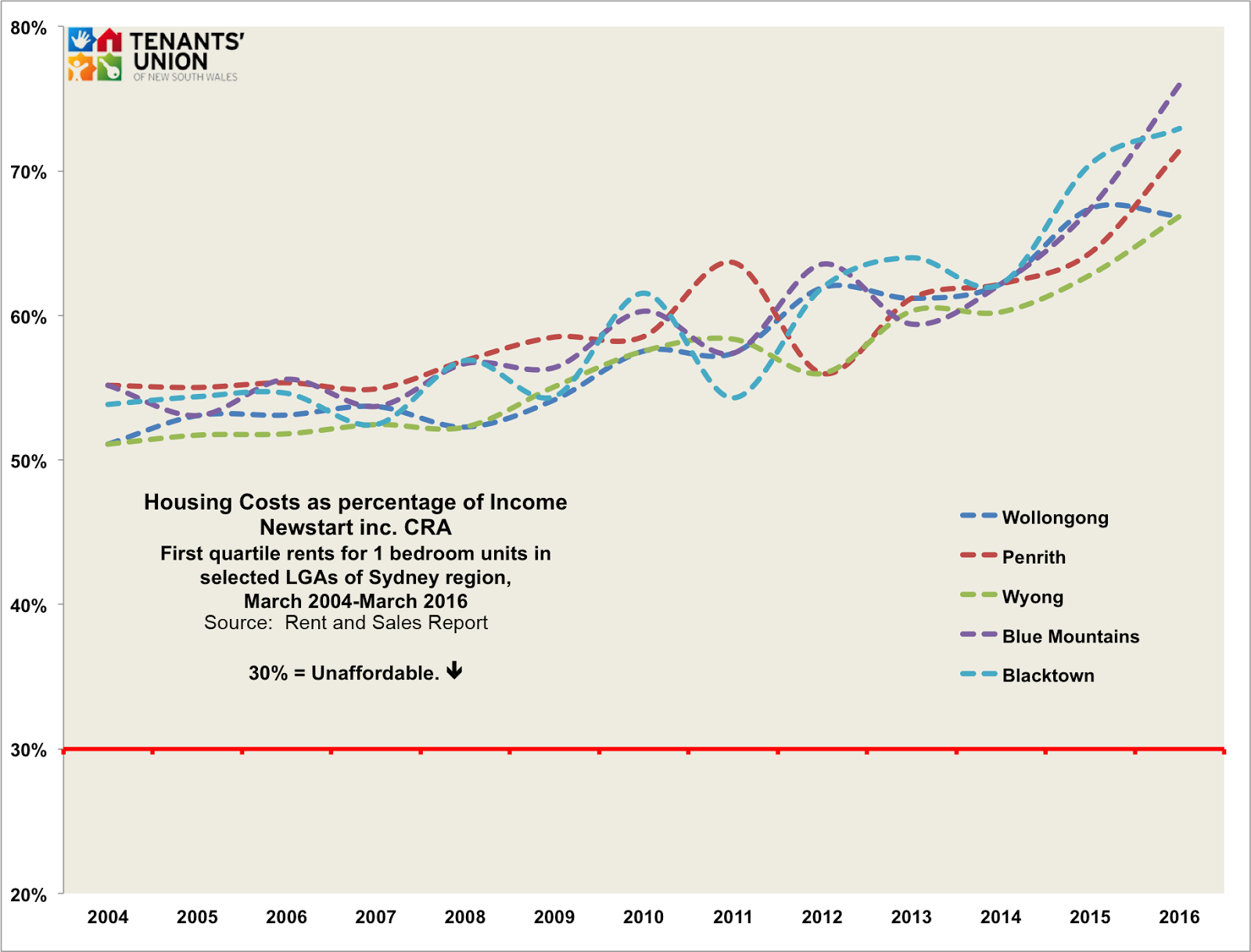
We've looked at how much a one bedroom apartment would cost to rent in some of the more traditionally affordable parts of Sydney and surrounds, and compared it to the income a single person person receives on the Newstart allowance, plus CRA. We can see the numbers going back to 2004 when the Rent and Sales Report began reporting on first quartile rents for each Local Government Area. The "first quartile" in this case is the level of rent halfway between the lowest rent for new bonds lodged in March of each year, and the median, or middle rent.

We chose these five Local Government Areas as being both historically and currently some of the most affordable areas of the Sydney region, as well as representing the northern, southern and western areas within a relatively accessible distance from the city.
Clearly, Rent Assistance has never been about paying the rent in full. But it does make a real difference in bringing a home within reach for a lot of us who would struggle even more without it.

Click image for larger version
Government figures show that more than a quarter of people in NSW who receive rent assistance would pay more than 30% of income if not for CRA, and 15% would otherwise be paying pay more than 50% of their rent. However, in NSW we are still left with 15% of people, or nearly 70,000 tenants, who are paying more than 50% of their income even after receiving CRA.

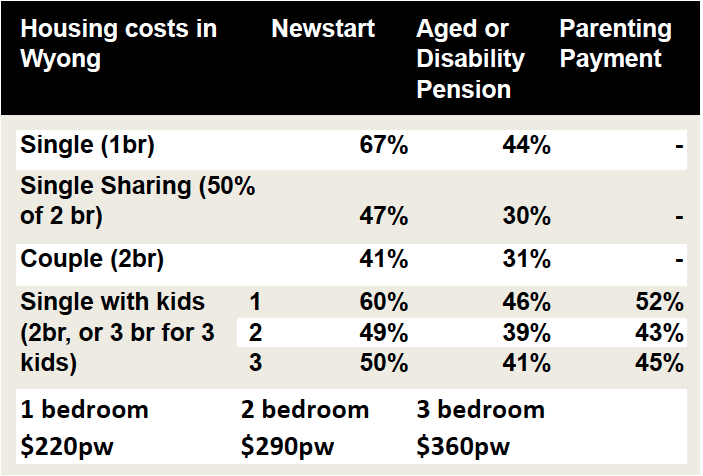
The #votehome campaign is calling for a 30% increase in rent assistance. What would that look like? We've applied that to a few different household types in Wyong, the cheapest LGA for lower quartile rents in Greater Sydney. These figures show what percentage of income is taken up by rent after receiving CRA. Remember, anything over 30% is considered unaffordable if you receive a low income:


With a 30% increase in CRA:


OK, it may not look like much, but it translates into around $20 a week more to spend on food, utilities, clothes or health. While the other income support payments look better, it is important to keep in mind that people living with disabilities, and those with kids do have other expenses that can really stack up. Ultimately, Newstart is just inadequate as a payment and needs to be increased, but an increase in rent assistance will still make a substantial difference.

You can support the increase by signing the #votehome petitions here.

The rent figures were derived from the Rent and Sales Report. We'll be releasing the first edition of Rent Tracker shortly, where we'll dig in to the reality of rent prices in NSW and explore the wealth of knowledge that the tenants of NSW provide simply by paying bond.

Monday, June 30, 2014

Welfare reform = rent reform?

The release of an Interim Report as part the Governmnent's Review of Australia's Welfare System has everyone talking about welfare reform today. There are some things that warrant a mention here on the Brown Couch, too.


The Report spends some time looking at Rent Assistance payments, showing that rates of Rent Assistance have not kept pace with the growth in rents. Rent Assistance recipients are paying a higher proportion of their incomes towards the rent, as the rent-specific benefit is eroded by housing costs that have risen more rapidly than general inflation.

The Report concludes that "there is a need to redesign Rent Assistance to assist people in private rental who have the highest needs". As to what that 'redesign' might involve, the report is not prescriptive. But it does make reference to some earlier suggestions - such as those in the Henry Review - that would see Rent Assistance indexed to something other than the Consumer Price Index. Linking Rent Assistance to actual housing costs might have an interesting effect on Treasury's interest in the stability of market rents - but we'll leave that as an aside for now.

The Report has a go at further entrenching the idea of moving away from income related rents in social housing, too. This is also something we've seen before in the Henry Review, as well as the recent Commission of Audit. On this, the Interim Report is also a bit non-prescriptive, with a mere suggestion that "consideration could be given to moving away from the current system of income based rents towards the use of Rent Assistance as the preferred rent subsidy scheme across both private and public tenures."

But its stated rationale for this suggestion is worth a look: the apparent 'perversity' of people on low incomes 'preferring' to live in public housing, rather than the private rental market, on account of its affordability! According to the report, people might pass up the opportunity for paid work in order to maintain their position in public housing, or even on the waiting list.

(This has an eerily familiar ring to it. Of course, rather than changing the way rents are calculated, governments could instead choose to invest in more public housing. Or they could do both - but perhaps we should just stick to the issues at hand... after all, there's another Government Inquiry for all that, right?)

We'd go so far as to suggest there is another reason to prefer a social housing tenancy to one in the private market - and that's the relative security of tenure. You're far less likely to be turfed out of a social housing tenancy at the whim of the landlord, and certainly not without a reason... The Report seems to have missed this point entirely.

There's another important thing that's been overlooked here - and that's Henry's suggestion that there might be an additional payment for 'high needs' clients in social housing. This is consistent with the Commission of Audit's report - it was overlooked there as well...

***

Interested parties have been invited to comment or make a submission on the Interim Report by August 8th 2014.

Friday, May 2, 2014

What the Commission of Audit says about housing

The much anticipated report of the National Commission of Audit was released yesterday.

 (Chair of the National Commission of Audit, Tony Shepherd)

Of the comment generated so far, we reckon Fairfax's Peter Martin has nailed it with his criticism of the partial nature of the Audit: it looks at government spending, but not really at tax, and certainly not at tax expenditures.

Martin gives the example of retirement incomes; we can also see the flaw in the Audit in what is says about housing.

The Audit zeroes in on spending on Rent Assistance ($3.6 billion pa), affordable housing – in particular, the National Affordable Housing Agreement ($1.3 billion pa), which funds social housing, and the National Rental Affordability Scheme ($1.5 billion over four years) – and alleviation of homelessness ($159 million pa). It frames these as 'programmes that duplicate State responsibilities' (on the basis that 120 years ago, it did not occur to the drafters to include 'housing' in section 51 of the Australian Constitution).

The Audit notes the 'limited success' of these programs in delivering affordable housing and reducing homelessness, and so considers that the Commonwealth should pull back and 'limit its involvement in this area to providing rent assistance to income support recipients'. That includes social housing tenants, who'd henceforth be paying market rents. There'd be no housing agreements or grants to the States and Territories for social housing or affordable housing; the National Rental Affordability Scheme would go too.

The Audit mentions the Henry Review in support of the case for extending Rent Assistance and market rents to social housing; it does not mention, however, that the Henry Review also recommended an additional payment for 'high needs clients' of social housing.

And that's it. Because it doesn't really look at taxes, and certainly not tax expenditures, the Audit misses the really big housing subsidies: the $30 billion pa benefit for owner-occupiers effected by not taxing their capital gains, imputed rents or land values; and the $7 billion pa benefit for landlords effected by not taxing income spent on the costs of speculation (negative gearing) and only half-taxing the gains of speculation.

These benefits have encouraged households with money (or credit) to spare to spend it on their own housing, or on speculating on rental housing, driving up prices and limiting the effectiveness of the Government's own spending on social housing and affordable housing and homelessness alleviation.

The Audit has missed the real problem in housing policy, and the opportunity of offering real solutions.

Tuesday, February 25, 2014

Fact based reporting: part 2 - Commonwealth Rent Assistance

Welcome to part 2 of our reporting on the Productivity Commission's Report on Government Services of a couple of weeks ago. In case you missed it, we ran through the Report's sections on Public Housing.

Today, we look at the reporting on the Commonwealth Rent Assistance. Rent Assistance is a commonwealth funded program that has been running for decades as a support for private tenants who receive income support from the government, and since 2000 as support for families receiving the Family Tax Benefit. Since 2008 it has also been available to Community Housing tenants and other social housing tenants who are not in public housing. For an overview of how Rent Assistance works in private market and the social housing, we cover it in depth in this Henry Review post. It is worth keeping in mind that for much of these numbers, social housing tenants are included, though the benefit of rent assistance to them is negligible as 100% of it is collected by their provider.

There were 421 235 rent assistance recipients in NSW in the year 2013- a full third of the nation's recipients.


Numbers of recipients in housing crisis, paying more than 50% of their income on rent.
Nearly 20% of CRA recipients still spend more than 50% of their income on the rent. This figure would be 34% if not for the payment.
Back in 2003, it was just over 11% and it's been going up almost every year since then, as the caps rise much more slowly than rents do. Along with other government payments, the CRA maximum rates get adjusted with CPI every 6 months.


The recipients of CRA have stayed broadly the same demographic over recent years except for the inclusion of the various social housing tenants who started receiving CRA since 2008. This has effectively changed very little as the recipients of CRA are largely the same cohort as people who live in community housing. 


The age spread of CRA does favour a younger population, mostly due to the parenting payments which comprise almost a quarter of recipients in NSW. It is worrying that all the groups over 60 are overrepresented as well, as rates of home ownership are higher in those older age groups. This suggests elderly tenants struggling to pay the rent without this payment though we certainly don't have the data to say this for sure.

Rent Assistance is an effective payment at assisting vulnerable tenants in the private market, though its effectiveness is being reduced as rents continue to rise faster than the payments can keep up. As the sole government payment directed solely at tenants, we hope it can continue into the future.

Monday, October 21, 2013

Grattan Institute on housing subsidies

We were just saying in Anti-Poverty Week how our housing system, in the absence of a genuine housing policy, enriches some while it impoverishes others – now the Grattan Institute puts some numbers on the problem.

The Institute's report, 'Renovating Housing Policy' looks at the cost and allocation of subsidies provided by Australian governments and delivered through the private housing system.

The winners are home owners, recipients of $36 billion (on average, $6100 per household) in tax expenditures and other benefits each year. These subsidies come from the exemption of owner-occupied housing from capital gains tax, land tax, income tax (on imputed rents), and the assets test for the Age Pension, and the First Home Owners Grants. Take a bow, home owners.

Runners-up are the landlords, recipients of $6.8 billion (on average, $4500 per household) in subsidies per year. These subsidies come from our generous tax treatment of capital gains and negative gearing.

And limping in in third place: private renters, whose Commonwealth Rent Assistance is worth, on average, $2900 per household per year.


All in all, more than 90 per cent of housing subsidies go to property owners. Some further dimensions of the inequity of our housing system are also made clear in the report.

First, rates of home ownership are declining, particularly amongst younger and lower-income households, so access to these subsidies is concentrating amongst older households and higher-income households.


Secondly, amongst owner-occupiers and landlords, the largest subsidies go to the households with the highest incomes.

The report concludes with a call for the renovation of housing policy, including such sensible measures as a broad-based land tax, a reduction in the preferential treatment of negative gearing and capital gains, and tenancy law reform to improve tenants' security and freedom of choice (for example, the choice to keep a pet).

A final thing: you might wonder where social housing fits in housing subsidy league table. The report doesn't say, but according to the most recent data from the Australian Institute of Health and Welfare, of public housing households who receive a rental rebate, the average amount is just under $6300 per year. Which puts their level of housing subsidy just ahead of most home owners, but still behind the level of subsidy that goes to homeowners in the top 20 per cent by incomes.

Monday, October 14, 2013

Anti-Poverty Week 2013

It's Anti-Poverty Week.


At the Brown Couch we see poverty in the context of the housing system, which enriches some while it impoverishes others. Our anti-poverty wish is for the housing system to be governed by a housing policy – we don't currently have one, either at Federal or State levels of government – with the objective of housing all citizens affordably, securely and to appropriate standards, and with housing tenure made a matter of genuine individual choice.

As it is, the kindest thing that can be said is that our housing system is governed instead by retirement incomes policy – and it is a pretty shabby sort of policy, being about transferring wealth to older households who already own property and are approaching retirement looking for a quick super fix.

It's hard on younger property-buying households, from whom wealth is being transferred, because of the debts they'll shoulder longer into their lives, without the assurance of rising asset values – or indeed, rising incomes – in an economy hollowed out of productive capacity because too much of our capital and credit has been sucked up the housing wealth/retirement spending transfer tube.

And it is hard on those households – young and old, but particularly the older households – who don't own property, and who won't in retirement have access to the transfer mechanism that retirement incomes policy is counting on.

That's big picture stuff, and there's lots to do to address it and effect a genuine housing policy. But there are a couple of particular things governments could do now to reduce housing-related poverty:

  • First, the Federal Government could lift the caps on the maximum amounts of Rent Assistance. (ACOSS recommends a $15 per week increase – total cost $500 million.) This is a targeted reform – not an across-the-board increase, but rather an increase for those at the pointiest end of the rental affordability crisis.
  • Second, the NSW State Government could repeal Housing NSW's policies for moderate income rental rates, and reviews as to continuing eligibility, which stop public housing tenants from seeking work, on pain of confiscation of half their earnings and eviction.   


Tuesday, February 7, 2012

Australians for Affordable Housing Budget Statement

Australians for Affordable Housing have today launched their Budget Statement for this year, calling on the Federal Government to address housing stress where it is hurting most – in rental housing.

And partly because it is Share Housing Month – and partly because it is where the housing stress numbers are worst – let's look more closely at the situation of students and job-seekers. 


According to AAH, more than 70 per cent of Austudy and Youth Allowance recipients, and more than 60 per cent of Newstart recipients, are in housing stress – that is, they pay more than 30 per cent of their income in rent, even after Rent Assistance is added to their (very low) incomes. And this means serious proportions of people skipping meals and going without health and dental care in order to pay the rent.

(Click on image for a better view)
In response, AAH proposes (as have we, and as did the Henry Review) an increase in the maximum rate of Rent Assistance. AAH proposes $25 per week, which, as you can see, would achieve a modest reduction in the number of persons in housing stress. 
More importantly (and this isn't shown in the numbers), an increase in the maximum rate would most help those in the most acute housing stress – even if it doesn't get them out of housing stress altogether. This might mean the difference, so to speak, between eating beans and not eating at all.

That's the demand side; on the supply side, AAH calls for an Affordable Housing Growth Fund, to continue what the stimulus only started: the rebuilding of the social housing system after years of neglect and decline.

And as the national media turns its attention to what the RBA will do to interest rates, it's the best affordable housing plan you'll read all day....

Tuesday, July 19, 2011

The Henry Review review: part 4

Now we draw to a close our review of the Henry Review and, in particular, what it had to say about housing.

We'll do so with a summary of what it had to say about (1) the taxation of owner-occupied housing, (2) the taxation of rental housing, and (3) the provision of housing assistance in the forms of Rent Assistance and social housing.

In relation to each, we'll also note the response of the Government, and add a few words of our own.


*

1. Taxation of owner-occupied housing.

Henry says: let's keep the preferential tax treatment of owner-occupied housing. In particular, let's keep exemption of owner-occupied housing from capital gains tax. (And let's not even consider the taxation of imputed rents – that is to say, the value of the housing services that owner-occupied housing produces and that is consumed directly by the owner.)

But, let's include owner-occupied housing in a reformed land tax regime.

And let's think about a bequest tax.

The Government said: we 'will not... at any stage... introduce land tax on the family home – this is a state tax and thus an issue for the States.' (And it goes without saying that we agree with Henry on keeping the exemption from capital gains tax.)

And we will not introduce a bequest tax at any stage, either.

The Brown Couch says: first of all, a general note: this was, literally, the Government's response to so much of the Henry Review's recommendations. Its press release of 2 May reads: 'In the interests of business and community certainty, the Government advises that it will not implement the following policies at any stage.' Thereafter follows nineteen dot points, of which land tax and the bequest tax are just two. We'll encounter a few more of these 'not at any stage' dot points.

As for the substance of the recommendations and the response: the preferential tax treatment of owner-occupied housing is a core component in the Australian house price bubble-making machine.

Now, this machine runs on a volatile blend of animal spirits and debt. It seems that at the moment, supplies of this fuel amongst Australian households may have been tapped dry: housing credit growth has stopped, and prices are flat and falling. We've heard from respectable commentators – that is to say, commentators who have long argued for reform of the taxation of housing to improve affordability – that including owner-occupied housing in the capital gains tax regime at this stage may be revenue-negative, because the gains aren't there at the moment and, as a necessary corollary, you'd also have to allow deductions for owner-occupiers' interest payments. And the latter aspect could well give a fillip to borrowing – at this stage. But, at some stage, there must come a time to start dismantling the house price bubble-making machine, including the tax-preferencing of owner-occupied housing.

Land tax reform, however, is something we could proceed on now – and the fact that it is a tax levied by the States does not mean that the Commonwealth cannot act on it. In particular, the Commonwealth should look at how it distributes, through the Grants Commission, its tax revenues to the States, and calculate the distribution on the basis that each States' own tax base will include a reformed land tax.

And the bequest tax – or unearned wealth tax, as we like to call it – let's do it!

2. Taxation of rental housing.

Henry says: investing in rental housing, shares, putting money in the bank – it's all saving, isn't it, so let's tax these different ways of saving more consistently. Let's tax the income from savings (whether it's rent, dividends, interest or capital gain) at a 40 per cent discount. In relation to rental housing, this means slightly more tax on capital gains, reduced tax for landlords who have a positive net rental income, and reduced losses deducted against other forms of income for landlords who have a negative net rental income – thus watering down the encouragement that Australia's unique negative gearing provisions give to big-borrowing landlords.

The Government said: we will not reduce the capital gains discount, or apply a discount to negative gearing deductions.

The Brown Couch says: negative gearing is financial alchemy, and when it's conducted in the crucible of the housing market, which is already subject to the tax preferencing of owner-occupation, you get a very volatile, bubbly brew. The reforms Henry recommends are mild; for a stronger reform, try quarantining rental losses from being deducted against other forms of income at all.

3. Housing assistance.

Henry says: as a form of housing assistance, Rent Assistance ticks a lot of an economist's boxes. We just need to lift the thresholds at which Rent Assistance maxes out.

Social housing, on the other hand, presents problems – but many of them are fixable, if you extend market rents and Rent Assistance to social housing tenants. For tenants with very high needs, there should also be a new additional payment, that goes to their landlord.

The Government said: we will not ask the States to charge market rents [subject to Rent Assistance] to social housing tenants.

The Brown Couch says: Like Henry says, lift the caps on Rent Assistance. And Henry makes some strong arguments about the problems with social housing's income-related rents. There's a number of forces converging on social housing rent policy that will change its shape – what do tenants and their advocates want to make of this?

*

Thus ends our review of the Review. We look forward to the National Tax Forum on 4-5 October this year, and recommend you keep an eye on TaxWatch in preparation.

A final couple of observations: all those 'not at any stage' dot points happened not just one year ago now, but one prime minister ago, one hung parliament ago. And, having retired from the Treasury, Dr Ken Henry has recently taken up a part time job in the office of the Prime Minister. He won't be doing the photocopying and making the coffee.

Wednesday, May 13, 2009

The Brown Couch's Budget Reply Speech

It is with regret that the Brown Couch, having applauded the Federal Government's second stimulus package in February, must now issue a strong boo in reply to its Budget.


(Boo!)

The booing is deserved for two reasons.

The first, of course, is the decision to extend the Boost to the First Home Owners Grant until the end of the year (albeit at a reduced amount for the last three of the six months). So first home buyers can continue to pay too much for their housing for the next six months (and, because almost all of them also borrow heavily, they will also be paying too much for the next three decades or so).

I understand the argument that the Boost, as it applies to newly-built dwellings, stimulates employment in the building industry. But that argument doesn't hold in relation to existing dwellings, which is where most of the Boost money goes. (And I think the housing industry lobby agrees. In the pre-Budget speculation about the fate of the Boost, they were implicitly saying: keep the newly-built-dwelling-Boost and, if you must, ditch the existing-dwelling-Boost.)

The Boost, as it applies to existing dwellings, doesn't keep builders and tradies employed. Let's call it for what it is: it's part of Australia's own housing-bubble bailout. This is a bailout of house-price speculators, partly financed by the taxpayer through the FHOG Boost, and partly debt-financed by first home buyers. And for many of the latter, as the recession hits harder and they lose their jobs, their participation in the bailout will end in tears.

The second reason for booing: what the Budget does in relation to pensions and other social security payments – or more accurately, what it does not do. One feels a bit curmudgeonly for begrudging Age Pensioners their increase, but not all of them need it so much as the social security recipients who rent privately do. These folks include Age Pensioners, but also Single Parent Payment recipients, Newstart recipients and others, and their housing costs have recently much more than the housing costs of Age Pensioners who own their homes or who rent in social housing.

The better way to go would have been to increase these citizens' incomes through the Rent Assistance payment. In particular, the Government should have lifted the maximum amount of Rent Assistance a person can be paid, because currently it is capped at amounts that leave some recipients in severe housing stress. This would entail no across-the-board increases, nor any expansion of eligibility, so shouldn't inflate rents generally – instead it would be targeted assistance to people who desperately need it. But no, they'll not be getting it from this Budget.

Monday, March 2, 2009

Government turns down smart reform of Rent Assistance

The ABC has reported some disappointing news about Rent Assistance, which is paid to some recipients of Centrelink payments and Family Tax Benefit.

The Federal Housing Minister, Tanya Plibersek, has ruled out increasing Rent Assistance payments, saying that the Government would prefer to increase the supply of affordable housing, and that

In a very tight rental market it's possible that an increase in the rent allowance would simply flow straight through to landlords in increased rents charged.

The Minister's comment makes a lot of sense – in fact, it would be nice to see this sort of sense applied to the First Home Owners Grant, which also flows straight through to existing property owners in increased prices charged.

The disappointment is that her government has passed up a smart proposal by ACOSS and National Shelter for an increase in Rent Assistance that directs, in a tightly targeted way, much-needed assistance to households with the worst housing affordability problems, while avoiding a general inflation in rents.

First, it helps to understand how Rent Assistance works. You get Rent Assistance if you're an eligible person whose rent is above a certain threshold (this threshold varies according to whether you're single or in a couple, and how many children you have). For every dollar of rent you have to pay above the threshold, you get 75 cents of Rent Assistance. Your Rent Assistance is also subject to a cap or maximum amount (this maximum amount also varies according to your household circumstances). At the moment, the maximum amount for a single person without kids is $110.20 per fortnight.

So, if you're in part of the country where rents are very high – say, inner Sydney, where the median 'new agreement' rent for a one-bedroom flat is $770 per fortnight – your Rent Assistance will max out at an amount that will leave you very short.

The smart thing to do is to lift the maximum amount of Rent Assistance. Doing so would help those renters most in need – without expanding the number of persons who receive Rent Assistance, and without increasing Rent Assistance payments across the board. This targeting means that the prospect of landlords simply increasing rents across the board is minimised.

A smart idea that has, alas, been turned down. What a shame that a fraction of the amount blown on the First Home Owners Grant Boost couldn't have gone to renters at the pointiest end of the affordable housing crisis.