Sunday, November 22, 2015

Vale Adele Horin

We're saddened today to read of the passing of Adele Horin, former Sydney Morning Herald columnist and blogger, as tributes flow from colleagues and readers alike.


Horin will be remembered for the things she chose to write about as much as the way she wrote. She gave a voice to issues that might have otherwise gone unspoken in the mainstream media, and her writing was always powerful.

We remember Horin in particular for her contribution to boarding house reform in New South Wales. The political motivation that finally resulted in the Boarding Houses Act 2012 is owed, in some part, to a report published in the Sydney Morning Herald in mid 2011 - Horin's Disturbing tales from behind closed doors.

There remains a great deal of work to do, to ensure the rights of boarding house occupants are protected and enforced in New South Wales. But today we take a moment to reflect on how far we have come, and acknowledge those who have made a difference along the way.

We paid tribute to Horin when she penned her last column for the Herald - a piece called For richer and for poorer, the battle goes on. In looking back over it today, we are again struck by Horin's insight, humility, and her frank ability to express what she saw. She made a few strong points that day. Many of them still resonate.

But that was not her last written word. Horin's last piece of public writing appears on her blog.
... right now dear readers, I’m too sick to continue to write the blog. Maybe I will be able to re-start it again. But if not, I want you to know what a privilege it has been to be part of such a thoughtful community.
Our thanks go to you, Adele Horin, for the part that you've played in giving a voice to that community. Vale.

Thursday, November 19, 2015

NSW Government: you can do better than this!


 The apartments in Millers Point where long term public housing residents will be allowed to stay, as their historic terrace homes are sold for millions.


Ninety public housing tenants remaining in Millers Point received letters on Monday, 16 November 2015, with an offer to stay in the historic suburb by swapping their current homes for other non-heritage apartments: 24 of which are one bedroom properties, one is a two bedroom property and three are three bedroom properties. But there is a catch. Altogether only 28 apartments are on offer. Not everyone can stay. 'It's Sophie's choice,' said Chris Hinkley of the Millers Point community working party, and a resident for 44 years. The letter states that residents not relocated to one of the 28 properties will be moved out of Millers Point. Minister for Social Housing Brad Hazzard said it was a 'massive shift for the government', which had previously declared all tenants would be evicted and their public housing homes sold. Read more here.

However, the letter to residents states that the Government is proposing to 'defer', rather than 'withdraw', the sale of these properties. This poses the question as to the Government's future intentions. Are these properties to become part of a land bank with a view to their future sale?  What security of tenure does this provide to those residents who move in?

On 2 September 2015 the General Purpose Standing Committee No. 2. of the NSW Legislative Council called for submissions to its 'Inquiry into elder abuse in New South Wales'. Submissions closed on Sunday, 15 November 2015. The Tenants' Union lodged a submission.  It argued that, although elder abuse is generally between two individuals of unequal power where there is an expectation of trust, elder abuse also may be a systemic problem, with a government through its policies also being the instigator of such abuse. And it asserted that this is what is happening at Millers Point. It asked that the final report of the Standing Committee include a recommendation that the NSW Government allow remaining older residents of Millers Point to age-in-place in their current housing. This submission was submitted on 13 November 2015 and subsequently published by the Standing Committee. You can read it here.

NSW Government: you can do better than offer just 28 apartments to the remaining 90 tenants! At Millers Point you coveted your neighbours house (read more here). And you made a motzer (read more here)! By the Minister's own admission, the cottages in Millers Point have been a 'goldmine' for the government, such as 18-20 Munn Street which recently sold for $5.5 million.


NSW Government: give the remaining older residents a proper choice, not 'Sophie's choice' ... and this includes aging-in-place in their current housing. Then perhaps sell some of their houses if this remains your plan. But why not retain some of the units within the Sirius Building and workers cottages to maintain a semblance of a social mix ... so that Millers Point does not become an enclave for the wealthy?

Also, why not construct a new apartment building on vacant land at Millers Point, as originally proposed. In March 2014 The Sydney Morning Herald reported that the battle for Millers Point's long-term public housing residents to stay was lost when former finance minister Greg Pearce was sacked. In 2013 the Land and Housing Corporation had received heritage office approval to construct a building at Millers Point to accommodate up to 140 long-term residents. The housing department was preparing to lodge a subdivision application for the building. But two days after Mr Pearce lost his ministry in August 2013, the housing corporation was transferred from Finance into the control of Community Services Minister Pru Goward and she favoured removing all public housing from Millers Point. Read more here. Indeed its own consultant, Cred Community Planning, recommended that some of the funds from the sale of homes in and around Millers Point be used to build new social housing properties nearby, especially for elderly residents, adding that they may experience 'ongoing negative impacts of stress and poor health outcomes'. Read more here. The site of this proposed building remains vacant.
 
This needs to happen now, because the New South Wales Government appears to be clearing the decks in Millers Point and removing the final barriers for obtaining vacant possession of all the remaining properties. On top of the announcement by Minister for Social Housing Brad Hazzard, offering some residents the right to stay in two rows of apartments, two other events have just occurred, perhaps not coincidental. Firstly, Clause 16 (1) of the Residential Tenancies Regulation 2010 was amended on 30 October 2015 to exclude heritage properties owned by New South Wales Land and Housing Corporation and the Aboriginal Housing Office from heritage properties exempted from the operation of the Residential Tenancies Act 2010. Read more here. Secondly, nine of the remaining tenancies in Millers Point are managed by a real estate agent. And a number, if not all of these, were issued with 90-day 'no-grounds' notices of termination at the beginning of last week on the instructions of the New South Wales Land and Housing Corporation. 


Monday, November 16, 2015

Re-opening the case of the lost public housing tenancies

Two years ago, as the historic suburb of Millers Point was finally being eyed off by a state government desperate for revenue, the Tenants Union noticed that due to that very history, many of the properties being eyed off were exempt from the Residential Tenancies Act, and from the jurisdiction of the New South Wales Civil and Administrative Tribunal.


Last week, as reports of the first official notices of termination for Millers Point residents come in, we discovered that Housing has closed that exemption- making the job of removing residents somewhat easier.

You can read more about the exemption in the original blog post, and its implications in a Shelter NSW briefing paper- both of which will now require some amendment to be current, but are still very good documents of the situation at the time.

Back then, we alerted Housing NSW and their legal team to this exemption and they were unaware of the issue. We figured it created as many problems as it solved for the residents, and would have increased the cost of any disputes beyond the reach of most of the people affected- except for HNSW's legal team.

That said, we are disappointed this change came without notice or consultation from FACS Housing. If not for the vigilant eyes of tenant advocates, residents of these properties may not have seen the change before relying on the regulation as it had been until only a few days ago. Government should be open and transparent in its dealings, particularly when it comes to the dealing of land. Changing the legal status of hundreds of vulnerable people is not something that should happen in the dark, tucked away down the back of the Government Gazette.

Friday, November 13, 2015

Tenants steal the show at Parliament!

This week was an important one for our More Bang for Your Bond campaign.


For over six months, we have been campaigning for an increase in funding for the 19 Tenants' Advice and Advocacy Services operating across NSW. These services are funded with tenants' money, via the interest accumulated by bond monies held by the Rental Bond Board. Much of this interest is retained by the Government in surplus. But tenants' services have had no increase in real terms for over 12 years, despite a 25% increase in the number of tenants in the state over that time. And so the services are now stretched thin, forced to turn back those needing help on a regular basis. So with the backing of over 1500 supporters, we took the campaign to NSW Parliament - formally presenting a petition to bring funding up to speed with the needs of the rental market in 2015.

The presentation ceremony featured speeches from our Executive Officer Julie Foreman, as well as Dr. Geoff Lee MP (Member for Parramatta and Parliamentary Secretary), Jenny Leong MP (Member for Newtown), and David Mehan MP (Member for The Entrance). But by consensus it was our tenant speaker, Milly Morison, who stole the show. Milly's words perfectly capture the experiences of countless tenants across the state, and the vital role played by the service that assist them.

We are grateful to Milly, and proud to republish her speech in full here. 


Milly's speech:

Thank you all for coming today. I would like to take a moment to thank the Tenant’s Union of NSW and the network of Tenants Advice and Advocacy Services throughout NSW, for all the help that they have given me during my time as a renter.

I would like to give you a bit of background as to why I am so grateful for their help. A couple of years ago I was renting a house directly through the owner. We were on a periodic agreement when the owner fell ill and required the house back. He wanted to give us two weeks’ notice to vacate, so of course, we panicked. Finding a house in the Sydney rental market is challenging under the best of conditions. I called my aunt who told me about the Tenants Union, so I gave them a call. The friendly gentleman on the phone gave me some advice and told me there was more detail on their website. There I found a wealth of information and Factsheets, which I have been using as my essential manual ever since. The information contained told me the minimum required notice was 30 days. Armed with this information I was able to negotiate with the owner so we weren’t going to end up homeless, which was a real possibility as I had just quit my job and my housemate was a casual waitress.

In our next house we needed additional housemates to cover the rent. The new tenants did not want to be on the lease, and I wanted the extra rooms set up as short term leases. The tenants.org.au website helped me set-up sub-lease agreements and provided a sub-lease template. It helped me to navigate the nitty gritty details and maintain a positive relationship with the real estate agent. With the help of the Tenants Union everyone was looked after and no one got the raw end of the deal.

When I moved out of that house I transferred the tenancy to the two remaining housemates and again, the information provided by the Tenants Union was invaluable. They wanted to have their dog on the lease and at first the owner refused, but we were able to write a letter using information provided in the Companion Animals Taskforce submission that changed the owner’s mind. They were allowed to have the dog and I was able to move out.

Most recently I was living in a house and I had a falling out with my co-tenant. I gave her my four weeks’ notice but things got ugly very quickly and she refused to return my bond. The Rental Bond Board holds the bond for the whole house and don’t return portions of the bond to individual tenants. If one tenant leaves it needs to be negotiated between the two parties. So it felt that she suddenly had control of all my money. My local Tenants Advice and Advocacy Service walked me through, step by step, how to communicate with the real estate agent, how to behave in such a way that I was in the right, when I should give my keys back, what to do about a condition report and documenting the house upon exit. TAAS gave me all of the tools that I needed to get my bond back and because of their handholding I was able to successfully retrieve my money without having to take it to the tribunal.

Throughout my experience as a renter, a tenant, a share house mate, I have needed the assistance of the Tenants Union and the TAAS and I have regularly called upon their support in all of those sticky situations. I have used the Factsheets for all those niggles and I watch with interest their advocacy for tenants’ rights.


Mine is not an uncommon story. My rental history is a cardboard cut-out experience shared by many other renters around NSW. I have trouble imagining how people manage these issues without the support of the Tenant Union and Tenants Advice and Advocacy Services and I cannot state strongly enough how vital they have been as my aids through the rental world.

Fair Trading's review of the Residential Tenancies Act also asks for comments on how interest on tenants' bond money should be spent. Let them know directly here!

Wednesday, November 11, 2015

Renting laws in review: inspections and privacy

At over fifty pages in length, and posing 42 questions, Fair Trading's paper for the review of the Residential Tenancies Act 2010 provides broad scope for discussion. In the coming weeks and months, we will be highlighting some of the topics that interest us most here on The Brown Couch. Today we are looking at a landlord's right to access a property without the tenant's consent. The paper asks:

24. Are the notice periods for carrying out inspections appropriate?

25. Should the number of inspections allowed per year be reduced for long term tenants? If so, how long should a tenant have continuously occupied the same premises to be classified as a 'long term tenant'?

26. Are any additional protections needed for tenants and landlords regarding inspections and privacy?


Is current NSW law around access and inspections of a rental property... elementary?

The law allows a landlord to enter a residence without the tenant's permission (or even presence) to carry out a general inspection, perform necessary maintenance, get a valuation, and show the property to prospective buyers or new tenants. Tenants are entitled to different forms of notice depending on the purpose of the visit - for example, a landlord must give seven days' notice in writing before a general inspection. There are no strict limits on the maximum number of visits overall, but there is a cap of four general inspections in any 12 month period.

The use of different notice requirements and caps on visits does complicate things at first glance. But once you unpack everything it's quite straightforward, as the table in our fact sheet on the subject shows. But is this simplicity actually problematic? Parties frequently differ in their view of what is appropriate or necessary when the landlord comes around. And whilst the Act does contain rules regulating the conduct of the landlord during inspections, they are less than comprehensive.

Photography and video recording is one common ground for disagreement. In particular, a landlord's agent will often want to document a residence for the purpose of advertising it to potential buyers or replacement tenants. As the discussion paper notes, this represents a privacy and safety concern for many tenants - particularly when the photos or recordings reveal their identity, or valuable belongings. It's easy to see where the agent is coming from; an empty property is hardly going to catch the eye the cutthroat world of the online real estate pages. But should it really be incumbent on the tenant to assist a landlord in a process that will result in an end to their tenancy?

Though tenants enjoy a fundamental right to peace, comfort and private enjoyment, the Act fails to address the issue of photography and video recording directly. Moreover, that general protection can be difficult and expensive to enforce. A tenant would need to convince the Tribunal that the proposed photography or recording would amount to a breach of their peace, comfort, or private enjoyment; and obtain an order safeguarding that right. This would typically require attendance at both a conciliation and a hearing.

What's more, given such an inspection is likely to occur within a short window of opportunity - probably within the 14 day notice period of a landlord's intention to sell - a tenant would almost certainly require an urgent hearing to make sure the matter goes before the Tribunal in time to prevent the apparent breach. Urgent hearings are provided at the Tribunal's discretion only, and there are no formalised means of requesting one. It's not difficult to see why most people don't bother.

The Act is also vague in establishing the basic rules for inspections to show a property to potential new tenants. Here, a landlord must provide reasonable notice, and conduct no more inspections than is reasonable in the 14 days before the tenancy ends. But there is nothing to guide parties on just what is 'reasonable' in these circumstances. And a tenant would have to jump through the same legal hoops as those outlined above to obtain an order restricting the landlord where either party's notion of 'reasonable' is not in accordance with the other. What's more, given a tenancy does not technically end until vacant possession is returned to the landlord, and not the date specified in a notice of termination, determining which are the 'last 14 days of the tenancy' can be decidedly tricky. It is always unclear when the landlord becomes entitled to arrange such inspections.

There is also the question of notice, and how it must be given. A landlord is required to provide a tenant with written notice of some types of inspections but not others, but a failure to 'put it in writing' is common cause for conflict in all types of legal disputes. Parties with conflicting interests tend to remember conversations unfolding in the manner that suits them best.

Finally, there's the question of whether this is even necessary for all tenants. As the discussion paper succinctly notes, "It has been suggested that in order to strengthen the rights of tenants who have resided at the same premises for a number of years (‘long term tenants’), the number of inspections allowed per year should be reduced." Certainly, reducing the number of general inspections allowed for tenancies that have withstood the test of time would allow long term tenants to better enjoy their right to peace, comfort and private enjoyment.

As you can see, there's much to discuss on inspections. We'd love to know your thoughts as well. How has the law concerning inspections and privacy worked for you over the last five years? What changes could be made to make them better?

Fair Trading wants to hear from you, too - you can make a submission to to the review of the Residential Tenancies Act 2010 to help them understand just how these laws are treating you in your part of New South Wales.


Friday, November 6, 2015

Speak up, be heard!

"Landlords have a right to ensure their investment is protected and can generate reasonable returns. Tenants are entitled to suitable housing and reasonable rights to enjoy their home and not be evicted without prior notice."

So begins Fair Trading's discussion paper as part of the statutory review of the Residential Tenancies Act 2010.


Let's just let that sink in for a minute.

Landlords have a right to a protected investment that generates wealth.

Tenants are also entitled to rights, but nothing beyond the point of enjoying their home while they have one. The risk in the rental market, it seems, is all theirs.

People who live in rented homes deserve better than this. Not being evicted without proper notice is nice - but not being evicted without a proper reason is what we should be entitled to.

The number of people who live in rented homes is growing, and their profile is changing.

In our recent report on the Act, we pointed out that the proportion of households who rent in New South Wales has been steadily increasing for at least a decade. In 2001, 27.5% of private dwellings were occupied by renter households. In 2006 it was 28.4%, and in 2011 it was 30.1%. There are no signs that this trend is reversing - the population of renters in New South Wales is growing faster than the population in general.

We also know that the composition of renter households has changed over time. More people are renting for longer, and more and more families with children are making their homes in the rental market. In 1981, the proportion of Australian renter households who were families with children was around 26%. In 2011 it was closer to 40%.

Fair Trading's discussion paper also notes the changing profile of the NSW rental market:
Historically, renting has been viewed as a short-term housing option - a stepping stone to home ownership. Today, people are renting for longer. According to figures from the Rental Bond Board, in the last ten years there has been a 7.2% increase in the number of tenancies lasting longer than 3 years. A corresponding decrease of 5.2% was recorded for tenancies of less than 6 months.
These statistics paint a clear picture - more people are renting for longer in New South Wales.

But pointing out the statistics doesn't always get us very far. If we are to challenge the view that tenants are merely entitled to enjoy their homes while they have them - rather than feel some basic level of security within them - then we need to do more than recite statistics.

Tenants need to find their voice.

Download and read Fair Trading's discussion paper. Circulate it amongst family and friends. Talk about it. Think about it. Respond to it.

Let them know you're out there. Let them know that you are a person, not a statistic. Let them know what you think of renting in New South Wales. Your experience is valuable.

Fair Trading has set up an online form where you can answer some or all of the questions they've raised in their paper - find it here.


Sunday, November 1, 2015

Reaching tenants with other languages

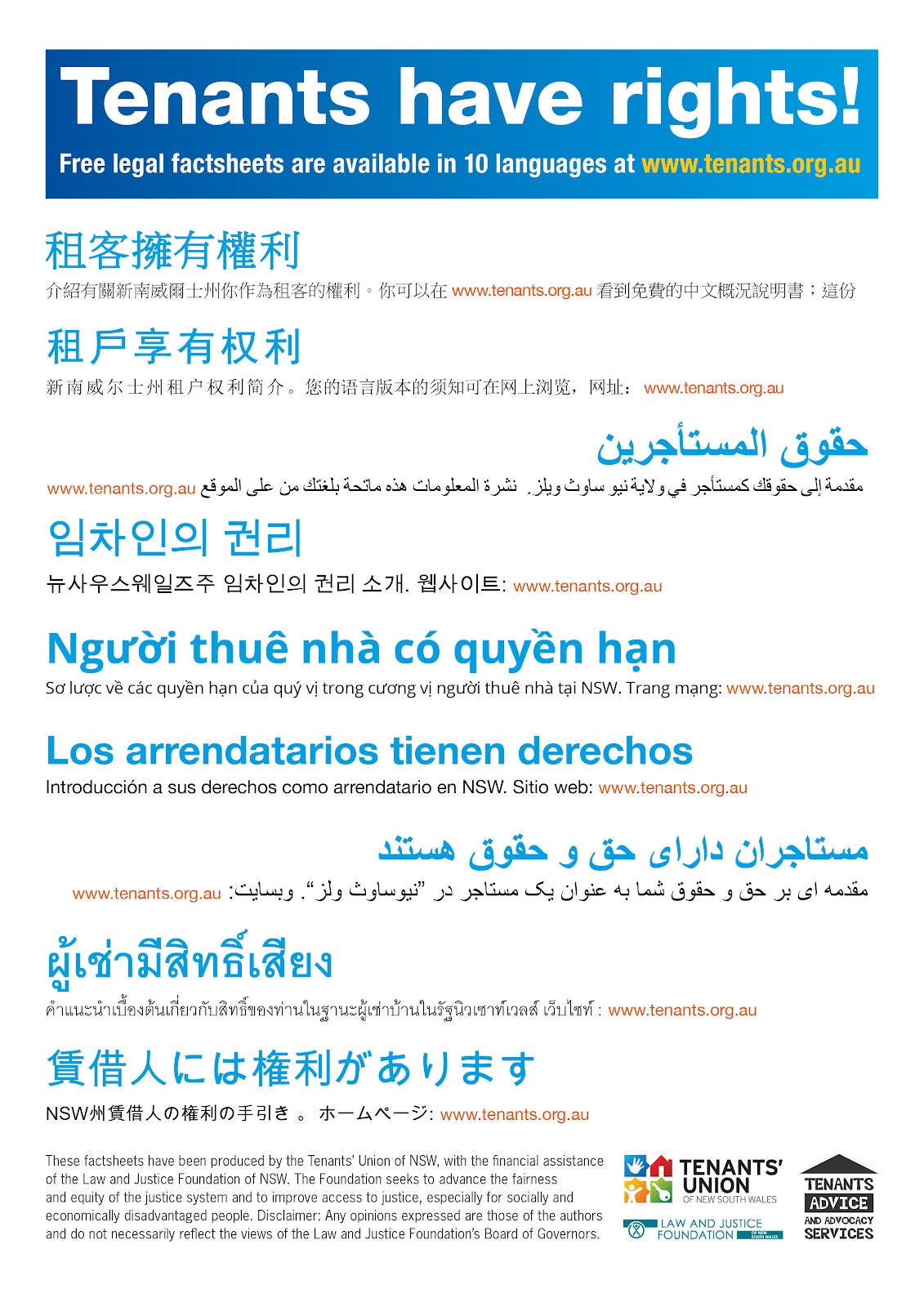
Ensuring everyone knows their tenancy rights is very important to us. With funding from the Law and Justice Foundation of NSW last year we released a spiffy new set of tenants’ rights factsheets translated into nine community languages that are common amongst renters in NSW.
thr-poster.jpg

The new factsheets can be found at the Tenants’ NSW website, right on the front page in the left most column. You can jump directly to your community language of choice and view an html version of the information or download a pdf copy.
If you or anyone you know wants to know about their rights and obligations as a renter in NSW and can read one of the following languages:
  • Arabic
  • Chinese (simplified)
  • Chinese (traditional)
  • Farsi
  • Japanese
  • Korean
  • Spanish
  • Thai
  • Vietnamese
Why not download a factsheet and give have a look!