Monday, October 3, 2011

International Tenants Day

It's 3 October, which means...

Happy International Tenants Day!


(Beautiful 2011 poster by our Swedish comrades)

When's International Landlords Day, you might ask. Why, it's every other bloody day of the year.

Enjoy the long weekend!

Friday, September 30, 2011

No cause for no-cause evictions

A no-cause eviction happens when a landlord gives their tenant a 90 day notice of termination. There's not a lot the tenant can do about a no-cause eviction, unless it can be proven that the landlord has given the notice in response to something the tenant has done to assert their rights. This is no good, and it's something that Tenants Advice & Advocacy Services have been talking about for some time...
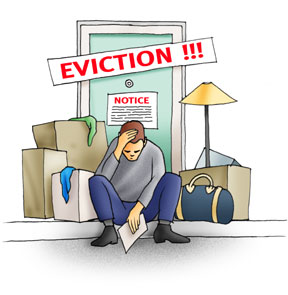
Now, it must be said that there is nothing in the law that compels a landlord to use no-cause evictions. Housing NSW, for instance, makes it a habit to not use them. That's because HNSW knows that, as a Social Housing provider, their tenants are entitled to know the reasons behind having their tenancy agreements ripped up. (It's also because they got dragged through the Supreme Court over the issue in 1991, and lost - in the famous case of Nicholson v NSW Land & Housing Corporation (Unreported, Supreme Court of NSW, 24 December 1991)). There are, of course, several ways to end a tenancy with cause, and generally these days HNSW tries these on instead...

But several Community Housing Providers (CHPs) do resort to no-cause evictions. According to our colleagues in the Tenants Advice & Advocacy Services, there are three observable trends in their use:

1. Managing transitional or temporary accommodation - that is, signing an otherwise homeless person up to a 'week-long' fixed-term tenancy in a refuge, and handing over a 90 day termination notice as a sort of appendix to the lease. (This rather interesting practice highlights the need for reform of the marginal rental sector - you can read more about that here).

2. Managing relocations when head-leases evapourate
- that is, using a 90 day notice of termination to end the lease on a property that is owned by a private landlord, rented out by a CHP, then sub-let to a social housing tenant, when the private landlord wants the property back. This is, in theory, followed by the CHP finding another place for their sub-tenant to live.

3. Avoiding scrutiny when trying to evict a tenant for a tricky or hard to prove breach
- that is, choosing to use no-cause evictions so that tenants can't argue against the reasons behind having their tenancy agreements ripped up, or properly respond to any allegations made against them.

Reliance on no-cause evictions is irksome in any circumstance, but it is particularly so when it comes to Social Housing landlords. They should, by the very nature of their business (not to mention their Regulatory Code), take a more open and transparent approach to ending tenancies.

It is also much more irksome now under the Residential Tenancies Act 2010 than it was under the Residential Tenancies Act 1987, because under that Act tenants did still have some hope of getting through a no-cause eviction without actually being evicted - back then the Tribunal was required to consider the circumstances of the case when deciding on matters of eviction, and had the discretion to call the whole thing off if the CHPs reasons for seeking termination were unsound. (For more information on this change to the law, see the discussion on Swain and the 'circumstances of the case' in this previous post).

But what would a more open and transparent approach to ending tenancies actually look like?


Let's have a look at each of our three scenarios above:

1. Managing transitional or temporary accommodation - for short term and temporary accommodation that is intended to last only as long as it takes to find a person a secure tenancy, occupancy agreements should be used instead of residential tenancy agreements. While there is currently no law requiring (or regulating) the use of occupancy agreements, we hope that this will soon change. In the meantime, CHPs and other socially responsible organisations providing temporary or crisis accommodation are well placed to pioneer the use of occupancy agreements. A sound occupancy agreement would set out the circumstances in which an occupancy can be terminated, and how much notice will be required.

2. Managing relocations when head-leases evapourate - there's simply no need to issue a notice of termination, by either the private landlord to the CHP, or the CHP to the sub-tenant. That's because a tenancy can quite properly be terminated by repudiation and acceptance, or by consent (under section 81(4) of the Act). In either case, the tenancy lawfully ends when vacant possession is returned to the landlord - which happens as a matter of course whenever a tenant moves out of one place and into another. A notice of termination is, in this scenario, nothing but unnecessary double-handling.

3. Avoiding scrutiny when trying to evict a tenant for a tricky or hard to prove breach - for every tricky situation that a Social Housing landlord might encounter, there are probably two notices of termination that could be applied - other than the 90 day notice. These have the added benefit of providing an opportunity for tenants to respond to any allegations made against them. The Tribunal - unless it is sorely mistaken - will not terminate a tenancy with cause unless it is satisfied, on the balance of probabilities, that the alleged cause has been established. In other words, the landlord must prove their case against the tenant before an eviction can occur.

Notwithstanding all of that, there are some compelling reason to regard no-cause evictions by CHPs as unsupported by law. We've run out of time to go into more detail on that side of things this time around... and we'll keep our fingers crossed that the issue will be dead and buried well before Social Housing Month comes around again. Because when it comes to Social Housing, there's really no cause for no-cause evictions.

Land tax and housing

This is a short diversion from Social Housing Month - but a necessary one. The Herald's Jessica Irvine has written a terrific piece on tax and housing, and especially the great advantages offered by reforming land tax. With the Commonwealth Government's Tax Forum on next week, it's essential reading.


(Well said, Ms Irvine!)

If you want to check out the research to which Irvine refers, you'll find Gavin Wood's presentation here.

Tuesday, September 27, 2011

Community Housing - what's not to like?

"Public housing is sometimes blamed for social problems ... However, that's the wrong way of looking at it because it's not the cause but the symptom."


So says Keith Jacobs from the University of Tasmania, in an article recently published by The Australian, called New ways of looking at social housing.

He also says "there's no question public housing is stigmatised in the eyes of many people, which is a real shame because 20 or 30 years ago it wasn't seen that way. I think part of the reason is that it's seen as a public policy failure, but I don't agree."

Indeed. But as the article in which he's quoted goes on to show, there's already a policy-shift taking place. Public Housing is on the decline. It's being swallowed up by the more politically attractive (and fiscally flexible) Community Housing - that is, non-government organisations who manage the government's housing assets (and, let's not forget, those consequential tenancies) for them...

Perhaps we're being a little melodramatic when we say "swallowed up". But there's certainly been a strong push in NSW to grow the Community Housing sector over the last three years or so, and this is not about to subside. Almost 3500 properties have been transferred over from HNSW's books to a number of Community Housing Providers (CHPs) since 2009, and the vast majority of properties built under the Federal Government's Nation Building stimulus plan are being handed over to CHPs as well.

...and in more good news for CHPs, a recent report into the social value of Community Housing in Australia has found them to be, well, significant. According to this report, the social benefits of a first year of living in community housing could add up to a substantial amount in monetary terms.


(Extract from "The Social Value of Community Housing
in Australia Report" page 3 - click to enlarge)


To break it down:
  • The economic benefit for residents due to greater financial flexibility and less ‘housing stress’ was assessed at $2,500 per person or $78.5 million across the sector.
  • Improved education opportunities for adults and children were valued at $75 million.
  • Health benefits due to improved health and less demand on public health services came in at $23 million.
  • The total social value of community housing was calculated at $176 million per year or $665 million over a five-year period.
Numbers like those should have everyone jumping on the Community Housing bandwagon. It would be interesting, of course, to see how the social value of Public Housing in Australia stacks up... and more interesting still to see what the cost of stigma really is. But that's not on the agenda right now. Right now it's all about Community Housing... and with so many of the benefits of Public Housing, minus the negative associations, what's not to like?

At the risk of sounding like a bit of a nark, here's a short list:

1. There's not enough of the stuff. Despite its recent growth, Community Housing still only accounts for about 1% of the NSW housing market. For comparison, private rental accounts for about 25%, and Public Housing accounts for 5%.

2. It's pretty tricky to get into. There are two reasons for this - the eligibility criteria is fairly tight, and on top of that there's not enough of the stuff. The successful applicant will be on a low income and experiencing some kind of difficulty obtaining or sustaining a tenancy in the private market... before being placed on a waiting list until a suitable property becomes available.

3. It's complicated. The sector operates within a complex maze of legislation, regulation and contractual obligation - and much of this is new. For many, finding a way through this web of complexity is a very daunting task. But quite aside from that, the very nature of the system results in inconsistencies across the sector, as each CHP is entitled to set its own policies and procedures as long as it complies with a general set of rules. While this is hailed by some as a key strength of the sector, it is felt by others as a new source of frustration.

Thursday, September 22, 2011

Tenancy Culture Studies: The Fringe Dwellers

The Institute of Tenancy Culture Studies returns with a look at Bruce Beresford's 1986 feature The Fringe Dwellers.


The Fringe Dwellers tells the story of Trilby Comeaway, a young Aboriginal woman who struggles to reconcile her expectations with her ambition. Trilby lives with her family in a makeshift shack on the outskirts of a country town, where she dreams of better things. She doesn't ask for much - just a life where she can study, work and live as an equal among the white, middle-class townsfolk... but for these dreams she is consigned to a life of derogation by both the mainstream she covets, and her family, who she would rise above. She fits nowhere - but she can't be ignored.

Trilby discovers that you can't escape yourself simply by changing your material circumstances. When her father Joe finds steady work, the Comeaways move into a neat fibro cottage in town, courtesy of the Housing Commission. It has all the mod-cons they had to go without on the fringe - running water, venetian blinds, a local school and a short walk to the hustle and bustle of Main Street. For awhile it looks as though all Trilby's dreams have come true.

Alas, it's not to be. Family and friends start to move in, and the house soon ends up as a microcosm of life on the fringe. But town-life comes with the entrenched racism and stigma that often follows Aboriginal people wherever they go. The neighbourhood fails to embrace the Comeaways and the townsfolk continue to malign them, as they struggle to live up to the expectations of their new community. Indeed, they rally against them, as Joe Comeaway proudly insists that no-one can remove his relatives from his home but he.

He needn't worry, because in all this time nobody's actually paid the rent. A simple oversight - an indication of the family's uneasy relationship with the town, and their failure to adapt to their new form of tenure - no-one's been down to the Housing Commission office since they moved in. Joe takes it on himself to sort this out, but is sidetracked on his way by an opportunity too good to pass up - an easy game of cards and a chance to double his money... He loses the lot, and goes walkabout rather than face the shame of telling his family what he's done.

Thus, the Comeaways are forced to give up life in town, and move back to their old shack in the bush. Here they can be themselves again - truly at home... But Trilby still doesn't see it that way. She leaves for the city, and an uncertain future.

The Fringe Dwellers presents a caricature of Aboriginal Housing - and a 25-year-old one at that. But there are many tales within that should still resonate today, particularly those of struggle, paternalism and prejudice. Because unfortunately, the Aboriginal Housing sector in NSW faces all of these things today...

Aboriginal Housing is a complicated beast. In NSW, it currently exists in two main forms - housing owned and managed by Local Aboriginal Lands Councils (LALCs) on behalf of LALC members; and housing owned by the Aboriginal Housing Office (AHO), often managed by an Indigenous Corporation specifically set up for that purpose. Each of these has their own administrative or legislative context within which to operate, and each is responsible to its own chain of command. These organisations have survived years of policy neglect and poorly targeted resourcing from various governments, to which they've adapted as best they can. The upshot of this is that a relative amount of rental housing is owned and managed directly by Aboriginal people in their own interests. The downside is that much of this housing is in poor condition, with significant maintenance and repair costs (on top of administrative costs and other expenses for many of these organisations) making the Aboriginal Housing sector as it is today largely unsustainable.

But the sector has the capacity to evolve, and it had begun to emerge from its predicament with a hint of confidence through a policy framework known as the Sector Strengthening strategy. A key aspect of this strategy was to support Aboriginal Housing providers in their tenancy and property management, predominantly through the use of Regional Aboriginal Management Services (RAHMS). RAHMS provide sector specific, independent, professional management services at arms-length, by Aboriginal organisations established for the purpose - and they take a huge amount of pressure off many small, struggling providers.

Another key aspect of the strategy was that it was based on a great deal of consultation and discussion amongst providers, tenants and relevant government agencies. It provided a solution that many people saw as workable, and those affected felt at least some ownership over it. So it came as a surprise when a new policy direction was announced shortly after the Sector Strengthening strategy kicked off...

The Build and Grow Aboriginal Housing Strategy follows reasonably closely the reforms to the mainstream Community Housing Sector - at least in spirit. It requires Aboriginal Housing organisations to register under a new registration scheme (the Provider Assessment Registration System - or PARS) in order to become eligible for funding made available under the National Agreement on Remote Indigenous Housing (even though the vast majority of Aboriginal people live in urban locations). But the registration requirements are more onerous than anything previously encountered by the sector, and the funding will not be recurrent... so there are concerns that many Aboriginal Housing organisations will opt not to register. Those who take this path will have a choice - to offer their properties to the AHO to be head-leased for a minimum of ten years to a registered provider, or to go it alone without further assistance.

Anyone with even a vague understanding of Aboriginal disadvantage will see that this is no choice at all. But the thought of handing properties over to the AHO is completely unpalatable to many Aboriginal people - who have fought long and hard for all that they've got - so there's a high probability that some Aboriginal Housing organisations will just opt out of the strategy completely.

This brings us back the The Fringe Dwellers, and its messages for Aboriginal Housing:

- Aboriginal people face a particular disadvantage that can't be overcome by simply requiring them to behave like their non-Aboriginal peers. Genuine support is needed.

- Aboriginal people are best placed to determine solutions to many of the specific problems they face - but paternalism, prejudice and the shackles of disadvantage will often prevent them from seeing these solutions through.

For all it might achieve, the Build and Grow strategy has failed to address these two critical points. For those who make it through PARS, we will applaud with gusto. But for those who don't, an uncertain future awaits...

Tuesday, September 20, 2011

Falling down in the best part of town

We make it a rule to stay away from the property pornography in the weekend Herald, but this story of a couple taking on a 'renovator's delight' in Millers Point caught our attention. The property in question is one of many historic buildings in the area owned by Housing NSW, having previously been owned by the Maritime Services Board and, before that, by the Sydney Harbour Commissioners, who resumed the area upon an outbreak of bubonic plague in 1903. Now these old buildings are being sold on 99-year leases*, with heritage conservation plans attached, to persons of means.


(Millers Point)

The sales started a couple of years ago, with 16 vacant properties put on the auctioneer's block. Now another 20 properties are to go. We don't mean to knock the new residents, but we have to admit to feeling uneasy and sad about what these sales mean for Millers Point.

We can understand Housing NSW's position. The houses are old and in need of repair. (We should know: until a few years ago, the Tenants' Union had its office in a terrace house on Bettington Street, Millers Point, and it was falling to bits. When the floor gave out under our litigation solicitor, it was time to go.) They are also historically significant, which makes the repair work very expensive.

So it would be costly to keep them... and letting them go to the bourgeoisie is proving to be lucrative. The house in the article went for $1.75 million. Last month another went for $1.25 million, and another for $980 000 – so far, $34 million has been raised, with which Housing NSW has purchased additional properties for public housing in the inner west.

But.... the decision to go further than the initial 16 properties rankles. It also makes Housing NSW's assurances that only vacant properties will be sold off less than completely comforting, particularly to public housing tenants at Millers Point. These people feel acutely the calculating gaze of Housing NSW's bean counters – and that of the media's self-appointed custodians of the public interest – and consequently enjoy less real security and peace of mind than they deserve.

It also seems a poor return for what public housing has done for the area. Sure, the buildings need repair; but the fabric of the area as a whole is a rare marvel. Walk up from the Quay: when you step out from the shade of the Argyle Cut, everything slows down; the residential streets and lanes are beautifully quiet. You can spend an afternoon walking through the history of inner Sydney: grand Georgian houses, Victorian terraces, working-class walk-up flats and boarding houses; the Observatory; the pubs and wharves and the sandstone cliff of the Hungry Mile; the Harbour Bridge.

Now, with the wharves being redeveloped as the Barangaroo parklands/office/floating hotel precinct, and the old houses being auctioned off, Millers Point is on the National Trust's 'heritage at risk' list. Intentionally or not, public housing helped keep Millers Point as it is. And we'd like to see it kept as public housing, with specific funds from the State's consolidated revenues for the repair and conservation of its heritage value.

* Why 99-year leases? According to community sector oral history, the resumption and redevelopment of the area has left the titles in a mess. More reliable explanations and evidence gratefully received.

Friday, September 16, 2011

How to win appeals and influence social housing landlords!

... and what would Social Housing Month be without an invitation to a Housing Appeals Committee forum making its way across your desk?

(click on the image to read the fine print!)

"A forum for Community and Advocacy Agencies - to help you advise clients on how the appeals system works in NSW, and how to help them appeal."

For more information on the Housing Appeals Committee, please visit their website, or contact your local Tenants Advice & Advocacy Service.