Yesterday Fair Trading released bond data for the first time other than through the Rent and Sales Report. We welcome the release of this data as it will be very useful to enhance understanding of issues and trends in the rental sector. As the Minister for Innovation and Better Regulation, Matt Kean said in his media release, “I want to put consumers first and this data does that by allowing open, transparent access to useful rental information.” Sounds good to us, Minister!
However, it pays to understand what this data tells us - and just as importantly what it does not.
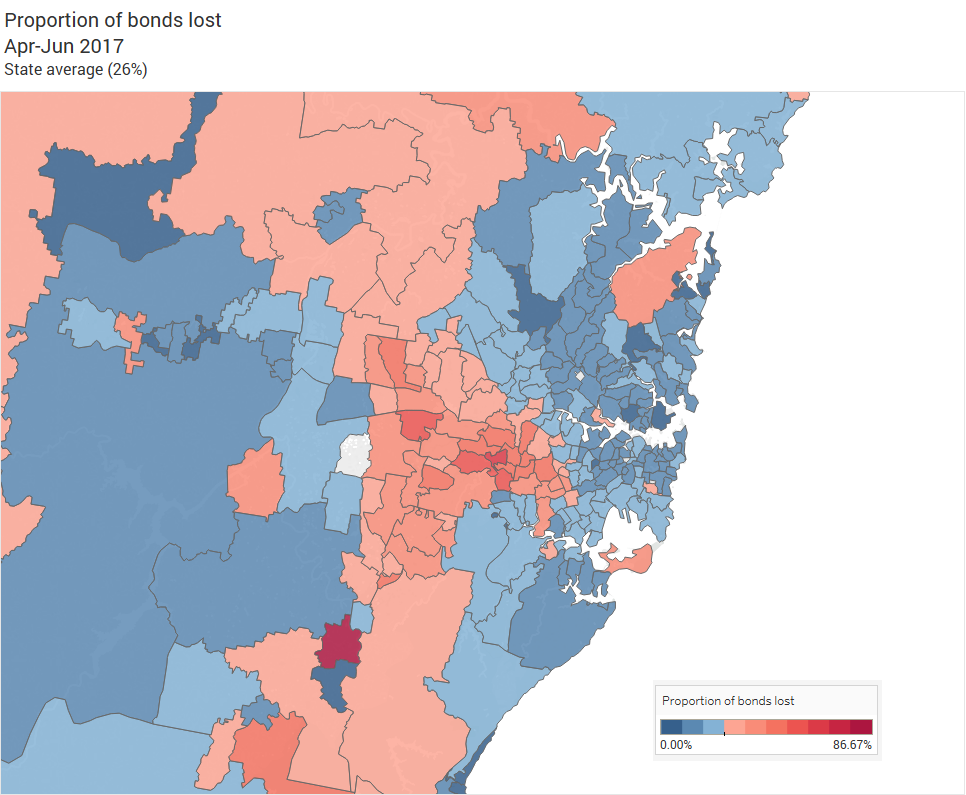
An article this morning helped to demonstrate the limits of this data. Looking over the data, the journalists discovered that a much larger proportion of bonds being refunded in some areas of Sydney and New South Wales were going to the landlord rather than the tenant. The problem is we don't know the context of those bond refunds, and how they were claimed.
Bonds can be released from the Rental Bond Board in one of three ways. The landlord and tenant can come to a mutual agreement and lodge a bond refund form with both parties agreeing to amounts payable either way. If the parties can't come to an agreement, one or other of them can make a unilateral claim for what they think is appropriate, without the other party's signature. The person who didn't sign is given 14 days to lodge an application to the Tribunal if they disagree with the claim. If they do not take it to the Tribunal the bond is paid out as requested. This is the second option. The last option is that the dispute does go to the Tribunal and the bond is decided either by a final negotiation, or as decided by the Tribunal Member.
Tenants and landlords should both be aware that the bond is the tenants' money. It is held in trust by the Rental Bond Board - it is not some common pool of money and landlords should not regard it as theirs for the taking. Vulnerable tenants may be unaware of their ability to dispute a claim against the bond, or indeed feel unable to assert their rights due to their vulnerability in the rental sector.
Whether bond refunds are agreed upon, or disputed, and whether a claim made by the landlord has been tested in the Tribunal is a crucial piece of information which the Rental Bond Board already has in its data banks and could release. It would go a long way to allowing researchers and journalists to peer behind the information that's already been released and examine the geographic differences that have been drawn out.
We've also heard that exit surveys on bonds have been considered - we think this is an excellent idea. For instance there is no information currently collected about how and why tenancies in NSW end - this means a government and community making decisions about how effectively tenancy legislation is working have a very deep and dark blind spot on an incredibly important aspect of renting law. An exit survey on the bond claim form would be a simple and effective way of adding a depth of knowledge to our collective understanding of the renting experience in our state.
In the spirit of open and transparent access to information, we encourage the Minister and Fair Trading NSW to consider releasing both the currently available information of whether bond claims are disputed and tested, and strongly consider implementing the bond survey to develop a truly excellent source of data.
Showing posts with label NSW Fair Trading. Show all posts
Friday, August 25, 2017
Friday, September 2, 2016
Does complaining make a difference?
Last week Fair Trading's Complaints Register was launched and the first months data is available. Unsurprisingly, four of the top 10 most complained about businesses are real estate agencies and their franchises. Those 4 companies shared 69 complaints about tenancy management, which was 21% of the complaints made about the 20 businesses on the register. Only the wide ranging "retail" category had more, covering computers to baby products across 8 businesses.
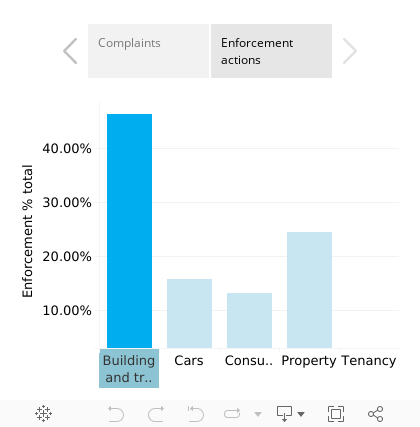
But what does this tell us about the impact of making a complaint to Fair Trading in New South Wales? We've had a look at the enforcement actions taken and total complaints made over the last year, which are also published by Fair Trading. We've had to make some broad assumptions in order to make the two lists comparable - enforcement actions are expressed as belonging to particular pieces of legislation, where complaints are categorised by complaint topic. For instance, there is some potential overlap between the two - a real estate agent misleading a tenant might fall under the Australia Consumer Law as well as the Residential Tenancies Act, and therefore could go under both Consumer and Tenancy topics below. You can scroll over each column to see how we've categorised complaints and enforcement action.
Although tenancy and consumer issues are two of the most complained about topics, they receive much less attention when it comes to compliance and law enforcement.
The lion's share of compliance action by Fair Trading NSW is carried out in relation to either the Property, Stock and Business Agents Act (which we have labelled Property) or the three laws relating to trades - the Home Building Act, Plumbing and Drainage Act and Electricity (Consumer Safety) Act. Despite only taking up 7% of the complaints made to Fair Trading over the year, they made up 70% of the enforcement action. Conversely, tenancy made up 9% of all complaints to Fair Trading, but only 0.25% of enforcement.
One way of explaining this gap is that there are different methods to deal with different kinds of complaint. For instance the NSW Civil and Administrative Tribunal is the primary way for tenants to address their issues with landlords and, by extension, real estate agents. Unfortunately, the Civil and Administrative Tribunal hasn't been publishing its annual statistics like its predecessor the Consumer Trader and Tenancy Tribunal did, and it misses much of the detail. The Tribunal's 2015-16 report has not been published yet but in 2014-15 we know that 58,360 applications were made concerning these topic areas (and others) and that more than three quarters (46,351) were about renting. What we don't know is who made those applications - but from historic data we know about 85% of Tribunal applications are made by landlords. So perhaps roughly 7,000 applications are made by tenants each year. This exceeds the 4,500 complaints made by tenants to Fair Trading, and dwarfs the 2 enforcement actions taken in relation to the Residential Tenancies Act.
This suggests to us that some people are expected to enforce the law themselves, and some can expect government will enforce the law on their behalf. The difference, it seems, is whether or not you are a renter.
We encourage tenants to make complaints, even if enforcement action is pretty thin on the ground. At the very least, complaints make Government agencies directly aware of the issues that people face. Fair Trading can use their complaints data to help them understand these issues and relate it to their public policy work, including current work around reforming the Residential Tenancies Act.
You can find sample letters that can help with writing complaints to Fair Trading at this link: here.
But what does this tell us about the impact of making a complaint to Fair Trading in New South Wales? We've had a look at the enforcement actions taken and total complaints made over the last year, which are also published by Fair Trading. We've had to make some broad assumptions in order to make the two lists comparable - enforcement actions are expressed as belonging to particular pieces of legislation, where complaints are categorised by complaint topic. For instance, there is some potential overlap between the two - a real estate agent misleading a tenant might fall under the Australia Consumer Law as well as the Residential Tenancies Act, and therefore could go under both Consumer and Tenancy topics below. You can scroll over each column to see how we've categorised complaints and enforcement action.
The lion's share of compliance action by Fair Trading NSW is carried out in relation to either the Property, Stock and Business Agents Act (which we have labelled Property) or the three laws relating to trades - the Home Building Act, Plumbing and Drainage Act and Electricity (Consumer Safety) Act. Despite only taking up 7% of the complaints made to Fair Trading over the year, they made up 70% of the enforcement action. Conversely, tenancy made up 9% of all complaints to Fair Trading, but only 0.25% of enforcement.
One way of explaining this gap is that there are different methods to deal with different kinds of complaint. For instance the NSW Civil and Administrative Tribunal is the primary way for tenants to address their issues with landlords and, by extension, real estate agents. Unfortunately, the Civil and Administrative Tribunal hasn't been publishing its annual statistics like its predecessor the Consumer Trader and Tenancy Tribunal did, and it misses much of the detail. The Tribunal's 2015-16 report has not been published yet but in 2014-15 we know that 58,360 applications were made concerning these topic areas (and others) and that more than three quarters (46,351) were about renting. What we don't know is who made those applications - but from historic data we know about 85% of Tribunal applications are made by landlords. So perhaps roughly 7,000 applications are made by tenants each year. This exceeds the 4,500 complaints made by tenants to Fair Trading, and dwarfs the 2 enforcement actions taken in relation to the Residential Tenancies Act.
This suggests to us that some people are expected to enforce the law themselves, and some can expect government will enforce the law on their behalf. The difference, it seems, is whether or not you are a renter.
We encourage tenants to make complaints, even if enforcement action is pretty thin on the ground. At the very least, complaints make Government agencies directly aware of the issues that people face. Fair Trading can use their complaints data to help them understand these issues and relate it to their public policy work, including current work around reforming the Residential Tenancies Act.
You can find sample letters that can help with writing complaints to Fair Trading at this link: here.
Tuesday, July 26, 2016
21st Century Bonds - part 2
Back in April we noted the introduction of a new Online Rental Bonds scheme, which allows tenants to pay their rental bond directly to the Rental Bond Board instead of handing it over for lodgement by a landlord or real estate agent.
We can see the benefits of such a scheme. Rental bonds are tenants' money, and it makes sense for them to have some agency over its payment into the Rental Bond Board. For that matter, real estate agents should appreciate some relief from the administrative burden of collecting and lodging all those piles of other people's money. That time could be spent lining up contractors to undertake repairs and maintenance, after all!
But tenants can only use the Rental Bonds Online system if their landlord or agent has registered to use it, and informs the tenant that the option is available. In reviewing the Residential Tenancies Act earlier this year, NSW Fair Trading explored this a little. Here's what their report says:
Most importantly, what do tenants who have made use of it think of the service? What are the concerns that might have lead some tenants to expressly decline to use it?
We'd love to hear from you if you've had any encounters with the Online Rental Bonds system. Drop us a line on Facebook, Twitter, or here on the Brown Couch.
Cheers.
We can see the benefits of such a scheme. Rental bonds are tenants' money, and it makes sense for them to have some agency over its payment into the Rental Bond Board. For that matter, real estate agents should appreciate some relief from the administrative burden of collecting and lodging all those piles of other people's money. That time could be spent lining up contractors to undertake repairs and maintenance, after all!
But tenants can only use the Rental Bonds Online system if their landlord or agent has registered to use it, and informs the tenant that the option is available. In reviewing the Residential Tenancies Act earlier this year, NSW Fair Trading explored this a little. Here's what their report says:
Rental Bonds Online The new Rental Bonds Online system has been very well received by all stakeholders. It has allowed tenants to pay their bond directly to the Rental Bond Board, thereby reducing the incidence of landlords and agents failing to lodge bonds – an offence under the Act. However, tenants can only lodge a bond electronically if the real estate agent or the landlord has an account with Rental Bonds Online.
In order to drive uptake by tenants and facilitate the transition of bond payments from a paper based system to an online system, the review concluded that the Act should require landlords or their agents to register with Rental Bonds Online and provide new tenants with an invitation to use Rental Bonds Online prior to lodgement of the bond.
Importantly, tenants without online access would not be disadvantaged. If they preferred, they could still give the bond directly to the landlord.It then went on to make the following recommendation:
Recommendation 8: That the Act require all landlords and agents to register with Rental Bonds Online and provide tenants with an invitation to use Rental Bonds Online prior to bond lodgement.Given this is a relatively new service, we wonder how many tenants have been offered the use of Rental Bonds Online by a new landlord or real estate agent? How many have taken up the offer? How many have declined?
Most importantly, what do tenants who have made use of it think of the service? What are the concerns that might have lead some tenants to expressly decline to use it?
We'd love to hear from you if you've had any encounters with the Online Rental Bonds system. Drop us a line on Facebook, Twitter, or here on the Brown Couch.
Cheers.
Labels:
Agents,
Five Year Review,
Landlords,
NSW Fair Trading,
Rental Bonds
Thursday, April 28, 2016
21st Century Bonds
A great many Australians increasingly prefer to administer their lives online. The NSW Government has willingly moved to shift services into the digital space - a snug fit with its overarching narrative of an 'innovative' Administration that is 'leaner and more efficient'.
Housing is no exception. In December 2015, NSW Fair Trading introduced Rental Bonds Online, an alternative system for the payment of rental bonds. The system allows tenants to send their deposit to the rental bond board directly using Fair Trading's website, instead of through their landlord or real estate agent. Both tenants and landlords can also make a claim for repayment of the bond online. A modest but perfectly sensible innovation for the digitally-inclined.
Moreover, given tenants' bonds must be given to the Rental Bond Board (and the interest pays for many services benefiting both landlords and tenants) it is appropriate that they may make payments directly. The system effectively eliminates the risk of misappropriation by an agent or landlord, or a refusal to release the bond in a timely manner after termination of the agreement.
Minister for Innovation and Better Regulation Victor Dominello would seem to agree. The Minister recently told Fairfax Media : "Misuse of rental bond money is a very serious issue but it can be prevented...Fair Trading's Rental Bonds Online system is a far more secure and efficient way of depositing bond money into trust". He continued, "I strongly encourage tenants and landlords to register to use the new system. It is an example of using digital innovation to provide greater peace of mind and transparency for consumers."
Tenants can only make use of rental bonds online if their landlord or agent has registered to use the system. Many agents were already using this system's predecessor (which was not open to tenants) and are already registered. So though there is some indication the system could become widely adopted, there will always be traders who opt out for reasons of retaining control, Luddism, or simple apathy.
If tenants want to use Rental Bonds Online and their landlord/agent hasn't registered, NSW Fair Trading encourages tenants to request that they opt in. We also encourage tenants to let Fair Trading know how the system is working for them (and get advice if problems arise).
This is intended to be an optional system - so if you prefer cash or cheques, don't fret. A landlord or agent who requires you to use Rental Bonds Online when you do not want to may be fined up to $2200.
If tenants want to use Rental Bonds Online and their landlord/agent hasn't registered, NSW Fair Trading encourages tenants to request that they opt in. We also encourage tenants to let Fair Trading know how the system is working for them (and get advice if problems arise).
This is intended to be an optional system - so if you prefer cash or cheques, don't fret. A landlord or agent who requires you to use Rental Bonds Online when you do not want to may be fined up to $2200.
And don't forget that you can claim your bond as soon as you hand your keys back, and can still make a claim if you disagree about the amount of the bond to be returned to you. Fill in the form with the amount that you want paid (you do not need the landlord or agent's signature). Then return the form to Fair Trading, or complete the claim using Rental Bonds Online.
Labels:
Agents,
Landlords,
NSW Fair Trading,
NSW State Government,
Rental Bonds
Subscribe to:
Posts (Atom)