Showing posts with label Rental Bonds. Show all posts

Monday, May 7, 2018

The bond is too damn high


Paying the bond is a real hardship for many tenants. Tenants move on average every 2 years, and for many its much more frequent than that! NSW Rental Bond Board data shows of tenancies ending in 2016 and 2017 more than 50% of tenancies ended after less than 18 months, and a full third ended in less than 1 year. That is a lot of people moving home!

To make matters worse, there is often a cross over period between tenancies where a renter has had to pay a bond on the new place, before the bond from the previous home has been released. Tenants also run the ever-present risk that an agent/landlord will make a claim on their bond - whether or not there appears to be any merit to the claim.

However, it is also important to note that the stats suggest that most tenants receive their bond back in full, or with very minor payments to the landlord. Over the two years 2016 and 2017 there were more than half a million bonds released from the Rental Bond Board - 57% of them returned to the tenant in full and 75% of tenants received more than half the bond back.


Of the bonds where some amount was claimed by the landlord, 41% were for an amount of less than $500.


Several companies have recognised the issue of bonds as a pain point for tenants and are pushing the boundaries of the law and math to try and work out how best to insert themselves into this process. For people who don't have the money for the bond there are currently pay day lenders, bond loan specific companies, and bond insurance products. Now come bond “surety” (or “guarantee”) products where the company promises to pay the landlord if there is a compensation claim at the end of the tenancy. Though not technically loans they function in the same manner - you have money in your pocket that you would not have had before, and you pay fees which effectively constitute interest on that amount.

Some bond surety companies have even attempted to promote themselves as a response to housing affordability. The ACT government has apparently rushed to allow at least one such company, Snug, to operate their BondCover product, to the dismay of some in the territory. We examine Snug’s BondCover in a companion piece also published today looking at whether BondCover works well for tenants. In this piece, we’ll focus on the broader issues raised.

Are bonds a tax?

Snug has taken to pointing out recently that bonds are an extra tax on renters. This is true. Bonds do create a kind of tax - but they are levied by landlords who require their payment as a condition of securing a home. While their stated purpose is to act as an assurance for the landlord, the effect of that payment is to cost the tenant the potential benefit of doing something else with the money. As bonds are refundable, strictly speaking the tax is 100% of the potential for using that money for something else rather than the bond itself.

These are known as private taxes – a cost which someone with no alternative is forced to pay to a private entity. For a further introduction to the concept of private taxes, we recommend this article on the subject from economist Philip Soos.

It is clear to us that Snug’s BondCover makes this private tax burden heavier, not lighter. The current rental bond board system doesn't solve the problem, but does change the private tax to something approaching a public one, which allows the benefit of the tax to be shared beyond only the landlord.

Snug's BondCover seeks to convert this back to a private tax, with the benefit mostly flowing to them. In the companion piece we meet a tenant, Jen, who finds that she is even worse off than if the landlord kept the bond themselves - here is a simplified version of a chart showing by how much Jen is worse off if the bond is in the Rental Bond Board or under BondCover.


So what does this bond tax currently pay for? The Rental Bond Board in NSW has $1.4 billion in bonds, which is then invested in a portfolio by TCorp, NSW Treasury’s investment arm. The interest the Bond Board earns on these bonds is spent on various aspects of infrastructure around renting – mostly Fair Trading NSW’s tenancy-related activity such as administering the Rental Bond Board, and administering complaints as well as funding the tenancy-related parts of the NSW Civil and Administrative Tribunal.

A small portion (about $6million a year) is used to partially fund the Tenants’ Advice and Advocacy Program which assists more than 25,000 tenants a year, and we at the TU receive some of that funding for our role in supporting the services.

We might spend the interest earned on tenants’ bonds differently if it was up to us. There are legitimate questions about the benefit tenants receive from this investment. But it is unquestionably better value than the traditional alternative which gave all the benefit to the landlord. Giving it and more to Snug instead doesn’t seem a better deal for renters.

Tenants will generally be distinctly worse off. Rather than the landlord demanding a fully refundable bond paid to the Rental Bond Board which costs the tenant potential interest, BondCover is an non-refundable amount which costs the tenants both actual fees and potential interest.

So, are there any other ways to reduce the hardship caused to tenants by bonds?

The NSW state government, and other state and territory governments, already has a solution available to them. For several years now, people who are eligible for social housing have been able to pay for their bond in installments over 12 months or more on an interest free loan.

Word from Family And Community Services who administer the program is that this is a highly successful program. It is a low cost, high impact program that effectively reduces the strain on households during their too-frequent moves.

We could consider this a pilot program, and expand its eligibility to every tenant in the state. Most tenants will not need it, but for those that do, it would be a very simple solution. With modern application processes the administrative costs for government are minimal and even if they are passed on to tenants it would be at a fraction of the cost of Snug. Fair Trading NSW could even use the money already sitting in the Rental Bond Board accounts to cover the loans – a true win-win.

Of course, we could also reduce the number of moves by ensuring the private rental market is not the insecure nightmare many experience (by the way, we've got a pretty good idea how to make that fairer too) – or even expand our public housing stock to ensure everyone who needs a home, has one.

Now that would be a real market disrupter.

Disclaimer: As discussed in this piece, the Tenants' Union of NSW receives some funding from the interest the Rental Bond Board earns on tenants' bonds. Details of what the bond interest money is spent on are detailed in the Rental Bond Board's annual reports.

Does BondCover have you covered?

In this article we take a look at a product known as bond surety, or bond guarantee – Snug’s BondCover – and whether it is a good deal for renters. The ACT government has apparently made regulation to allow Snug and other products lawful in that territory, to the dismay of renting experts there. See our companion piece also published today which discusses the rise of these products and offers some ways of thinking about the issue of bonds.

What is Snug’s BondCover?

In Snug's BondCover model the landlord agrees for there to be no 'bond' for the tenancy. Instead, the tenant pays between 5% and 9% per annum fee either as an annual, monthly or weekly fee to Snug (along with an initial administrative set up fee). In exchange for that fee Snug issues a certificate guaranteeing to the landlord that if there is any breach at the end of the tenancy for which a bond claim would ordinarily be made, Snug will pay it out.

To receive coverage by Snug, they must judge you as having a good tenant history and the landlord must also agree to the arrangement.

At the end of the tenancy, if the landlord makes a claim which the tenant doesn't agree with and it's under $500, Snug will assess the claim by the landlord and pay out if they think it's appropriate. It is not clear what expertise Snug has in assessing these kinds of claims. They are backed by IAG insurance though in our experience insurance companies aren't necessarily well-versed in tenancy law either.

If the landlord’s claim is over $500 the landlord will need to make an application against the tenant in the relevant court or Tribunal (in NSW the Civil and Administrative Tribunal or NCAT). Snug will pay the landlord according to the orders made by the Tribunal.

If Snug pays out to the landlord, they will attempt to recover the money from the tenant. If the tenant disagrees with Snug's assessment for under $500 Snug would need to take the tenant through the Local Court. Dealing with disputes in the Local Court tends to be more costly and difficult than dealing with disputes in the Tribunal – which is designed to be more accessible and less formal for tenants.

We understand the Snug contracts attempt to ensure that if they pay out money to the landlord you will owe them the money, even if it can be proven that they paid out incorrectly. For instance a landlord might apply to the Tribunal and be successful initially, but after Snug pays out the Tribunal decision might be overturned. It will be interesting to see how that pans out in practice.

Snug's selling point for tenants is that they will have their money in their hands, to do something more productive with it. Snug asked its potential customers what they would do with the money. 68% said either save or invest. 6% said spend it on a holiday. The other 27% of responses weren't made public.


Material on Snug’s Facebook page appears to encourage people to spend their bond money instead on very risky investment strategies like trying to find the next Amazon. This would be astonishingly poor financial advice for anyone who needs to be concerned with the affordability of their housing.

There are some transparency issues with Snug’s product. When using the example given on Snug’s website (a bond of $1,500), two different prices are given for the same bond amount. The first, static pricing example says $110 for a 2 bedroom. But when you start getting a quote in the second its jumped up to $140 for a 1 bedroom. We haven’t attempted to gain a full quote.

The fee is between 5-9% which is really a large range. It would be good if there was some transparency on how these fees are actually calculated. Clearly the number of bedrooms makes a difference. What else does?

The fee reduces over time as various loyalty bonuses are applied - but note the fine print: you appear to start with an all new administration fee and the higher cost, except for a 5% “no claim” discount, with each new property.

So is Snug’s BondCover worth it?

Let’s take the example from the website and use the example of a $1500 bond for a 2 bedroom apartment that a tenant, let's call her Jen, is going to move in to. To give Snug a bit of help, let's also assume we know Jen is going to get to stay for 3 years (a very long period for most tenants at present – only about 20% manage to stay for 3 years or longer). Jen takes her $1,500 and instead of putting all of it in the Rental Bond Board, she gives $110 of it to Snug. Now she starts the tenancy with $1,390 in her pocket. How much would Jen have to earn on the $1390 to avoid being worse off with Snug?
Assumes interest compounds daily, and tax is paid on interest earned at 2017-18 rates on additional income for a lone person household earning $60k pa - just under the income needed for rent to be considered affordable at $375 per week
After 3 years, Jen would have needed to have achieved returns of 8% a year just to cover the snug fees. In various parallel universes, some Jens who put their money into managed investment funds tied to the stock exchange will have achieved that – but many won’t have. They aren’t at all reliably performing at above 8% returns per year. The Jens who kept their money in high interest bank accounts would be topping out at about 3% pa at the moment, so those Jens are more than $100 worse off. The 6% of Jens who went on holiday effectively paid $223 extra for their tickets.

To explore the issue fully, we also ran the numbers where Jen would be with the money without having to pay a bond at all, and if the landlord held the bond (as they used to before the Rental Bond Board was implemented).


Jen is actually worse off in terms of productive use of her $1500 using Snug than just handing the whole bond over to the landlord.

Who is the real customer of Snug’s BondCover?

So, apart from Snug, who really benefits from this BondCover scheme? Ultimately, BondCover will need to be of benefit to either landlords or their agents if Snug is to run a successful business. It is landlords, not tenants, who choose whether a bond is taken and thus whether BondCover is required. Consider - if a landlord says they want BondCover and the tenant says they don't, the tenant might choose not to move in but you can be pretty sure someone else will. If the tenant says they want BondCover and the landlord says they don't - then there is no BondCover for that tenant.

You might think it could prove difficult to convince landlords to trust a start-up merely promising to have cash available, since landlords already have ready access to cash set aside specifically for the purpose of reimbursing them for any costs at the end of the tenancy. There are two clear advantages for the landlord and their agent.

Unlike a Tribunal member, Snug needs to consider its relationship with the landlord in order to ensure return business – the customer is always right and in this case, landlords are the real customers, even though they are making tenants cough up to pay for it. There will be a real incentive for landlords to make even more claims that come in just under $500, since that avoids the need for Tribunal scrutiny. Even if the claim is unsuccessful it saves real estate agents and landlords both time and money. We would expect to see more, not less, claims made on tenants’ bond money.

The second is that it appears Snug now pays referral fees equal to the first year's fee to real estate agents who sign their landlords up. This has code of conduct implications for real estate agents who need to disclose this kind of payment system in NSW, but it certainly could be enough to grease some wheels.

Is BondCover legal?

No. Not in NSW.

You don’t even need to take our word for it. The Snug website claims that BondCover is legal in all states where it is offered. It isn’t offered in NSW, and there’s a lobbying attempt to have government change the law, so you can be pretty sure it isn’t legal here.

There appears no good reason why a government would make a product like this legal – the math just doesn’t work out for tenants.

Disclaimer: As discussed in the companion piece, the Tenants' Union of NSW receives funding from the interest the Rental Bond Board earns on tenants' bonds. Details of what the bond interest money is spent on are detailed in the Rental Bond Board's annual reports.

Friday, August 25, 2017

New Bonds data released but more is needed

Yesterday Fair Trading released bond data for the first time other than through the Rent and Sales Report. We welcome the release of this data as it will be very useful to enhance understanding of issues and trends in the rental sector. As the Minister for Innovation and Better Regulation, Matt Kean said in his media release, “I want to put consumers first and this data does that by allowing open, transparent access to useful rental information.” Sounds good to us, Minister!

However, it pays to understand what this data tells us - and just as importantly what it does not.

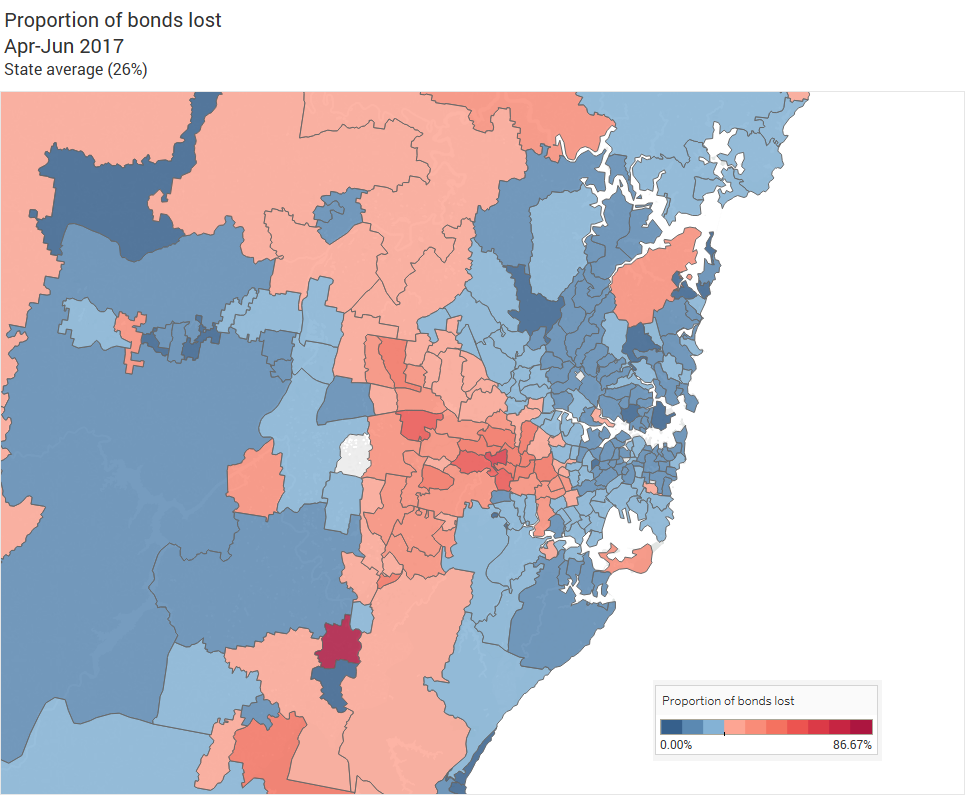
An article this morning helped to demonstrate the limits of this data. Looking over the data, the journalists discovered that a much larger proportion of bonds being refunded in some areas of Sydney and New South Wales were going to the landlord rather than the tenant. The problem is we don't know the context of those bond refunds, and how they were claimed.

Click for full size!

Bonds can be released from the Rental Bond Board in one of three ways. The landlord and tenant can come to a mutual agreement and lodge a bond refund form with both parties agreeing to amounts payable either way. If the parties can't come to an agreement, one or other of them  can make a unilateral claim for what they think is appropriate, without the other party's signature. The person who didn't sign is given 14 days to lodge an application to the Tribunal if they disagree with the claim. If they do not take it to the Tribunal the bond is paid out as requested. This is the second option. The last option is that the dispute does go to the Tribunal and the bond is decided either by a final negotiation, or as decided by the Tribunal Member.

Tenants and landlords should both be aware that the bond is the tenants' money. It is held in trust by the Rental Bond Board - it is not some common pool of money and landlords should not regard it as theirs for the taking. Vulnerable tenants may be unaware of their ability to dispute a claim against the bond, or indeed feel unable to assert their rights due to their vulnerability in the rental sector.

Whether bond refunds are agreed upon, or disputed, and whether a claim made by the landlord has been tested in the Tribunal is a crucial piece of information which the Rental Bond Board already has in its data banks and could release. It would go a long way to allowing researchers and journalists to peer behind the information that's already been released and examine the geographic differences that have been drawn out.

We've also heard that exit surveys on bonds have been considered - we think this is an excellent idea. For instance there is no information currently collected about how and why tenancies in NSW end - this means a government and community making decisions about how effectively tenancy legislation is working have a very deep and dark blind spot on an incredibly important aspect of renting law. An exit survey on the bond claim form would be a simple and effective way of adding a depth of knowledge to our collective understanding of the renting experience in our state.

In the spirit of open and transparent access to information, we encourage the Minister and Fair Trading NSW to consider releasing both the currently available information of whether bond claims are disputed and tested, and strongly consider implementing the bond survey to develop a truly excellent source of data.

Thursday, April 13, 2017

Australia, the land of indefinite, insecure tenancies

There's been a lot of talk lately about the insecurity of renting in Australia, and how things would be better if we can somehow get everyone onto longer leases. There's a perception that Australian tenancies are notoriously short, with the majority of leases lasting around 6 or 12 months.


We're often asked how long leases ought to be in order to give renters the security they need. Take, for example, this recent interview Leo did with ABC 24's Breakfast program, where he is asked (at 1:50) "what length of tenancies would you like to see become available for people?"


And Su-Lin Tan's latest piece in the Australian Financial Review - Renting in Australia is generally 'miserable' but doesn't have to be - wades into similar territory. Tan notes the growing number of Australians "not interested in buying a home" and adds:
But one of the biggest obstacles is the lack of long-term leases, a stumbling block for people who have kids in school, long-term job commitments or simply want a settled life.
Referring to data and commentary from the recent Unsettled report, Tan also notes that the Netherlands, Germany and Denmark offer "infinite leases".

For a more comprehensive look at how European tenancies work, there's the recent publication of the International Union of Tenants report from members to its 20th congress, Rent Regulation and Security of Tenure in the Private Rental Sector. Or, for a quicker grab, there's UK Shelter's map of renters rights in Europe. These tell us that for the majority of European countries tenancies are "protected" with fixed terms of three years, if indeed they are not "permanent" and can only be ended with legal grounds.

And what of Australia? In all jurisdictions tenancies tend to begin with a fixed-term agreement. It is for the parties to decide the length of that term, and it is a matter of convention rather than law that most tenancies begin with a term of 6 or 12 months. If a tenancy agreement is not formally terminated following the processes set out in our renting laws, or a new fixed term created, it carries over and becomes a periodic or continuing agreement once the fixed term expires. It does not end simply because the fixed term expires. These are essentially permanent agreements similar to what we see in parts of Europe, where tenants' have some of the strongest protections against eviction and unreasonable rent increases in the world.

So what makes Australia different? What's missing from our laws, that operates in those parts of Europe that we look to for inspiration, is the part about not being able to end tenancies without legal grounds. Or rather, in all of the Australian states and territories it is lawful to end a tenancy without a reason, so the legal ground becomes "no grounds". In New South Wales this can happen at the end of a fixed term agreement with 30 days notice to the tenant, or at any time during a periodic agreement with 90 days notice to the tenant.

When issued with a valid notice of termination without grounds, there is generally nothing a tenant can do to save their tenancy but beg. The rationale for this is that "landlords should be able to deal with their property as they see fit". While in Europe, landlords presumably still manage to deal with their property as they see fit, but they must do so within structures that protect tenants from unfair or unreasonable evictions.

A tenancy cannot be terminated without grounds during a fixed term, which is why it's often suggested that longer fixed terms would be a good thing. It might also explain why some tenants enter into new short fixed terms at the expiry of their term, although this might also be because landlords and real estate agents often insist - threatening termination without grounds if a "new agreement" isn't signed. And while longer fixed terms may suit some people, we can't help but notice that tenants frequently ask for advice on how to end a fixed-term agreement early. Some might be encouraged by the use of longer fixed terms, but they are not the catch-all solution we're after. Indeed, long fixed term agreements might present unacceptable risks to many tenants, if the means by which they are encouraged is the erosion of tenants' rights.

How long are Australian tenancies then? The Unsettled report doesn't give us much detail on this, focusing instead on the length of fixed terms for Australian renters. Unsurprisingly, it found that 83% of Australian renters have no fixed term agreement, or are on an agreement of 12 months or less. It also found that half of Australian renters have moved three times or more, including 19% who have been renting for less than five years, and 42% of those under the age of 35.

For tenancies in New South Wales, tenants' bonds lodged with the Rental Bond Board reveal a little more. From data released under a freedom of information request in 2016 and made available as part of the NSW Government's open data portal, it is clear that only a small proportion of tenancies end within 12 months or less. The majority continue into a second year and a significant amount go on for a third year after that. Slightly more than one in ten rental bonds have been held by the Board for more than three years.

Bonds lodged with the NSW Rental Bond Board, by duration
Whether they are (or were) attached to agreements with a fixed term of 6, 12 or any number of months, these tenancies are indefinite. They are insecure because they can be brought to an end without grounds. If predictability and stability for long-term renters is what we're after, we should focus less on encouraging longer fixed terms, and more on getting reasonable grounds for termination into our renting laws. As long as their home remains available to rent, and they continue to meet their commitments under the agreement, tenants should not be asked to leave without a good reason.

Friday, December 9, 2016

21st Century Bonds - part 3

If you haven't already heard about the Rental Bonds Online service, chances are you soon will.
Rental Bonds Online: coming to all new tenancy agreements?
That's because the NSW Government has just changed to the Residential Tenancies Act 2010 to make it more or less mandatory for your next landlord or their real estate agent to tell you about the service, which allows tenants to electronically transfer a rental bond payment directly to the Rental Bond Board. This is great, as it means you'll no longer have to hand over wads of cash, or go out of your way to get bank cheques or money orders in order to pay a bond. It also means landlords and agents won't even have to see your bond money at all - unless they become entitled to some of it at the end of your tenancy...

The Government has made this change because, to date, only a relatively small number of new tenancies have had a bond lodged via the online service. This is despite a high number of landlords and agents having registered to use it, suggesting that many are not telling tenants about it. Instead, they continue to take tenants' bond money to lodge with the Rental Bond Board themselves.

The change will come into force on 30 January 2017. From that time on, a landlord or real estate agent will be prevented from "requiring or receiving a rental bond from a tenant" unless they have registered to use Rental Bonds Online, and have given the tenant an opportunity to pay their bond to the Rental Bond Board directly, using the service. The only way landlords and real estate agents will be able to lawfully avoid telling you about the service will be to refrain from taking a bond in the first place.

No doubt we'll be hearing more about this over the next couple of months...


Tuesday, November 15, 2016

Credit where it's due: post script

Back in early October we noted the Minister for Social Housing had taken heed of warnings against plans for rental bonds for public housing tenancies, and opened up the plans for discussion.


We said:
FACS Housing has expanded the handful of non-government housing peaks it has asked to comment on a draft operational framework, and the Minister for Social Housing himself has invited several of us to meet with him to discuss our concerns.
This, we said, was an indication that when it came down to it, Government was prepared to stop and listen to concerns about the scheme... to the Minister's credit.

Yesterday Minister Hazzard's office circulated a note, giving an update on the development of the policy. It confirms the Minister will put the rental bonds scheme on hold, "to allow for further review of the framework". This in an indication that rental bonds for public housing tenancies may yet become a reality - in keeping with the Minister's commitment - but not this time around, and not in the manner proposed. For now, at least, it's back to the old drawing board.

This is excellent news. Cheers, Minister!


Wednesday, October 26, 2016

Bond Insurance - a gamble not worth making.

We've recently found out about BondSure, a new company offering bond insurance, as well as bond loans and contents insurance. We do not think bond insurance is worth it for most tenants, unless you are exceptionally accident prone.
This guy. This guy needs insurance.
Let's consider the kind of insurance being offered. Your rental bond is already a form of insurance - the tenant pays a lump sum up front to ensure that if there is compensation due to the landlord at the end of the tenancy, the money is already there.

For most people insurance is about peace of mind – a protection against large, unexpected costs. This is exactly what your rental bond is!

It's not too different from paying insurance on a car, except that it is refunded at the end of the tenancy if you do not need to rely on it. And during the tenancy, it's held by the Rental Bond Board and there's the opportunity for your bond to be used for good.

So would you consider paying insurance on your insurance? It may sound a little odd, but that's the logic being offered by BondSure. Perhaps this reflects a view among landlords and agents that the bond is the tenants money in name only, and really it’s just waiting to go to its rightful home with the landlord. Is it a coincidence that BondSure is managed by former real estate agents?

So, how does this insurance on your insurance work?

Let's look at the insurance on a $2000 bond. The fees are $31.58 per month on a 12 month agreement, for a total of $378.96 for the year. You pay your fees, and if you need to make a claim, you pay your excess of $300 (Excess is 15% of bond or $200, whichever is higher). Coverage extends only to the bond amount, so the maximum claim you can make is your bond amount of $2000.

Now, because you have already paid the $378.96 in premiums, and $300 in excess, your insured $2000 bond effectively only gives you a benefit of $1321.04. The insurance does not cover anything above the bond, and it only covers "accidental damage". It does not cover many of the things that bonds often pay for, like rent arrears, utilities bills, or even most cleaning bills.

We know from the Rental Bond Board that the actual numbers of people losing their bonds are very low. Once you take out the stuff that BondSure's bond insurance doesn't cover, these numbers will be even lower.
Click for full size!
In the 2014-15 financial year, there were 266,856 bonds refunded. 53% of tenants received their bond back in full. If those tenants had held bond insurance, they'd have made a $378.96 bet and lost. This is where BondSure makes its money.

Another 38% received part of their bond back. Because of the excess of $300, the claim by the landlord has to be above $678.96 before it even makes sense to claim anything. If your landlord comes to you with a bill for damage of $150 dollars, you wouldn't spend $300 dollars to fight it, would you? So a large chunk of those tenants won't make the claim on the insurance, they'll just pay the landlord directly. So they'll have made a $378.96 bet and lost, on top of whatever "small" amount the landlord has claimed. This group end up paying both BondSure as well as their landlord, without actually obtaining any benefit.

If the claim on the bond is higher than $678.96, and only for accidental damage, then it becomes worth it for the tenant to have held their BondSure policy. They will start getting a payout that puts them ahead of where they would have been if they'd just saved their money. But that's assuming they've only been paying their premium for one year.

For those playing along, that leaves just 9% of tenants who lost their bond entirely in 2014-15. We know that many claims for the whole bond occur following breaches, such as rent arrears and the like, so only some would get the benefit of bond insurance. Those tenants often also owe more than the bond to the landlord, so they will still have costs above the payout.

If you are lucky(?) enough to be one of the small percent who had accidental damage that cost you exactly what your bond would cover (and nothing more!) then you get the full benefit of the insurance, and get your bond back. Happy days!

In considering all of this we haven’t included the cost of attending the Tribunal, which a bond insurance system discourages tenants from using. If your landlord's claim is high enough the "rational" thing to do would be to accept it and take the BondSure payout, even if you know the claim is false or an overreach. Without bond insurance it is usually worth it for a tenant to dispute a bond claim because the Tribunal forces agents and landlords to provide evidence for their claim.

As with all insurance, this is basically a gamble. Only around 1 in 4 tenants will get some benefit from a BondSure bond insurance policy. Most won't, and this is why when you gamble the house always wins. The house here is BondSure, who get paid either way, and if they do pay out make a relatively small loss. Using the proportions above, if everyone had a $2000 bond covered by BondSure they would make an average of $131 per client. Tenants, on the other hand, would spend an average of $319 by taking out insurance on their insurance.

Save your money, don't use bond insurance. If you really want to cover yourself for the unexpected loss of a rental bond, you'd be better off sticking $30 a month in an old jam jar.

Tuesday, October 4, 2016

Bonds for public housing? Credit where it's due...

We recently grumbled about the lack of consultation leading up to the proposed introduction of bonds for public housing tenancies.


Since then, FACS Housing has expanded the handful of non-government housing peaks it has asked to comment on a draft operational framework, and the Minister for Social Housing himself has invited several of us to meet with him to discuss our concerns.

It's entirely possible that none of this would have happened if not for our grumble, but it's likely the grumbling of others has had a fair bit of impact, too. We know we're not the only ones put out by the proposal, and we're not the only ones who've said as much.

This is an indication that the NSW Government is prepared to stop and listen when it aims wide of the mark on policy, and we've got to give them credit for that. But even so, the Minister has confirmed his commitment to bonds for public housing tenancies.

Numerous advocacy groups have implored him to reconsider, and this includes the TU. Our comments on the draft policy and operational framework can be found here.


Thursday, September 15, 2016

Building policy that resonates

A couple of weeks ago we mentioned the looming possibility of a rental bonds scheme for new public housing tenancies. We now know that FACS Housing have been feverishly working away on this, putting in a great deal of time and energy to build the policy's operational framework.


You see, the Social Housing Minister's office decided to go with a rental bonds scheme somewhere after the 2015 NSW State election, and although this was never formally announced they stuck a quick mention of it in the 2016 document Future Directions for Social Housing. Thus, the policy was born.

But here's the problem: the Future Directions strategy is a reflection of a 2014 discussion paper concerning Social Housing in NSW that was subject to very broad consultation. It was initiated by Gabrielle Upton when she was the Minister for Housing. The discussion paper asked no questions about rental bonds for public housing tenancies, so of course none of the participants raised any issues or concerns about such a scheme. This is significant, because the idea had been raised before - way back in 2012, when Greg Pearce was the responsible Minister.

It was not until late April 2015 - some 3 months after the close of the Upton-lead discussion paper's consultation period (a period during which New South Wales not only went to the polls but also saw a Cabinet reshuffle that brought in a new Social Housing Minister) - that the idea of bonds for public housing tenancies came up again. This was in a Daily Telegraph "exclusive". Now, that can hardly be seen as an invitation to comment, if indeed it was intended as a serious policy announcement.

Then the initiative was slipped into the Future Directions document and became part of the ten-year Social Housing strategy, that was supposed to have been informed by the 2014 discussion paper.

The upshot of all of this is that FACS Housing have embarked upon a significant shift in policy that will have implications for their own work, the lives and livelihoods of their future tenants, and the State of NSW's budget (yes, this is likely to come at a cost to Government). They have taken this bold step without asking anyone these two simple questions: is this a good idea? ... and ... how would it work alongside our existing tenancy management and debt recovery frameworks?

The answers to such questions could surprise them, and perhaps that's why they've not been asked. Then again, perhaps they're just taking their lead from the tabloids and the shock-jocks rather than the people this policy would affect. It wouldn't be the first time a Government and its agencies did that.

For our part, we can see a couple of significant problems meandering along behind this proposed scheme. Notwithstanding our principled objection to the idea in the first place - rental bonds are about cash-flow for small time landlords with mortgages to worry about, not public housing departments with budgets in the hundreds-of-millions - there is a great deal of work to be done to ensure the public housing landlord's approach to tenant liabilities and debt recovery processes is properly suited to a rental bonds scheme.

Built on incorrect assumptions, this scheme could well go the way of the Tacoma Narrows Bridge.


Friday, August 26, 2016

Bonds for public housing?

The notion of rental bonds for public housing tenancies has been floating around for years. Government Ministers who take responsibility for the Land & Housing Corporation - the legal entity that actually owns all the public housing in New South Wales - are forever looking into the idea of taking and holding large sums of tenants' money, to retain in the event of a cleaning or repairs bill at the end of a tenancy, to see whether it would give them access to money that they can't otherwise recover from tenants of limited means. Usually, they conclude the cost of running such a scheme would outweigh any benefit it could produce for the Government landlord.


Public housing tenants are already liable for the negligent or intentional damage they cause during their tenancy, just like every other tenant in New South Wales. But, unlike every other tenant in New South Wales, they are also legally required to enter into and make good on agreements to pay their debts to social housing landlords. Throwing a bond into the mix won't really add much that isn't already being achieved, but it will add a whole lot of new work for whoever has to take, hold and refund all of that money. Then there is the financial imposition it would place upon all public housing tenants - necessarily on low incomes, as a condition of eligibility - rather than just those who do cause damage to their property during a tenancy.

The latest iteration of this idea seems to have taken a different turn. In one of his first media engagements as Social Housing Minister, Brad Hazzard said “[A bond] reinforces the message that if you do something bad to this property that you don’t own, you will lose some money to fix it.” Then, in the Future Directions for Social Housing document released in January this year, it was announced that FACS Housing would:
Introduce public housing rental bonds for all new tenants through an approach that mirrors the private market rent bond scheme, reinforcing tenant responsibility in regard to rent arrears and tenant damage, as well as helping to prepare them for transition to the private rental market. To commence during the second half of 2016, the bonds will be applied to new leases and will be equivalent to four weeks market rent, capped at $1,400. Tenants will be able to pay the bond in installments over two years, which will be administered by the Rental Bond Board.
In shifting away from a cost recovery strategy to one of encouraging tenant responsibility and capacity building, it seems that Government may have decided to push ahead with a public housing bonds scheme after all, even if it comes at a new cost to taxpayers.

There's a strong likelihood that it will come at a cost to public housing tenants, too, even after putting aside the difficulties most tenants living well below the poverty line would face in paying fortnightly instalments for two long years. A quick investigation of how well the Land & Housing Corporation handles "tenant damage" matters reveals a couple of systemic problems they will need to address, if their scheme's objectives are not to be doomed from the start.

The first is that they are notoriously bad at completing ingoing condition reports. As this 2008 article from Robert Mowbray shows, the problem is a long standing one. There are recent examples, too, indicating this problem hasn't yet been addressed. Examples such as the tenant who signed up for a new tenancy late last year and still hasn't received a condition report. Apparently the local FACS staff have said they'd just like to add a few things to it before they hand if over. Then there's the tenant who recently moved from one property to another, whose new condition report notes a "clean, undamaged and working" exhaust fan in the kitchen - except that there isn't one... And what about the time FACS staff referred to a condition report that was compiled many years before the tenant they were trying to recover damages from had even signed a residential tenancy agreement and moved into the property? Before a Tribunal, no less!

But even where ingoing condition reports are compiled, whether poorly or otherwise, they seem to have far less importance placed upon them than an outgoing inspection. According to one Tenants' Advocate, “we constantly see ingoing condition reports prepared by FACS Housing that have little or no detail in them and no photos. Every single item is recorded as clean, undamaged and working. Yet the outgoing report is always extremely detailed with photos and every single item is recorded as not clean, damaged and not working.”

The second issue flows from the first. Without a reliable condition report, tenancy managers are unable to establish what, if anything, the tenant should actually be held liable for. To get around this, it seems a common practice has arisen whereby the entire bill for bringing a property back up to re-lettable standard is passed on to the tenant. Sure, there will be times when this includes some cleaning and repair costs that a tenant is liable for, but it can push a bill that a tenant is only partially liable for into the stratosphere. As one Tenants' Advocate was informed by local FACS workers when questioning such a bill - "this is standard procedure".

The Brown Couch knows of a situation where a "tenant damage" bill exceeding $7,000.00 was more than cut in half when a Tenants' Advocate became involved, questioning a number of costs that were clearly not the tenant's responsibility. These included replacing worn-out kitchen appliances that the tenant had been making do with for some time, and the cost of restoring parts of the property that had been vandalised after the tenant had vacated. In that case, it also included some costs that the tenant agreed they were liable for, and was happy to pay. But that is not always so.

The Land & Housing Corporation also raises debts in situations where they shouldn't, such as against a former tenant who had been escorted from her property after an extreme domestic violence incident. The property had been trashed after she'd left, and FACS staff were well aware of this. They noted on her file that she should not be charged for the damage, but a debt was raised nevertheless. Even after discovering their mistake it took a very long time for the debt to be waived after it had been raised in the system.

In yet another example, a bill of several thousand dollars was reduced during conciliation in the Tribunal, because FACS staff knew they were trying to charge the tenant for things she wasn't responsible for. Then the tenant reminded the FACS' representative that her rent was in advance and she was entitled to a refund. When all was said and done the Land & Housing Corporation actually owed the tenant about $90.00. That's something that should have been picked up well and truly before making a Tribunal application, and it shows the work the Land & Housing Corporation has before it if it wants a rental bond scheme to be seen as anything other than a way of harvesting tenants' money more easily.

You'll forgive us if we seem to be going on about this a bit, but it really can't be stressed enough. Tenants should not be asked to embrace a scheme that is designed to encourage personal responsibility and capacity building unless the system within which it is to operate is responsible, and has the capacity to deliver on its undertakings. When it comes to the Land & Housing Corporation's approach to "tenant damage" and related debt recovery, no such system exists. If we are ever to see such a system, the necessary reform to policy and practice will not come from placing new expectations upon tenants, but on the landlord.

There are many reasons why bonds for public housing tenancies are a bad idea. Even if we ignore them all, the introduction of a bonds scheme would be premature. The public housing landlord needs to get its own house in order first.


Tuesday, July 26, 2016

21st Century Bonds - part 2

Back in April we noted the introduction of a new Online Rental Bonds scheme, which allows tenants to pay their rental bond directly to the Rental Bond Board instead of handing it over for lodgement by a landlord or real estate agent.


We can see the benefits of such a scheme. Rental bonds are tenants' money, and it makes sense for them to have some agency over its payment into the Rental Bond Board. For that matter, real estate agents should appreciate some relief from the administrative burden of collecting and lodging all those piles of other people's money. That time could be spent lining up contractors to undertake repairs and maintenance, after all!

But tenants can only use the Rental Bonds Online system if their landlord or agent has registered to use it, and informs the tenant that the option is available. In reviewing the Residential Tenancies Act earlier this year, NSW Fair Trading explored this a little. Here's what their report says:
Rental Bonds Online The new Rental Bonds Online system has been very well received by all stakeholders. It has allowed tenants to pay their bond directly to the Rental Bond Board, thereby reducing the incidence of landlords and agents failing to lodge bonds – an offence under the Act. However, tenants can only lodge a bond electronically if the real estate agent or the landlord has an account with Rental Bonds Online. 
In order to drive uptake by tenants and facilitate the transition of bond payments from a paper based system to an online system, the review concluded that the Act should require landlords or their agents to register with Rental Bonds Online and provide new tenants with an invitation to use Rental Bonds Online prior to lodgement of the bond. 
Importantly, tenants without online access would not be disadvantaged. If they preferred, they could still give the bond directly to the landlord.
It then went on to make the following recommendation:
Recommendation 8: That the Act require all landlords and agents to register with Rental Bonds Online and provide tenants with an invitation to use Rental Bonds Online prior to bond lodgement.
Given this is a relatively new service, we wonder how many tenants have been offered the use of Rental Bonds Online by a new landlord or real estate agent? How many have taken up the offer? How many have declined?

Most importantly, what do tenants who have made use of it think of the service? What are the concerns that might have lead some tenants to expressly decline to use it?

We'd love to hear from you if you've had any encounters with the Online Rental Bonds system. Drop us a line on Facebook, Twitter, or here on the Brown Couch.

Cheers.

Thursday, April 28, 2016

21st Century Bonds

A great many Australians increasingly prefer to administer their lives online.  The NSW Government has willingly moved to shift services into the digital space - a snug fit with its overarching narrative of an 'innovative' Administration that is 'leaner and more efficient'. 

Housing is no exception. In December 2015, NSW Fair Trading introduced Rental Bonds Online, an alternative system for the payment of rental bonds. The system allows tenants to send their deposit to the rental bond board directly using Fair Trading's website, instead of through their landlord or real estate agent. Both tenants and landlords can also make a claim for repayment of the bond online. A modest but perfectly sensible innovation for the digitally-inclined. 

Moreover, given tenants' bonds must be given to the Rental Bond Board (and the interest pays for many services benefiting both landlords and tenants) it is appropriate that they may make payments directly. The system effectively eliminates the risk of misappropriation by an agent or landlord, or a refusal to release the bond in a timely manner after termination of the agreement. 
Minister for Innovation and Better Regulation Victor Dominello would seem to agree. The Minister recently told Fairfax Media : "Misuse of rental bond money is a very serious issue but it can be prevented...Fair Trading's Rental Bonds Online system is a far more secure and efficient way of depositing bond money into trust". He continued, "I strongly encourage tenants and landlords to register to use the new system. It is an example of using digital innovation to provide greater peace of mind and transparency for consumers."
Tenants can only make use of rental bonds online if their landlord or agent has registered to use the system. Many agents were already using this system's predecessor (which was not open to tenants) and are already registered. So though there is some indication the system could become widely adopted, there will always be traders who opt out for reasons of retaining control, Luddism, or simple apathy. 

If tenants want to use Rental Bonds Online and their landlord/agent hasn't registered, NSW Fair Trading encourages tenants to request that they opt in. We also encourage tenants to let Fair Trading know how the system is working for them (and get advice if problems arise). 

This is intended to be an optional system - so if you prefer cash or cheques, don't fret. A landlord or agent who requires you to use Rental Bonds Online when you do not want to may be fined up to $2200.

And don't forget that you can claim your bond as soon as you hand your keys back, and can still make a claim if you disagree about the amount of the bond to be returned to you. Fill in the form with the amount that you want paid (you do not need the landlord or agent's signature). Then return the form to Fair Trading, or complete the claim using Rental Bonds Online.

You can find out more about Rental Bonds Online here 
And check out all things Bond at our factsheet here

Tuesday, April 28, 2015

Bonds for social housing tenancies - part 2

The State's leading journal for social housing policy analysis - the Daily Telegraph - has done it again, announcing today that Social Housing Minister Hazzard is considering bonds for social housing tenancies.


This idea has been rattling around for awhile now - the last time we spoke about it on the Brown Couch was back in 2012, when Greg Pearce was the responsible Minister. Back then, we pointed out that as a landlord, the government doesn't always do a very good job of correctly attributing blame for damage to the housing portfolio. In case you missed it, here's a look at what we said:
...it's pretty clear that there are some issues with the way the government's housing portfolio is being looked after. We're not convinced that fingers of blame should always be pointed at tenants, to whom only a fraction of the problem might actually be attributed even before we start to test any specific allegations of liability.
It's interesting that this time around Minister Hazzard has likened a bond to a warning - 'look after your property, or you'll lose some money'. But tenants are always liable for the damage they cause, and an overwhelming majority are already looking after their homes.
A bond is not a warning, or something to be held over a tenant lest they make off with the silver. It offers a small piece of security to landlords, and it is optional. Where levied, it adds a significant cost to tenants at the commencement of a residential tenancy agreement.
Households entering a social housing tenancy are already facing challenges, and one of those is necessarily a financial challenge. They wouldn't be eligible otherwise. Asking for an additional four weeks rent - no matter how many instalments you break it down to - will only add to that challenge.
As for the security a bond offers... some landlords might need that more than others. A small time speculator operating at a loss might struggle to re-hang a curtain, or repair a kitchen benchtop, without reasonably ready access to a small pot of tenants' money. (Of course, we're assuming the tenant's liability is a given, for the purpose of this little hypothetical...)
But the Land & Housing Corporation, with its operating budget in the hundreds of millions, is not such a landlord. It should always be able to find the money to fix a problem today, and seek to recover from those liable tomorrow.

And remember, when it comes to the housing budget in New South Wales, tenants are already pulling their weight. For every $1.00 that Government puts into public housing, tenants contribute around $5.00 through the payment of rent and other charges.

Saturday, January 31, 2015

Where does the interest on my bond go?

For the answer to that question, see the TU's 'More Bang for Your Bond' page.


Put into the calculator the amount of your bond, and the time you've been in your tenancy, and see how much interest it has generated – and how little of it goes to your Tenants Advice and Advocacy Services, and you individually.

Sign up to the campaign, share it around and tell your MP and anyone else who'll listen that you want More Bang for Your Bond!

Monday, October 6, 2014

International Tenants Day

Happy International Tenants Day!

(Artwork from the TUACT's International Tenants Day Art Competition and Exhibition)

We hope you enjoy the long weekend. Your Tenants Advice and Advocacy Services will be back at work on Tuesday, answering calls for phone advice (they took more than 22 000 phone advice calls last year), advocating for tenants in communications with landlords and agents (more than 4 600 cases last year) and representing tenants in Tribunal proceedings (more than 2 000 cases last year).
They're funded to do this work with interest generated on tenants' money – that is, the $1 billion in tenants' bonds lodged at the Rental Bond Board, and monies in agents' statutory trust accounts. We think using interest on tenants' money is an excellent way to fund services for the benefit of tenants.
However, as we noted previously, most of the interest on tenants' money does not go to services for the benefit of tenants.
Worse, the amount that goes to TAASs has not increased in real terms in 12 years – even though the number of tenancies has grown by 25 per cent in that time.
This means TAASs are stretched thin, and tenants are missing out on the services they need and deserve.
We're asking the NSW Government to increase funding to TAASs by $5.15 million per annum now, and to ensure that going forward, funding grows in line with the number of tenancies.
That $5.15 million would restore value to TAAS funding, as well as properly fund the duty advocacy that TAASs do at the Tribunal, and an additional much-needed Aboriginal TAAS for southwest New South Wales.  
This is affordable – after paying its share of the increase, the Bond Board's interest account would still be running a surplus – and a fairer use of tenants' money.
Please, let your State MP know that you want more of your money to go to your services – the TAASs. 

Wednesday, March 12, 2014

NSW tenants – you're billionaires!

Congratulations, tenants of New South Wales – you're billionaires!


According to the annual report of the NSW Rental Bond Board, at some point last year the total value of tenants' bonds lodged with the rental bond board ticked over $1 billion for the first time. At 30 June 2013, the total stood at $1 043 000 000.

All of it tenants' money.

That billion dollars earned interest: a handy $58 million for the year. Most of that interest was divvied up and paid out for various purposes.

All up about $38 million – almost two thirds of the interest earned – went to the NSW State Government. The largest part – a bit over $24 million – went to the NSW Department of Finance and Services for 'administrative services' rendered to the Bond Board.

Another $13.5 million went to the Consumer, Trader and Tenancy Tribunal, as a contribution to the cost of its operations (a similar contribution will be made to NCAT). It's true that tenancy is a big part of the Tribunal's business: across its three tenancy-related divisions (Tenancy, Social Housing and Residential Parks) it received more than 51 000 applications. Of these, 83 per cent were made by landlords.  

And another $500 000 went to NSW Fair Trading, as a contribution to the cost of its telephone information service, which gives tenancy information to tenants and landlords alike.

Out of the remaining third, $7.5 million went to the Tenants Advice and Advocacy Program: in other words, your TAASs, which provide information, advice and advocacy to tenants – never landlords. Tenants advocates like the work, so thank you tenants; we also reckon tenants get a very valuable service for their money.

A little over $3 million went to not-for-profit financial counselling services, a little over $2 million went to the No-Interest Loans Scheme, and a little over $400 000 went to The Aged Care Rights Service. These are valuable services too, and we encourage you to use them if you need them.

And $2.5 million went in grants to affordable housing schemes – in particular, as the NSW State Government's contribution to NRAS projects. 

Last – and least – $132 000 went to individual tenants, in interest payments on bonds paid out at the end of tenancies.

That leaves a bit over $3 million of interest not paid out over the year. This was added to the pile of surplus monies from previous years where, in total, a little more than $62 million has now accumulated.

So, tenants have some valuable services to show for their billion dollars – but we think they should have more. Between the surplus and the payments to government – particularly the payment to the Tribunal, which really should be funded by the whole of the community, not in such a large part by tenants – more monies should be directed to the TAASs, which are still funded as if they are serving the rental market circa 2002, and more should go to tenants individually.

Friday, October 19, 2012

Bonds for social housing tenancies?

A couple of days ago Greg Pearce, the NSW Minister for Finance and Services (he's in charge of government assets, including the bulk of housing that is managed by Housing NSW), made an announcement - he would like to start charging bonds to social housing tenants, among other strategies, to curb deliberate vandalism of social housing properties.


You can find a link to the Minister's press release from the Finance & Services website… or you can download the .pdf version from here.

Mr Pearce says that it will cost up to $12 million to repair vandalised public housing properties this year, and that's up from $5 million last year and $8 million the year before. He says that "there are hundreds of social housing properties across the state waiting to be refitted because previous tenants caused so much damage that they are not fit to live in".

Now, regular visitors to the Brown Couch may recall our recent discussion about the Parliamentary Q&A session between the Treasurer, acting on behalf of the Finance and Services Minister, and Mr Jamie Parker, the Member for Balmain. In this session it was revealed that the 2012-13 budget for repairs across NSW is $210.2 million for planned and responsive repairs, and $194.5 million to upgrade social housing properties. That's a total of $404.7 million being pumped into the repair, maintenance and upkeep of the government's mostly ageing housing portfolio in the current financial year. Clearly, this is an expensive business. $12 million, in the grand scheme of things, is not big bikkies.

That said, $12 million is still a whole lot of money. As the Minister suggests, it would be better if it could all be spent on building new homes. But we wonder how much of that $12 million can be directly attributed to the liabilities of tenants, taking into account their obligations under the Residential Tenancies Act 2010? How much of it is a result of other factors?

Let's have another look at that Q&A session…

As we've already mentioned, in 2012-13 there is $210.2 million to be spent on planned and responsive repairs, and $194.5 million to be spent on upgrades of ageing stock - so there is clearly a lot of work to be done. But it was also revealed that in the 24 months before June 30th 2012 the government's contractors were called back to 39,142 jobs where further work was required. The majority of these recalls were at the contractors' own expense, which might indicate that the job was in fact not properly seen to the first time around.

We wonder how many incomplete repairs are not properly picked up on by HNSW or its contractors, with tenants incorrectly being charged for these repairs at the end of their tenancy? Our discussions with the Tenants Advice & Advocacy Services would suggest that this is not uncommon. On top of this, it is often reported to us that attempts are made by HNSW and its contractors to charge outgoing tenants for routine repairs and maintenance that they are not liable for, but that any good landlord should tend to between lettings of a property.

We can also note from the Q&A session that at the time it occurred - late July, early August 2012 - there were no properties that were unoccupied because they were not considered fit for habitation. Now, just a few short months later, there are apparently "hundreds across the state". We're just not sure what to make of this.

Regardless, it's pretty clear that there are some issues with the way the government's housing portfolio is being looked after. We're not convinced that fingers of blame should always be pointed at tenants, to whom only a fraction of the problem might actually be attributed even before we start to test any specific allegations of liability.

But back to the issue at hand: bonds for social housing tenants.

Interestingly, a large number of tenants who are housed by social housing landlords in New South Wales have already paid a bond. Many Community Housing providers already make use of the practice, although it is true that Housing NSW does not. We'd be prepared to bet that almost every one of those tenants has obtained their bond money through either a grant or a loan from Housing NSW. This is because, as the Minister himself has alluded to in this recent announcement, "in most cases, tenants are on such low incomes they can't afford it…"

Perhaps even more interestingly, the Minister suggests that bonds "would only be considered for high risk tenants who may have a history of damaging properties and who ask for a second chance". Currently, such tenants would be subject to the policy of 'categorising a former tenancy', that might see them subject to specific conditions in order to meet the social housing eligibility criteria a second time around. At a minimum, a 'less than satisfactory former tenant' (that is, someone who owes Housing NSW more than $500 from a previous tenancy) is eligible to go onto the waiting list, but their application will be suspended for a period of six months… which makes the application effectively useless if the need for housing is critical. So while we're not ready to sing the praises of social housing tenancy bonds in general, if they were to replace this system of 'categorising a former tenancy' (and applicants could borrow the money on interest free terms, and Housing NSW would take more care in assessing damage for which a tenant is liable at the end of a tenancy) we might start to be persuaded.

But in the meantime, we'll continue to remind Housing NSW and the Land & Housing Corporation of their own obligations when it comes to the repair and maintenance of the properties in which their tenants live.

Thursday, April 26, 2012

Rentstart bond loans - a few things to keep in mind

A couple of weeks ago we mentioned an anticipated change to Rentstart - the suite of assistance 'products' from Housing Pathways that aims to help social housing clients secure homes in the private rental market (helpful, indeed, if you're waiting approximately 5-10 years for a house, or being kicked out of social housing because you've started a job).

Rentstart helps out with a few extra dollars towards the bond at the start of a tenancy. It's currently provided by way of a grant, and any unclaimed money is returned to the funding pool at the end of the tenancy. Soon, it will be provided by way of a no interest loan, and tenants will have to pay it back - over an agreed period of time, just like any loan - into the funding pool themselves. The plus side of this is that tenants will get the benefit of any refund of the bond when the tenancy is over - after all, once they've paid it back, it's their money. However, as we discussed last time, many landlords are already in the habit of claiming Rentstart money, and some tenants might struggle to hang onto it.

When we discussed this earlier, we didn't know when this change would happen. We'd had some conversations, heard some rumours, and seen the occasional reference to Rentstart bond loans on a couple of updated Housing Pathways application forms... but we were none the wiser about when 'Rentstart Bond Loans' would start.


We can now confirm that this change will take effect on May 1st 2012 - that's next week!

You'll be able to apply for a Rentstart grant right up until April 30th - and we understand that 'live' applications for this type of bond assistance will remain open until May 7th - to allow people in the midst of the process a bit of time to finalise their application, and not miss out on a grant (evidently there's more to this than simply filling out and handing over a form... applicants need to provide various supporting documents as well).

However, any applications received from May 1st onwards will be processed as a Rentstart Bond Loan. So... if you're thinking about applying for bond assistance through the Rentstart scheme, bear this in mind.

Another couple of things to bear in mind: the Tenants' Unions factsheets on bonds and the CTTT, and the contact details of your local Tenants Advice and Advocacy Service. You never know, they might just come in handy.