Showing posts with label Guest Appearances. Show all posts

Wednesday, October 24, 2018

The Limits of Rights and Protections: Housing as an Essential Service

This article by Leo Patterson Ross of the Tenants' Union of NSW and Mark Riboldi of Community Legal Centres NSW was published in the September issue of Parity, "Marginal Housing: Where to From Here?". We are pleased to have been given permission to republish here, and encourage you to consider subscribing to Parity for coverage of all aspects of homelessness; its causes and consequences and the policies, programs and services developed to prevent, respond to and, end homelessness.


Public policy relating to renting and tenancy is typically approached through two competing conceptions: consumer protection and human rights - are we regulating an economic exchange or ensuring that everyone has a roof over their heads? The problems resulting from these, governments resistant to enforceable rights mechanisms and not all tenancies being commercial transactions, mean too many people are denied adequate housing. Perhaps it’s time to explore a different way of framing this issue: through the lens of access to housing as public service provision.

Governments across Australia tend to approach tenancy as a subset of consumer protection, with Residential Tenancies Acts across the country being in the consumer affairs portfolio or equivalent. This implementation is inconsistent: under Australian consumer law, most residential tenancy landlords are not recognised as being ‘in trade or commerce’. At the same time, many marginal rental landlords, such as boarding or rooming houses, are recognised under the consumer law, though enforcement is rare.

The way renting is regulated through consumer affairs typically misunderstands the basics of the relationship between landlord and tenant. It generally conceives of two parties with roughly equal incentive coming together to create a contract. In a parallel example, a customer who walks into a TV shop will happily walk back out again without a TV if the price is not right, the product not suitable, or the salesperson not helpful. In terms of renting, landlords have the same financial incentive to make a ‘sale’ as the shop-owner, however tenants have a much greater need for shelter than the prospective TV watcher does for the latest episode of The Bachelor. This imbalance diminishes the ability for landlords and tenants to negotiate on equal terms and therefore to make renting fair government must intervene in the ‘market’ interactions.

Another problem caused by treating housing as a market place is the competition created between multiple parties seeking to live in a particular home. For potential ‘winners’, the lines of 30, 40, or more applicants creates the feeling of intense competition. But the reality is it only ever takes another applicant to be richer, whiter[i], or otherwise less of a ‘risk’ than you, for that home to remain out of reach. This environment pushes the ‘losers’ into increasingly substandard accommodation.

In comparison to this typical legislative approach, most housing advocates take a rights-based approach to housing, building on the right to housing enshrined in the Universal Declaration of Human Rights, and more fully explored in the International Covenants on Economic, Social and Cultural Rights[ii] and Civil and Political Rights[iii].

A key component of the right to adequate housing not implemented in Australia, which is not at all addressed by a consumer affair approach, is legal security of tenure. The Committee on Economic, Social and Cultural rights explains: “Notwithstanding the type of tenure, all persons should possess a degree of security of tenure which guarantees legal protection against forced eviction, harassment and other threats.”[iv]
 
With Australia’s general lack of constitutional or legislative rights frameworks, these rights to housing suffer from being neither recognised nor legally actionable in Australian jurisdictions, except in limited circumstances for public housing tenants in Victoria and the ACT. An unenforceable right is barely a right at all, and it’s questionable how many people think of the right to housing in the same way the think of the rights to freedom of assembly or speech. Framing issues around rights is additionally challenging: advocates and experts tend to talk about rights as individual objects existing on paper, created by lawyers; this is dissonant with the everyday reality of people’s lives, and from the right to housing as something that is innate or enacted by caring communities. From a housing advocate’s point of view, shifting both public opinion and government policy from a consumer affairs to a human rights framework may be a mountain too high and steep.

Another problem is that public discourse and campaigning around ‘renters’ rights’ in Australia focusses heavily on people in more formal residential tenancies – namely standard arrangements between landlords and tenants, typically brokered through real estate agents. Far less attention is given to the rights of residents in other forms of renting, particularly marginal housing forms like boarding and rooming houses, lodgings in private residences, public housing and residential parks tenancies. In every jurisdiction except the Australian Capital Territory multiple forms of marginal housing are not covered by legislation. Even in the ACT, effective coverage is limited.

This unfortunate phenomenon is understandable. Residential tenancies impact a broader proportion of the population, affecting social groups with greater social capital and power than the frequently more marginalised residents of, for example, boarding houses. Broad support is important for successfully shifting public policy and governments, which tend drag behind both academic consensus and popular opinion. In terms of renters’ rights, this makes it crucial for advocates to frame the issue in a way that is inclusive of marginal renters.

To achieve this, and to break the dissonance between housing as consumer affair or human right, an alternate conception may be to refocus on housing as the provision of an essential service, in a similar way that we look at education, health and transport. In the Australian context, all of these to varying degrees operate in a mixed public service / private provider policy environment, where public debate revolves around how much should be accessible free-of-charge. Such an approach may be more palatable to lawmakers turned off by the concept of human rights enshrined in legislation.
Importantly however, it also comes without the degradation of purpose that can accompany pragmatic solutions to thorny issues, such as the current trend towards not-for-profit housing as a response to a public housing approach governments have underfunded into failure.[v]
 
Recognising housing as an essential service offers a number of advantages in terms of advocating for improved conditions for people in marginal housing. While there is fierce political debate about how best to supply essential services, no credible decision-maker in Australia would be willing to argue that simply having a lower income should exclude a person from having access to clean water, healthcare or a high school education.

A public service approach would necessitate state and federal Ministers for Housing to ensure that the housing supply chain was functioning properly, and that the ultimate use of the shelter was regulated appropriately. This would require a realignment of the ministers currently responsible for planning, social housing and renting regulation.

Recognising housing as an essential service means sensible legislative reform to ensure that laws around renting are no longer a patchwork of coverage with cracks for marginalised people to fall through. Under this framework all renting contracts, whether an inner-city boarding house, a lodging in a family home, or a mainstream residential tenancy would then include:
· protection from unfair and arbitrary evictions, and
· requirements that homes be of adequate comfort and safety, and
· effective and accessible dispute resolution mechanisms, including of eviction decisions.

Housing as essential service cuts across the prevailing legislative framework of renting as commercial transaction. If we can reframe housing as an essential service, we will be less likely to accept the current restrictions to access, the arbitrary cut-offs through evictions and the overpricing of supply, particularly in the informal sector. While Australians are generally accustomed to private entities delivering public services, people are becoming increasingly aware that the corporate ‘efficiencies’ and ‘choice’ provided by profit-driven entities do not necessarily equate to quality services, take for example recent criticisms of the private health insurance rebate, the underperformance of for-profit superannuation funds, or the concerns about unscrupulous players in the aged care sector which sparked the recent Royal Commission.

Reframing housing as an essential public service will be a challenge, but it’s clear that we need to find effective ways to shift the political discourse and legislative framework away from housing and renting as simply consumer transactions. Rather than a move away from a rights-based approach, we suggest exploring a different way of advocating for these rights that is both inclusive of marginal renters and builds on the existing support for a various public and community delivered services as foundation stones for fair, vibrant and inclusive communities.

[i] MacDonald H., Nelson, J., Galster G., Paradies Y., Dunn, Kevin M & Dufty-Jones R. (2016) "Rental Discrimination in the Multi-ethnic Metropolis: Evidence from Sydney", Urban Policy and Research, 34(4), 373-385
[ii] Article 11, https://www.ohchr.org/en/professionalinterest/pages/cescr.aspx
[iii] Article 17, https://www.ohchr.org/en/professionalinterest/pages/ccpr.aspx
[iv] Committee on Economic, Social and Cultural Rights: General comment No. 4: The right to adequate housing (art. 11 (1) of the Covenant) (1 Jan 1992). Available at http://tbinternet.ohchr.org/_layouts/treatybodyexternal/TBSearch.aspx?Lang=en&TreatyID=9&DocTypeID=11
[v] Emma R. Power & Tegan L. Bergan (2018): Care and Resistance to Neoliberal Reform in Social Housing. Housing, Theory and Society.

Tuesday, July 31, 2018

Renting with bats, mice and squirrels in the wild Midwest USA

Today we have a special guest appearance from Chloe Schumacher, an intern from the USA working at the TU. As Australia considers the possibilities offered by 'build-to-rent' landlords, she presents a timely example of the need to look past the marketing promises of 'institutional' or corporate landlords. This experience is not a one off - recent research found many housing advocates raising concerns about the approach corporate landlords take in the USA.

The first time I had ever rented a home was with five friends back home in Iowa. We are all in college and renting a home off campus is very normal after your first year in college. It was mid summer when we all moved in, and the first night I spent in the house was when the problems began.
I woke up around 3:00am to something hitting my chest. My hand hit something off my bed and that is when the fluttering started. I had woken up to realize there was not one, but several bats flying around in my room! My first terrified thought was to get out, but when I opened the door the pack flew into the kitchen and throughout the rest of the house. 

After this incident my roommates and I tried to call the rental company’s complaint and emergency hotline, but received no answer. Due to receiving no answer we all went into the office the next morning to sort out how to get rid of the families of bats living in our home. We explained the situation and our concerns – bats can carry rabies, their bite can’t be felt, and their faeces is a health hazard. After the story and explanations of concern, I was told that it was bat season; therefore there was nothing that they could do!
After being told that there was nothing that our renting company could do to rid our house of the infestation, we decided to be hopeful and leave our front door open to try and let them fly out on their own. This didn’t end up working; instead the bats went to sleep, hanging from the living room ceiling away from the door, due to it being so hot outside. They liked our house because it was nice and cool!
We had numerous run-ins with the bats. There were many times when one would be hanging inside the door frame and then when the door was shut, it would accidentally be smashed and injured or killed. Due to being concerned about rabies and other diseases, we decide to keep a few of the dead bats to send to be tested. After receiving positive results for the bats caring diseases, we became increasingly concerned and continued to seek out our landlord for help. The battle lasted for over 2 months and included several sessions of the five of us planting ourselves in their office and asking to speak to manager or company head. We even resorted to bringing in and leaving the bats in the office that had died in our home to try and prove a point.
We could go no longer go into our basement and finally after the two-month plea for someone to come out and do something about our bat invasion, our landlord sent over a maintenance crew.  These two men had no idea what to do about bats and were only trained in carpentry; they claimed they couldn’t find any bats. Since our landlord had sent someone out as we had asked, they acted as if they had done all they could to help.
It wasn’t until a few days after the carpenters had visited that a police officer was called and he kindly collected all of the bats in our living room and removed them. This process took him over two hours to catch and release the creatures, because they are protected in Iowa and much of the United States.
Even though our bat problem had been solved, we continued to have animal problems in the home throughout the rest of our tenancy. There was a large nest of mice living in the basement and they would also get into cupboards, but when we complained about this we were told the house is old and that is to be expected. If we wanted anything done about the mice, we were told we’d have to figure it out ourselves. Later we had squirrels and mice in our walls and again we received no help and were told it is just part of living in Iowa and in an older home. So, we dealt with the scratching noises that they created at night in the walls. Another problem we had was the power would randomly go out. When we complained about this, we were told it was due to the mice chewing away at cables and they weren’t responsible for such instances, even though we had complained about the mice problem previously!
The company we rented from was unhelpful and eventually became rude whenever any of my roommates or myself even entered the office building. We were treated more as a nuisance than customers, or even tenants. All of our requests for help were met with excuses and explanations of “that’s just how it is.” Unfortunately this isn’t an uncommon scenario in my college town, because a single company owns a very large majority of the homes and apartments for rent in the area. This allows the company to provide unsatisfactory tenancy experiences but still not go out of business. This is a huge problem where I am from and the company has been taken to court on many different occasions for their actions (or inaction). In fact, they would often only respond to tenants who were paying rent above a certain grade and the rest of the tenants who didn’t pay as much were never helped or even received a response to complaints or maintenance requests. Students have even come to expect that they will never see their deposit money back, even if they were perfect tenants and did not damage the home at all.
This company is the backbone of the renting industry where I am from, which allows them to get away with their mistreatment of tenants. Students are forced to just deal with their tenancy problems – like living in a pest menagerie –, because we have no other option of places to rent from within in a reasonable distance from campus. 

Thursday, April 5, 2018

Wealthy landlords and more sharehousing: how the rental sector is changing

This article by Chris Martin, UNSW was originally published on The Conversation. Read the original article

[TUNSW comment: This research highlights the need for modernised renting regulations. Renting in Australia in the 21st Century is increasingly for everyone - but our laws are designed to entrench insecurity and diminish the ability of renting households to create homes for themselves.]

 More people are becoming heavily indebted by buying rental properties and shared accommodation is flourishing, as third party tech platforms help people find a place without a real estate agent.
A new report from the Australian Housing and Urban Research Institute explains how the private rental market is changing over time for both landlords and tenants.

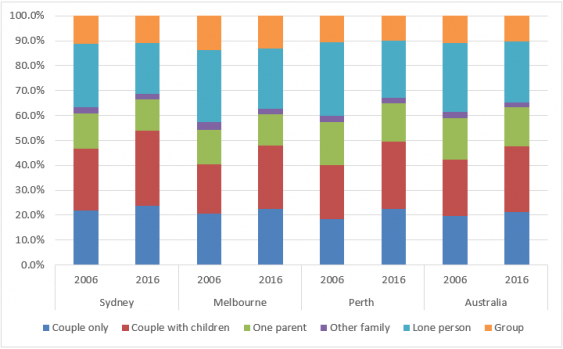
Over the 10 years to 2016, the number of renters grew 38% - twice the rate of household growth. More renters now are couples, or couples with children, so it seems the sector is shaking its image of unstable housing or perhaps these people are left with few other options.

Households by type, 2006 and 2016
 
The report analyses data from the 2016 Census, the 2013-14 Survey of Income and Housing and the 2014 Household, Income and Labour Dynamics in Australia (HILDA) Survey. It also draws on interviews conducted with 42 people involved in all aspects of the private rental sector: financing, provision, access and management.Rental property ownership also grew. We found the number of households with an interest in a rental property grew and the number that own multiple properties grew slightly as well.

But the typical landlord is still the conventional “mum and dad” investor. Two-thirds of rental investor households have two incomes, and 39% have children.

However they are also mostly high-income and high-wealth households: 60% are in both the highest income and highest wealth bracket. Interestingly, about one in eight landlords is themselves a private renter.

Housing finance ($A), 2000 - 2016

The biggest change in ownership is in finances: owners of rental properties are relying more heavily on debt.

Financing rental properties


The people we interviewed highlighted the Australian Prudential Regulation Authorities’ (APRA) guidance to lenders on loan serviceability calculations as having the greatest impact on overall investment levels and investor decisions.

Adding to the complexity is the proliferation of intermediaries, such as mortgage brokers and wealth advisers. These advisers are telling borrowers what lenders and loan products to use to maximise their borrowing power and negotiate lender and regulator requirements.

Houses are the most commonly rented in Australia, but everywhere rental markets are moving away from this and towards dwellings like apartments.

There’s now more diversity in rental properties too. For example the building of high-rise student accommodation, “new generation boarding houses” and granny flats.

These allow landlords to house more people in the one building, increasing revenue and making management more efficient.

The informal sector of shared accommodation appears to be flourishing, like improvising shared rooms and lodging-style accommodation in apartments and houses.

Finding a rental


People have moved from finding rentals in real estate agents’ high street offices and onto online platforms. New third-parties like apps and other digital platforms offer non-cash alternative bond products, schedule property inspections, collect rents, and organise repairs.

Even though these technological innovations avoid agents, they have in fact increased their share of private rental sector management. Agents themselves are use these platforms to change their businesses, and the structure of their industry.

Our research found that revenue from an agency’s property management business (its “rent roll”) has become increasingly important. Some players in the industry are consolidating their businesses around it, to make higher profits from tech-enabled efficiencies.

However, the real estate business still depends on building personal relationships, particularly in high-end markets.

The new tech platforms of the private rental sector raise issues for tenants too, particularly in terms of the personal information they collect. For example, one of the online platform operators told us they looked forward to using applicants’ information to score or rank applicants. Another one of the new alternative bond providers uses automatic “trust scoring” of personal information to price its product.

These innovations may be convenient to use, and may give some tenants an advantage in accessing housing - but at the expense of others who are already disadvantaged.

Rental properties meeting demand?


If the private rental sector is going to meet the demand for settled housing, governments will have to intervene. This can’t be left to technological innovation, or higher income renters exercising their consumer power.

Federal or state governments could create public registers of landlords, or licensing requirements, to police landlords who are not “fit and proper” and exclude them from the sector.

There could also be stronger laws around tenancy conditions and protections for tenants against retaliatory action. The Poverty Inquiry in the 1970s set the basic model of our present laws and they haven’t changed much.

Tenants’ personal information also needs to be protected, to properly take account of the rise of the online application platforms; another is the informal sector, which is currently in a regulatory blindspot.

The ConversationThe popular emphasis on “mum and dad” investors diminishes expectations of landlords. Rental property investment should be regarded as a business that requires skill and effort. As for-profit providers of housing services, landlords should be held to standards that ensure the right to a dignified home life.

Chris Martin, Research Fellow, City Housing, UNSW

Wednesday, January 3, 2018

Home Truths

Jennifer StoneWe're very pleased to present this guest appearance from Jennifer Stone, a renter in the Snowy Monaro region, who has recently started a group for renters in the region to connect and discuss local renters issues. The original version of this article was published on their Facebook page.


The home of the silenced
Snowy Monaro renters welcomes you to come into our place and sit with us a while. There is something vital we need to tell you, something which concerns us all.  If you come to know who we are and our situation, you will understand.
We come from diverse backgrounds, interests, beliefs and aspirations, yet we are a family, united by common experience. Though we are significant in number, we are marginalised, distained, unheard and unknown. We have no real shelter, but pay a high price to dwell where the walls of greed’s injustice over shadow us - and block us from a home.
We know our nations’ harsher reality, our nation’s pain. We offer you home truths, and hope you will hear us. Until we are heard, our nation is in plight.

Towns prosper when we prosper and whither when we thirst
While a substantial amount of our income goes to supporting landlords and real estates, we spend much that is left in our community. In this way we provide vital support to the local economy and help it stay afloat.  Our numbers have brought extra medical centres, high schools and supermarkets to service the community.
We work in almost every sector of the region. Our children represent a significant number of the student population in the regions’ schools.  Amongst us are also pensioners and those struggling to find jobs in our community. For those on social security payments without community or state housing, average rental costs are prohibitive. 
The economy is much impacted by the increasing and excessive rents in our region. Renters face great hardship and are struggling to find money for even the most essential items. There is a shortage of permanent rental properties appropriate to our means and needs.  As rents are becoming unaffordable, Snowy Monaro renters are increasingly forced to pay for sub standard housing with inefficient heating, lacking proper insulation. High power bills cripple our financial capacity.
If we complain at our conditions or at breaches by the landlord and real estate, we face eviction in retaliation, and inter real estate black lists. Indeed there is a special provision so landlords may give termination notices for “no grounds” – this is so the tenant can not argue their eviction (even with much evidence of retaliation by landlord and real estate).
As we are forced to leave a place and go to another, we have to find bond money, we lose pay days while moving and sick days from intense rental stress. Children suffer from such destabilisation, as does the whole community. In general we are in an ever growing inescapable cycle of debt. Our plight impacts the community’s well being as a whole. We see our regions’ potential for prosperity much diminished as rents become unaffordable - yet the financially powerful minority, seem blind to this.

We suffer from divisive and prejudicial myths
It seems there is a myth amongst some landlords who own local businesses that they are the backbone of the community. They say that renters are lowly “lazy”, “dirty”, drug addicted, poor “dole bludgers” who are beneficiaries of their “hard work”. They speak of us as second class citizens, less important than themselves. Some real estates call the renter “scum” and we know for sure they treat us as such.
Derogatory myths can create a painful reality. The myth that the majority of renters are financially poor has now come to express fact. As houses have become unaffordable, rent has become unaffordable. Both renter and mortgaged landlord share the pain of immense financial pressure, often in debt and living beyond their means – an economic climate stirred by the greed and power lust of just an elite few. This pressure has lead to an economy where those who have more financial wealth, gain more each day and those who have less financial wealth, lose more each day.
The average wage hardly changes while rents go up exponentially. Renters are paying their landlords’ mortgage along with their own increasing debts. Landlords who have no mortgage are greedily extorting tenants, renting out sub standard houses at excessive market prices. Such landlords hold shelter to ransom. As landlords increase their ability to buy yet another house, renters become more likely to never have a home. The myth that renters are lazy while landlords worked hard for what they have, purveys a great falsehood. Indeed, renters work doubly hard for what their landlords have! We are the hand that feeds the landlord, are we not?

Wisdom heals the prejudice and division
Those who have become financially impoverished are not worth less. The financially rich are not worth more.  There is nothing which can diminish the worth of any being.   All people are  intrinsically valid, necessary to each other and vital in their unique contribution. No one is better than or less than another. In truth we are really one, there is no division.
Everyone creates the community and all are responsible for the conditions of that community. Prejudicial myths inevitably create the worst of conditions for all. A myth which divides people by declaring some of greater worth and others of lessor worth, by any measure, must inevitably lead to a conflict for power and recognition. This conflict develops a ravishing greed which devastates and seeks to devalue all contesting its path. This in turn gives rise to mass poverty, disenfranchisement, marginalisation, cruelty and suffering.
A harmonious and prosperous community would grow, if it was understood that we are all equal yet unique, individual yet one. If all are seen of vital worth, no one would seek to devalue another nor make a house of greater value than the people who dwell there. Divisive myths of prejudice blind the powerful minority to their own truth and the truth of their nation. 

The home truths which can heal us – please listen, please hear us
We are your kin, your sisters and brothers, parents and grandparents, children, and, generations to come. We are one. In truth, we are you. What happens to any one happens to all.  No one is at home when all about them are homeless, paying for insufficient shelter, exposed to greed, extortion, repression, and eviction at a landlord’s whim.  A house which comes by way of life long debt or subjugation of another can never be a home for anyone. The nation cannot be at peace, when so many are unsettled.  
When values of decency are worth less than values of commodity our nation is impoverished.  Happiness, not commodity, is the measure of a nation’s wealth. A nation is truly wealthy when its people enjoy a peaceful home without fear of eviction, where all may contribute to society through unique expression, welcome in the nations embrace. A nation is not wealthy if its people are homeless, enslaved and in perpetual debt. If on paper a house is worth a million dollars, it is worth nothing to those who cannot call it home - that paper value serves no one if its cost destroys life. Money on a graph is not food we can eat and property on a graph is not a place to shelter.
Houses are homes and not commodity. Economists devoid of moral compass, call out triumphant when run down cottages sell at palatial prices - while homelessness ravages the nation. Who gains when the majority have no claim to home, striving to survive, and backs bent to power thirsty property managers who lack empathy, and distain ethics? How is it that the financially powerful minority of this nation sanctify greed without question – do they not see the greater part of their nations’ family in despair.  Muted acquiescence to raging greed makes all of us complicit in the theft of happiness from generations to come.
What we do to another we do to ourselves - when did people abandon this eternal guidance? The ancient truths have never changed, we reap what we sow. Seeds of kindness bear fruits of happiness, fulfilling and empowering all. When the nurturing harvest of this wisdom is ravaged, hunger for power grows, casting seeds which bear injustice, cruelty, drought and despair. 
There are elderly pensioners eating from cans of pet food to pay the rent, suffering the pain of eviction when the landlord sells for their needed profit, did you know? This is our pain as a nation, this is our home truth.
Let’s meet again and find a better way.

 By Jennifer Stone of Snowy Monaro Renters

Thursday, July 27, 2017

Hit the pause button

Front page of The Sydney Morning Herald, 26 July 2017
A fortnight ago ABC News reported that Australia looks almost certain to win a seat on the United Nations Human Rights Council. However, do we deserve a seat?

In recent years Australia's human rights record has become very blemished ... not just in the area of treatment of asylum seekers and refugees. Back in August 2014 Ms Kim Boettcher, solicitor for Seniors Rights Service addressed the United Nations' Open-Ended Working Group on Ageing (5th session), and drew attention to the plight of tenants of social housing at Millers Point and The Rocks. She told the Working Group how one of the elderly residents said to relocate her away from her community is ‘one step short of putting you up against a wall and shooting you because it’s saying you are of no value to society. You are worthless.’ You may read her full address here. Indeed, last year The Millers Point Community Working Party and Tenants Union of NSW made submissions to the Australian Law Reform Commission on 'Protecting the Rights of Older Australians from Abuse', arguing that the actions of the NSW Government in Millers Point constitute systemic elder abuse.

The NSW Government's sale of public housing in Millers Point continues. As at 11 July 2017, there have been 151 sales, some of multiple properties. Altogether the sale of 200 properties at Millers Point has raised $422.77 million (with a further $22.09 million being generated in Stamp Duty!). You may check the NSW Government's dedicated website for their figures at the end of June 2017 here.

But at what cost? At the time of the Minister's announcement to sell all social housing stock in Millers Point, there were 579 residents in 399 tenancies in the portfolio.

At 19 July 2017, 16 residents in 10 tenancies remain. So, altogether 563 tenant and household members in 389 tenancies have either vacated or are committed to moving. There are 2 tenants remaining in the Sirius Building. We have previous reported extensively on the impact of forced relocation on the residents.

So when is enough, enough? This once proud and historic community indeed, the only community to have bestowed upon it the status of 'A Living Heritage', has been decimated by the cruel edict in March 2014 to remove all social housing tenants from their community and sell off their homes, resulting in great pain and suffering! The last few surviving elderly, vulnerable tenants ask the NSW Premier, Gladys Berejiklian, to end this abuse of their basic human rights and allow the few to stay, and 'age-in-place'.

A new development gives our Premier the opportunity to redress this great injustice. On Tuesday of this week, the NSW Land and Environment Court made a ruling that the NSW Government's decision not to put the iconic Sirius Building on the heritage list was invalid. This gained wide media coverage on the ABC News , The Sydney Morning Herald and The Guardian . Shaun Carter, Save Our Sirius chairperson, said it was a good day for the building, the local community and the whole of NSW. He urged the Premier to hit pause on the demolition and and sale of Sirius. He said let's talk about the heritage listing of Sirius and how the building could be used for social housing again. He added: 'We are desperately short of social and affordable housing, let's now use it for what it was intended.'
Last two remaining Sirius residents Myra Demetriou and Cherie Johnson
and Save our Sirius chairperson Shaun Carter. (ABC News)
So the question becomes: Will the NSW Government show compassion and allow Myra and Cherie (and the other older residents of Millers Point) to age-in-place in their homes? Yes, stop the evictions, with more residents facing hearings at the NSW Civil and Administrative Tribunal. Yes, seize the opportunity which the Land and Environment Court has provided and let's talk again about the importance of retaining social housing in Millers Point. You have received oodles of cash from the sales to date and you also announced a billion dollar windfall in revenue from stamp duty in this year's State Budget. If you still insist on selling the homes which are not in the Sirius building, then defer this and do so when these few remaining residents don't require them. 

Over to you, Premier! Show the nations of the world that our great state, New South Wales, has a government that leads the way by being fair and compassionate when it comes to its citizens, no matter of age, race or creed! Let's make a seat on the United Nations Human Rights Council more than mere words.

The authors of this post are Barney Gardner, member of the Millers Point Community Working Party, and Robert Mowbray, Project Officer - Older Tenants with the Tenants' Union of NSW.


Wednesday, May 31, 2017

National Reconciliation Week


This post written by our Legal Officer - Aboriginal Support, Jessica Hall. Along with an Aboriginal Paralegal, Jessica works to support the Aboriginal Tenants' Advice and Advocacy Services and conduct litigation to advance legal rights of Aboriginal and Torres Strait Islander tenants in NSW.

This week is National Reconciliation Week, recognised each year between May 27th-June 3rd and placed during this time due to two significant milestones in Australia’s journey to reconciliation: the 1967 Referendum (May 27th) and the historic 1992 Mabo decision (June 3rd).

This year in particular, marks important anniversaries of both these events – 50 years since the referendum that amended the Australian Constitution to legally recognise Aboriginal and Torres Strait Islander peoples, and 25 years since the landmark Mabo decision which legally recognised native title rights in Australia for the first time.
Here at the Tenant’s Union, we marked this week with a successful morning tea yesterday organised by our Aboriginal Paralegal John in collaboration with Community Legal Centres NSW, National Association of Community Legal Centres and Justice Connect, to host friends and colleagues in the spirit of reconciliation.

As we commemorate these two milestones with NRW events around the country, we ask that all Australians join together in a unified front to be a part of the journey to reconciliation, mutual respect and a better future for our first Australians.
The motto for this year’s NRW is ‘let’s take the next steps’, reflecting that we are all responsible collectively for the future of reconciliation in Australia. The Uluru Statement from the Heart speaks to the next steps to come, and the long journey to be taken together as Australian people for a better future.

Tuesday, May 9, 2017

Evictions begin at Millers Point

Words and pictures from John Dunn, Friends of Millers Point

This morning the NSW Government is taking action against public housing tenants in Millers Point.

FENCE AROUND SIRIUS

At Sirius the assets branch of the NSW Government is erecting a cyclone wire fence around the site. Family and Community Services (FACS) has informed residents that the fence is being installed to improve public safety.
The fence around Sirius appears to be poorly located for protecting public safety but it is well located if it is in preparation for demolishing of Sirius and its ground-floor courtyards. In the meantime it alienates more of the common areas of Sirius from its residents. Effectively, the government is evicting the remaining tenants of Sirius an inch at a time.

All of the interior common areas have been locked away from the tenants of Sirius. Recently, senior FACS officers cancelled Myra's booking of the Phillip Room which had been booked for a studio session in which people were to draw her. The Phillip Room was subsequently covered in black plastic so that it could no longer be used. Myra's drawing studio sessions were moved to the courtyards of Sirius and proceeded with great success and without incident. Similarly, Myra has had guests for Friday Night Sirius, a barbecue event in the courtyard. Myra has been looking forward to the next Friday Night Sirius barbecue on 2 June. Also during the past few months, the Sirius Foundation has conducted dozens of tours of Sirius which have been booked by more than 1000 people and are conducted by Tao Gofers, the leading architect of Sirius. Initially tours were allowed inside Sirius, but as their success has grown, the areas they are allowed into have contracted.
Watching the fence being erected at Sirius one is reminded of the Berlin Wall going up. If Sirius represents the Heart of Sydney, the NSW Government appears determined to destroy it.

EVICTING A MILLERS POINT RESIDENT

This morning the sheriff was scheduled to evict Peter Muller from 32 High Street, Millers Point. Currently he remains in his home, surrounded by residents and supporters. The staff from the assets branch of the NSW Government were keeping a close eye on proceedings from a safe distance.


Friday, May 13, 2016

Ivanhoe Estate Tenant Group - Ryde Council's Volunteer Group of the Year, 2016

Today on the Brown Couch: former Ivanhoe Estate resident Marie Sillars talks about the strength of a community, the shock of relocation, and how to ensure all is not lost to "renewal".

***
My time with the Ivanhoe Estate Tenant Group Inc. started some 6 years ago and I am a Founder Member of the Group. We established a Community Centre (pictured) and started organising BBQs, meetings and getting involved in our community.


Four years ago we heard (on TV News) that Ivanhoe was to be demolished as it had gone past "its use by date" and very quickly we started to gather information, attend meetings, take part in Community Reference Group meetings and even became involved with a Parliamentary Committee on public housing. At the same time the group were running craft classes (we have knitted and crocheted scores of blankets, beanies, scarves etc. which will be donated to a homeless shelter & local hospital) computers for the elderly, breakfasts at the Centre, established a community garden (tenants were invited to take any herbs or veggies that they needed) and generally made ourselves busy with the day to day matters that a community needs. We had Oz Harvest for 2 years where we distributed up to 150 kilos of food on a Saturday afternoon and we had the greatest fun. Most of the Oz Harvest Committee were over the age of 60 and it was a great way to make sure that the elderly tenants had enough fruit, vegetables and groceries to keep them going until the next Saturday. Rain, hail and shine we worked our way through the food with an incredible energy for people of our age.

We knew the time was coming when the final decision would be made but somehow just kept working away trying not to think about the inevitable time when the FACS people would deliver the letters and we would then we would have to decide how we would deal with this. Late last year the letters were delivered and even though we knew it was coming the whole place went into shock and we were called to a meeting at the Community Centre where we were introduced to the officers who would become our Relocation Officers. It was an awful day and it had quite a negative effect upon the tenants, especially the elderly folk. We decided on that day that the Committee would go ahead "business as usual" and try hard to get through what was to become a difficult period. As Christmas at Ivanhoe came and went we all knew that this would probably be our last Christmas together as a group, and the atmosphere around the Centre changed. People were sad and a bit down and together with the Salvation Army on the Estate we tried very hard to keep people's spirits up and tried to make a positive side of the relocations.

As time went on and we were still attending meetings the interviews with our respective Relocation Officers were conducted and we were then told to wait as the Officers searched for places for us. As this has been happening tenants started to move away and so I contacted some people outside of the Estate to help establish a "Footprints" Committee to gather information, pictures and stories about the Estate so that when the new places are built, people there will know that there was a thriving, exciting community existing before. Ryde Council, Salvation Army, Macquarie University, FACS, and many of our wonderful supporters have come on board with this idea to create media, films, interviews and many other ways to show how a great Community CAN work and that Public Housing Tenants can work in a positive and intelligent way to come together and be proud of what they have achieved.

Two weeks ago I myself had to move and I am not very far away from the Ivanhoe Estate so I am able to keep craft classes happening on Mondays for those who are still there. The Committee who had worked so hard at Oz Harvest had started to move away also and we will all keep in touch in the future. As this Community fades away we are keen to let people know that through the Footprints Programme the Ivanhoe Committee will not be forgotten.

Last week (5th May 2016) some of the Committee attended a Volunteer of the Year Evening with Ryde Council and I was so very honoured to be nominated as Volunteer of the Year. I did not win but the Ivanhoe Estate Tenant Group DID win Volunteer Group of the Year 2016 and I have to say it was one of the proudest moments of my life. Even through our times of sadness it just shows that a community such as the Ivanhoe Estate can shine through, smile and move on to other communities. As they say "Onwards and Upwards" but in the end it has been a great achievement and one I will never forget!

Marie Sillars May 2016

Saturday, March 5, 2016

Transgender Women and Homelessness

Originally published in our recent International Women's Day Tenant News special, this article was written by Amy Davis, a PhD candidate at University of Wollongong and a staff member at the TU. We post it today as a small contribution to Sydney's Mardi Gras festival.


Transgender and trans are umbrella terms applied to people whose sense of themselves as gendered people (gender identity) is in some way incongruent with the gender assigned to them at birth, where assigned gender is typically based on the medical perception of external genitalia. 
Some (but not all) trans people choose to socially and/or medically transition by changing their name to one that is more appropriate to their affirmed gender, wearing gender-affirming clothing, accessing hormone therapy or undergoing surgical reassignment procedures, among other things. This article specifically addresses the experiences of trans women, being people who were assigned male at birth and who identify as female.
It is difficult to estimate the rate of homelessness among young transgender people since homelessness statistics are not collected in relation to trans status. However, taking same-sex attracted youth and/or transgender youth together, in NSW it has been estimated that although only 7-11% of the population are same-sex attracted and/or transgender they constitute roughly 25% of the young people who are homeless.
Parental rejection and family violence based on gender identity have been cited as causes of homelessness for young trans people in Australia. Homeless can mean sleeping rough on the streets but it can also mean staying in supported accommodation, ‘couch surfing’, or living in accommodation that falls below minimum community standards such as boarding houses. 
Fundamentally, homelessness is about insecurity which can in turn have devastating effects on a person’s mental and physical health. Given that trans people are already four times more likely to have been diagnosed with depression than the general population, the compounding effects of homelessness on trans people can be dire.

Alyssa, 23, who identifies as a bisexual trans woman, has been no stranger to insecure housing and accommodation stress. Her family lived in multiple houses across Australia when she was young and never stayed in one house for more than a year.
However, as she began to medically and socially transition in her early twenties it put more pressure on her relationships with her family members and in turn her housing situation.
“My parents were also not great people to grow up under,” Alyssa says. “In my early twenties I was also briefly homeless and couch surfed for a while until I found my feet living independently.” As Alyssa’s relationship with her father broke down it became necessary for her to leave home. “I was homeless briefly due to moving out of my Dad’s house into my grandfather’s house but he passed away shortly after I moved, so I couch surfed after that point, rather than go back to living with my Dad.”
Alyssa now lives in share housing after spending a year living in transitional, supported accommodation provided by Twenty10, a non-profit organisation which works with young people of diverse genders, sexes and sexualities. She is now partway through a computer science degree at the University of New South Wales and works full time at a software company. While Alyssa’s accommodation situation has improved since leaving home she says that being homeless puts a lot of pressure on the mental health of young trans people.
While Alyssa reached out to support services it took her a long time to find stable accommodation. Research has consistently found trans youth regularly experience harassment, violence and transphobic abuse when accessing accommodation services, both on the part of the workers and other service users. On top of that, staff and residents at some women’s services reject trans women or refuse to acknowledge their affirmed gender. For many trans people this not only means that they do not feel comfortable disclosing their gender identity when accessing services, but that some prefer to sleep rough rather than access accommodation services.
Alyssa says, “I branched out to a number of different places, most of them had negative results (being at capacity already, or not being very willing to help me as I’m a big queer). I found temporary year-long housing with Twenty10 which helped me a ton.”
Alyssa expressed concern around the lack of accommodation services for trans women and other LGBTIQ (lesbian, gay, bisexual, transgender, intersex, queer) people.
“When I was homeless in my twenties I had a few queer youth help groups to reach out to, particularly The Gender Centre and Twenty10, but nothing else aside from that,” Alyssa says. “I think that at the moment there is a big deficit of safe housing in general for queer women, particularly for women without a steady income or on a Centrelink allowance. Having more houses that can house at-risk people can only be a good thing in my mind.“
Research suggests that between an estimated 5,000 and 6,250 LGBTIQ youth are homeless in Australia on any given night, a significant proportion of which would be in NSW. The LGBTIQ youth service package as part of the Going Home Staying Home reforms is funded to accommodate only 140 young people, meaning that LGBTIQ youth homelessness is significantly underfunded in NSW. Alyssa would love to see a place that provides a safe and supportive environment for people like her who have experienced transphobia. In the meantime, however, young trans women like Alyssa are struggling with limited support.

For more info and resources, check out twenty10.org.au and gendercentre.org.au

Friday, November 13, 2015

Tenants steal the show at Parliament!

This week was an important one for our More Bang for Your Bond campaign.


For over six months, we have been campaigning for an increase in funding for the 19 Tenants' Advice and Advocacy Services operating across NSW. These services are funded with tenants' money, via the interest accumulated by bond monies held by the Rental Bond Board. Much of this interest is retained by the Government in surplus. But tenants' services have had no increase in real terms for over 12 years, despite a 25% increase in the number of tenants in the state over that time. And so the services are now stretched thin, forced to turn back those needing help on a regular basis. So with the backing of over 1500 supporters, we took the campaign to NSW Parliament - formally presenting a petition to bring funding up to speed with the needs of the rental market in 2015.

The presentation ceremony featured speeches from our Executive Officer Julie Foreman, as well as Dr. Geoff Lee MP (Member for Parramatta and Parliamentary Secretary), Jenny Leong MP (Member for Newtown), and David Mehan MP (Member for The Entrance). But by consensus it was our tenant speaker, Milly Morison, who stole the show. Milly's words perfectly capture the experiences of countless tenants across the state, and the vital role played by the service that assist them.

We are grateful to Milly, and proud to republish her speech in full here. 


Milly's speech:

Thank you all for coming today. I would like to take a moment to thank the Tenant’s Union of NSW and the network of Tenants Advice and Advocacy Services throughout NSW, for all the help that they have given me during my time as a renter.

I would like to give you a bit of background as to why I am so grateful for their help. A couple of years ago I was renting a house directly through the owner. We were on a periodic agreement when the owner fell ill and required the house back. He wanted to give us two weeks’ notice to vacate, so of course, we panicked. Finding a house in the Sydney rental market is challenging under the best of conditions. I called my aunt who told me about the Tenants Union, so I gave them a call. The friendly gentleman on the phone gave me some advice and told me there was more detail on their website. There I found a wealth of information and Factsheets, which I have been using as my essential manual ever since. The information contained told me the minimum required notice was 30 days. Armed with this information I was able to negotiate with the owner so we weren’t going to end up homeless, which was a real possibility as I had just quit my job and my housemate was a casual waitress.

In our next house we needed additional housemates to cover the rent. The new tenants did not want to be on the lease, and I wanted the extra rooms set up as short term leases. The tenants.org.au website helped me set-up sub-lease agreements and provided a sub-lease template. It helped me to navigate the nitty gritty details and maintain a positive relationship with the real estate agent. With the help of the Tenants Union everyone was looked after and no one got the raw end of the deal.

When I moved out of that house I transferred the tenancy to the two remaining housemates and again, the information provided by the Tenants Union was invaluable. They wanted to have their dog on the lease and at first the owner refused, but we were able to write a letter using information provided in the Companion Animals Taskforce submission that changed the owner’s mind. They were allowed to have the dog and I was able to move out.

Most recently I was living in a house and I had a falling out with my co-tenant. I gave her my four weeks’ notice but things got ugly very quickly and she refused to return my bond. The Rental Bond Board holds the bond for the whole house and don’t return portions of the bond to individual tenants. If one tenant leaves it needs to be negotiated between the two parties. So it felt that she suddenly had control of all my money. My local Tenants Advice and Advocacy Service walked me through, step by step, how to communicate with the real estate agent, how to behave in such a way that I was in the right, when I should give my keys back, what to do about a condition report and documenting the house upon exit. TAAS gave me all of the tools that I needed to get my bond back and because of their handholding I was able to successfully retrieve my money without having to take it to the tribunal.

Throughout my experience as a renter, a tenant, a share house mate, I have needed the assistance of the Tenants Union and the TAAS and I have regularly called upon their support in all of those sticky situations. I have used the Factsheets for all those niggles and I watch with interest their advocacy for tenants’ rights.


Mine is not an uncommon story. My rental history is a cardboard cut-out experience shared by many other renters around NSW. I have trouble imagining how people manage these issues without the support of the Tenant Union and Tenants Advice and Advocacy Services and I cannot state strongly enough how vital they have been as my aids through the rental world.

Fair Trading's review of the Residential Tenancies Act also asks for comments on how interest on tenants' bond money should be spent. Let them know directly here!

Wednesday, October 7, 2015

You shall not covet your neighbour's house

On March 19th 2014 the O'Farrell Government announced the proposed sale of 293 public housing properties in Millers Point and the Rocks. Now, just over 18 months later, Dr Robert Mowbray provides a sobering look at the impact on this unique inner-suburban community, and its resident tenants...


*****

You shall not covet your neighbour's house (Exodus 20:17) - Millers Point 18 months down the track

Just over 18 months ago the Hon. Prue Goward MP, then Minister for Family and Community Services, announced the sale of all public housing in Millers Point, Dawes Point and The Rocks, including the Sirius Building. The stated reason for the sale was the high cost of maintenance, significant investment required to improve existing properties to an acceptable standard and the high potential sale values of property assets on the Sydney Harbour foreshore, with the proceeds to be reinvested into the social housing system across NSW.

Previous articles on this blog (check them here and here) and on the ‘Friends of Millers Point’ website (check it here) have debunked some of the myths used to justify the sale of properties in Millers Point. The second of these articles makes the point that there's no plan for the sustainability of the social housing system generally: no asset portfolio strategy, no estates strategy, despite the recommendation by the Auditor-General.

There were 293 properties marked for sale in Millers Point. This affected 600 people and 409 tenancies.  Many of the tenants were over the age of 65 and relied upon neighbours, as well as hospitals, doctors, public transport and other support services close to the city. Many of the tenants have lived all their lives in the area and have strong community connections. Indeed, Housing NSW’s own publication Millers Point Oral History Project: Summary Report reported on page 6: 
Millers Point … has a very integrated community who love living there and have a sense of belonging and allegiance to the place.  … The residents have a rich reservoir of memories of living at the Point, going, in some cases, as far back as six generations. They were born, worked, lived and died in the houses at Millers Point. They also have a strong sense of history and heritage. It’s a community within a community where everyone knew each other through work and place of living  [my emphasis].

The NSW Government’s own consultant, Cred Community Planning noted that:
… 55 per cent of Millers Point tenants have lived in the area for over 10 years, and that 12 households have lived in the suburb for at least five generations. For many residents, the state government’s plan to sell their homes is not only an attack on the basis of their livelihoods but an attack on their emotional and historical links to the suburb. Cred recommended that some of the funds from the sale of homes in and around Millers Point be used to build new social housing properties nearby, especially for elderly residents, adding that they may experience “ongoing negative impacts of stress and poor health outcomes”. ... The state government dismissed this recommendation, and said that they want elderly residents to “build connections in their new communities” [my emphasis again].

You can read about this here. You may also wish to check out the excellent presentation on Millers Point by The Sydney Morning Herald, available here.

The NSW Government gave itself two years to empty the suburb of its public housing tenants and complete the sale of its properties. Well, these properties now are highly sought after real estate.  Just in the last month three properties facing Barangaroo Headland Park reached between $2.46 million and $3.30 million at auction.  You can check these sales here. Prior to these auctions, News Corporation reported that the NSW Government has generated $64 million in revenue from the sale of 29 properties.

Millionaire realtor and TV personality, John McGrath, has anointed The Rocks (read ‘Millers Point’) as one of ‘must-have addresses’ in Sydney, Melbourne, Canberra and Brisbane. He is quoted as saying:
As a shift in the housing stock moves from Government owned to private dwelling there is bound to be a massive upgrade to these beautiful harbourside Georgian and Victorian homes. Plus a significant change in local amenity that usually follows such upgrades. With the recently opened Barangaroo Point park, a 5 minute walk to the CBD & Barangaroo commercial precinct, this is fast becoming one of the most fashionable addresses in Sydney.

Previously, John McGrath was reported as saying that he is a great believer that money, like many things, can be used for good or bad. Well, is it good or bad to covet the houses of others? Likewise, from last year, check out Issue 2, 2014 of Lifestyle Guide which targets Sydney’s most affluent residents. It reads: 
What to buy ... My tip for the most popular and affordable entry into The Rocks is the Sirius Apartment development. ...  The 79 apartments have a retro feel and require minimal refurbishment. In contrast, the terraces and freestanding homes will need a much more extensive renovation and could take up to four years of love, sweat and tears to renovate. It is a lengthy investment of both time and money but in the end, you will own an important part of Sydney’s history in one of the best locations in Australia. Priceless.

In mid-July of this year the Heritage Council of New South Wales called for submissions in regards to the listing of the Sirius Building on the State Heritage Register (you can view the Tenants’ Union’s submission here). The action by the Heritage Council has revealed a rift between government agencies, as reported in the Daily Telegraph:
FACS wants to sell the building to raise money for more social housing, just as it has with several other Millers Point public housing properties, and said it was preparing its own submission to the Heritage Council. An Office of Environment and Heritage spokeswoman said: “Listing on the State Heritage Register does not prevent the sale or transfer of a property."

Ponder ... the real agenda at Millers Point is to free up housing stock around Barangaroo for gentrification and to create a Paris Quarter ... a touch of Montmartre. Of course, this must be seen in the context of the development of the casino being built on the same site.

So, what has happened to the residents? 

By mid-September 2015 approximately 95 to 96 properties remained tenanted, with 130 to 135 residents still holding on. Most of the others have moved voluntarily, but for many the move was under duress. Shelter NSW’s newsletter Around The House (No. 101) documents some of these in the article 'When older people are forced to move' (see from page 18):
Once upon a time the inner-city areas were seen as slums and we aspired to live in the suburbs. Now this is reversed; and former inner-city areas are being transformed into exclusive enclaves of wealth and opportunity. In a search for new funds for public housing, the State Government is cashing in on this gentrification in an attempt to generate dollars. All public housing tenants in The Rocks, Millers Point and Dawes Point at the northern eastern edge of Sydney’s CBD have been told they must leave. The government’s excuse is that these properties are too valuable to retain for public housing and too expensive to repair. 
As a consequence, Myra faces eviction. She is 88 years old and blind and has lived in the Millers Point community since 1959. Through her own determination and with the support of those around her, she is able to lead an active and independent life. Myra is a volunteer church and community worker and an inspiration to the people who know her. The State Government wants to ‘relocate’ Myra away from the only place she knows. If Myra is forced to leave, she will lose her independence.  
Richard is a single chap in his 80s. Recently he signed papers to move to Newtown because his greatest fear was that they’d dump him in Campbelltown. He’s been in Millers Point for over 60 years and worked in the bond stores. Richard moves slowly now and has to stop regularly for breath. But others in Millers Point keep an eye on him. He tells people that if I fall over in the street at Newtown, they’ll step over me because no-one knows me … or rob me. I know if I fall over in the street here, my friends and neighbours will look after me. 
Just one week after telling this story, Richard fell over in Kent Street. Locals rushed to his assistance and he was carted off to hospital where friends and neighbours visited him. The pressure and worry has become too much for Richard and he moved just a few weeks ago. 
Over recent months, social media has run stories about Myra … and also Mary Vo, Flo and other older residents of Millers Point facing eviction. Read all their stories here. On the ABC’s Open Drum the uniqueness of Millers Point is penned very poignantly by the daughter of another resident. 
One local resident is documenting the impact of forced relocation on the tenants. She writes: “Amidst Housing NSW’s glossy brochures and promises of better opportunities in a new home, Millers Point residents have heard many stories that tell a different tale about what being relocated is really like. Some were initially positive about moving, and for others the idea was palatable as they were hoping for a house without steps or somewhere bigger, to be closer to family or with a yard for their dog. 
“But even for these people, it seems, forced eviction has been a very negative experience. The new house often has problems, apparent only after moving in; and some have been surprised at what it means to be in a place where no one knows your name. For those for whom Millers Point was very important for their well-being it seems that it has been at best traumatic, sad and a massive change, resulting in unexpected new stresses and loss. At worst it has resulted in tragedy.” 
She goes on: “We have seen a dramatic spike in hospitalisations, serious injury and illness and, indeed, the process is killing people as predicted. Within weeks of the announcement an elderly neighbour who was somewhat reclusive but functioning well, having lived with her son in Millers Point for over 30 years, took her life. A woman who had been battling cancer for some time and living in a house with mould that Housing NSW never remedied was moved out of her home on the Wednesday, went to hospital on the Friday and died on the Monday. We have lost at least three others ...” 

A film by Blue Lucine and produced by Helen Barrow and Tom Zubrycki entitled 'Millers Point: Community or Commodity?' was released at Parliament House on Thursday, 19 March 2015 and documents the struggle of the residents. You may view a clip here.

The Millers Point Public Housing Working Party (check here and here) has been waging a valiant campaign to save some of the housing stock for the older and long term residents. The Working Party have the support of Alex Greenwich who is their local Independent MP, many in the Australian Labor Party and The Greens, but, also very importantly, Reverend Fred Nile, leader of the Christian Democratic Party and a key member of the current NSW Legislative Council.

The Working Party organised a report by SGS Economic Planning which provides an alternative way forward and submitted this to the NSW Government. They are asking, at the very least, that the workers’ flats be retained as public housing. They are also supported by the Friends of Millers Point group. Amongst its patrons are the likes of Jack Mundey, Eva Cox and Anthony Albanese. 

Inner Sydney Tenants Advice and Advocacy Service, auspiced by Redfern Legal Centre, with the support of City of Sydney, has been running a service for tenants affected by the relocation. Since the service began in May 2014, advocates have assisted over 160 tenants, providing advice about their rights, attending interviews and inspections with FACS Housing, and helping to prepare correspondence and appeals. Read more about this here.

Following the NSW State Elections on 28 March of this year, residents had some hope that things would change, because a new Minister for Social Housing, the Hon. Brad Hazzard MP, was talking to the residents. Previous Ministers had declined to take up the invitation. However, negotiations are moving very slowly and the FACS Housing Relocation Team is still going 'full steam ahead' in asking the remaining tenants to move out. In the meanwhile, Minister Hazzard is reported as saying that he supports a mix of social and affordable housing in developments of public land involving private developers. Only time will tell if he believes that this should apply in Millers Point.

The sale of properties in Millers Point and The Rocks remains an important topic of discussion in the NSW Parliament. In May of this year Alex Greenwich, Member for Sydney, submitted a series of questions to Minister Hazzard about the welfare of tenants being relocated. You can read Mr Greenwich's questions, as well as the brief responses the Minister provided, here. And on the last day of August of this year, as part of the Budget Estimates process, the Legislative Council’s Standing Committee No. 1, submitted 22 questions to Minister Hazzard.

While his answers were far from comprehensive - referring, for instance, to the soon-to-be-published 2014-15 FACS Annual Reports - he did report that 99 new housing units funded through the sale of properties are underway in suburbs outside of the City of Sydney. He also clarified that no funds from the sale of properties at Millers Point have been ploughed back into the City of Sydney local government area, or the nearby inner-western suburbs of Sydney. But, overall, the 2015 Budget Estimates process has done little to assure tenants and other interested parties that the NSW Government welcomes scrutiny over its sale of public housing in Millers Point and The Rocks.

Back to our text from Exodus 20:17. A great injustice will have been perpetuated if the remaining residents of Millers Point, many of whom are elderly, are required to leave their homes and Millers Point becomes an enclave of the wealthy. The NSW Government must pull back from enticing others to covet their neighbour's house.