Friday, October 5, 2018

Striking the right balance on evictions in NSW

On the day of debate around the proposed amendments to Residential Tenancies Act 2010 the Hon. Matt Kean, Minister for Innovation and Better Regulation, made a number of statements that formed the basis of an article in the Sydney Morning Herald’s Domain.

In this article, titled, ‘Better Regulation minister Matt Kean hits back at rental law critics’ by Tawar Razaghi the Minister made two statements we'd like to correct.

1. “The data suggests that over 95 per cent of people were not concerned about no-grounds terminations.”
The data the Minister is referring to is the Unsettled report, published by Choice, National Shelter and the National Association of Tenants' Organisations (of which TUNSW is a member). We say it suggests no such thing.

There is very little data on the broader question and this is a big part of the problem for public policy debate. The government also has a proposal we put forward to implement a way to measure eviction rates and the reasons for evictions through the bond claims system, using a simple 3-question survey on the claim form, and we encourage them to take it up.

While the primary fear of renters who took part in the Choice research was rent increases (which is hardly a surprise given the number of tenants currently in rental stress), the secondary fear is not specifically identified in the data but it is there, if you look hard enough:

“Worryingly, we found that renters with more experience in the market were less likely to complain when something goes wrong which illustrates the entrenched culture of fear among renters. This is all the more of a concern when you consider the rising number of long-term renters across Australia,” said Ned Cutcher, then the National Association of Tenants’ Organisations spokesperson.

There is new research from our evictions survey which we have distributed to parliamentarians today that show that the rate of concern is much higher. Here's a sneak peek:


This now sits alongside the lived experience of tenants and academic expertise recommending a course of action to replace no grounds evictions with a reasonable grounds system. Minister Kean and the Government should accept this evidence.

It is clear that the single most important reform to ensure that the renting system is fair and that the right balance has been achieved is by ending no grounds evictions. The parliament should do that now.

2. “I respect the sacrifice that mum and dad investors have made to purchase an investment property, and we’re not going to make it impossible for them to move into their home if they wish to do that.”


Firstly, if a mum and dad investor has purchased an investment property then this is not their home. They already have a home or principal place residence. The concept of private property rights is a bundle - one of which is the right to occupy and use the premises as a home. That right was transferred to the tenant through the lease. So their investment property is somebody else’s home, and removing that person from their home shouldn't be done lightly.

Nonetheless, if an property investor ceases to have another home and needs to make use of their investment property as a home, then the proposed amendments will allow them to do this. One of the Tenants’ Union’s proposed expanded list of grounds for termination includes ‘premises to be used by the landlord or a family member as principal place of residence’. This is a feature in the ACT and Victorian reasonable grounds lists and appears in many international rules as well.

Secondly, respectfully, Minister Kean, mum and dad investors can also be mum and dad renters. The two are not mutually exclusive. But even those mum and dad investors who are not simultaneously mum and dad renters are not necessarily opposed to the removal of no grounds terminations.

Another sneak peek in the evictions survey - 55% of landlords who took part in the survey agree that there should be a reason given when ending a tenancy. As Russell told our recent NSW Parliamentary event:


So the Hon. Minister Matt Kean we implore you to, in your own words, “go back to the drawing board on no-grounds evictions” as the data and evidence is most certainly there to support removing it. Work with Parliament to strike the right balance and make renting fair!

Monday, October 1, 2018

International Older Tenants' Day


Artwork from a great essay by Anwen Crawford, 'Nowhere to go – older women and housing vulnerability', Right Now, 4 October 2016. She writes: ‘The number of older women who are rental tenants in Australia is growing, and these women ... are increasingly vulnerable to poverty and homelessness ... Housing affordability and security for rental tenants will only become a more pressing issue as Australia’s population continues to age.’
This year International Tenants’ Day coincides with International Day of Older Persons and is celebrated on Monday, 1 October.

On 22 May 1986 the Council of the International Union of Tenants met in Paris and designated the first Monday in October as the ‘International Tenants’ Day.’ The date chosen was made following a resolution by the United Nations General Assembly for a World Habitat Day, first celebrated in October 1986. Read more here. So, this year is the 33rd International Tenants´ Day.

Resolution 45/106, passed by the United Nations General Assembly on December 14th 1990, declared 1st October to be the International Day of Older Persons.

The United Nations 2018 theme aims to:
  • Promote the rights enshrined in the Declaration and what it means in the daily lives of older persons;
  • Raise the visibility of older people as participating members of society committed to improving the enjoyment of human rights in many areas of life and not just those that affect them immediately;
  • Reflect on progress and challenges in ensuring full and equal enjoyment of human rights and fundamental freedoms by older persons; and
  • Engage broad audiences across the world and mobilize people for human rights at all stages of life.
Accordingly, the International Union of Tenants has chosen the theme: “Sound, safe and suitable housing for elderly people” as this year’s theme for the International Tenants’ Day 2018.

There are currently an estimated 962 million people aged 60 or over in the world, comprising 13 per cent of the global population. It is predicted that this figure will have risen to 2 billion by 2050. Such huge numbers are likely to create many challenges, not least in housing the growing number of older people.

The International Union of Tenants has identified the following sub-themes for this International Tenants’ Day:
• An adequate supply of suitable, safe and sound housing for the elderly at affordable rents.
• The right to social and housing assistance to ensure a decent existence for elderly people who lack sufficient resources.

• A tenure neutral stance expressed through public policy could achieve wide availability of suitable rental housing alternatives for elderly people.

• Adaption of housing to suit the elderly. Many elderly people suffer from health and/or mobility problems. Therefore, many older people may have to leave their accommodation. Policies should support home adaptation for safe living without increasing the rents to a level where they become unaffordable.

• Urban environments should by designed as an inclusive urban environment by providing accessible services for the elderly. Public meeting places, shopping facilities and elderly care should be available locally.

• Understanding of the new developments in society and providing solutions for the growing number of single households. People may value privacy but not necessarily loneliness. Housing should be suitable also for the many people who live on their own.

• Prevention of accidents that happen in the everyday lives of elderly people (the majority represented by falls).

• The rate of financial effort related to housing increases from retirement age onwards. Many pensioners’ income is very low and/or has decreased whilst housing costs have risen and therefore housing policy must consider support structures for those tenants, including elderly people that may otherwise live in housing poverty or become homeless.

• Suitable facilities. Identifying the needs of people growing old at home and technical adaptations that may be carried out and new technologies that may be used. Tenants are particularly vulnerable as they may have no equity which they can release to finance adaptation of their homes.

• Ensuring that housing is sound and free of hazards and that they are suitably heated or cooled and maintained.

• Preventing vulnerability, in particular energy poverty and protection from crime and abuse.

• Including elderly people in decision making processes through the creation of participatory structures at national and at local levels. The planning of new housing developments and the adaption of existing housing should be supported by consultation processes with stakeholder groups.
You may read their full media release here.

So how is Australia doing on this International Day of Older Tenants?

Back in March of this year, The Brown Couch published ‘A longer lease on life’ here. It says that today across Australia more people are renting for longer periods. The reality for older renters is described by words such as : Overlooked, A distinct financial disadvantage, Condemned, Vulnerable and Financial stress … and that’s just for starters.

In July of this year Isabelle Lane at the New Daily wrote: 'Older Australians are falling off the housing ladder and face spending their retirement as renters, with the situation expected to worsen for coming generations.'

The Australian Housing and Urban Research Institute provides an excellent analysis of the situation facing older, low income tenants in the private rental sector. They also points to some current research. Check it out here.


Emma Power of Western Sydney University writes for The Conversation: 'Life as an older renter, and what it tells us about the urgent need for tenancy reform.'  The article is based on research findings presented in a talk by the author at an event, 'Fair for Everybody: Reforming Renting in NSW', hosted at Parliament House on Wednesday 26 September 2018.

So, on International Older Tenants’ Day, let’s particularly celebrate the contributions of older tenants whom we know. They may be a member of a tenants’ group, an activist in social housing or an advocate for the rights of residents in a land lease community. They are the back bone of the struggle for a fairer housing system. Often they are quiet about what they do day-in and day-out. But they are part of a worldwide movement!

Thursday, September 27, 2018

Renting laws debated in parliament

Yesterday was a huge day for renting law in  NSW.

At lunch together with Everybody's Home, we organised an event today at Parliament bringing together renters, housing academics, campaign supporters, and MP decision makers.


We heard from Keith – a renter who has lived in seven homes over the last ten years.
"I am sick and tired of being forced to move. I’ve figured out that each time we move it has cost us around $3000. No grounds evictions have totally disrupted my family’s life."
Dr Emma Power spoke about her research on the experiences of older women renters and the hardships they face. Russell Rodrigo, a property investor, spoke about how the proposed reforms are actually in landlords' interests - because they will foster better relationships and improved stability.
Russell, Dr Emma Power, Dr Chris Martin and Keith Young.

Then at around 5pm the fun really started. The debate started for the Residential Tenancies Amendment. As expected, the Government spoke to their bill and emphasised the positive steps it is taking.

Labor spoke strongly for the need to end unfair no grounds evictions and made clear that while there other issues in our renting system, that getting the fundamental fix of ending no grounds evictions would be the focus of their work on this bill.

Jenny Leong for the Greens moved 20 amendments to the bill raising a number of issues that so many tenants raise. Her amendments ranged from big ticket items like pets and rent increases, to more focussed improvements to the current bill, like a number of additional minimum standards.

The three Legislative Assembly Greens were joined by Alex Greenwich of Sydney to vote and support these amendments. With independents Joe McGirr of Wagga Wagga and Greg Piper of Port Macquarie. joining them for some issues, like supporting an end to blanket bans for tenants to keep pets.

Labor did not support these various amendments in the current bill, but made several commitments throughout the night to return to many of these issues and we look forward to discussing those issues with them soon.

Once the Legislative Assembly completed their deliberations, the bill was immediately raced over to the Legislative Council. The parties made generally the same points again. But significantly, Paul Green speaking for the Christian Democratic Party stated:
We believe this bill, for the most part, strikes a good balance... However, I encourage the Government to acknowledge the challenges faced by tenants regarding no grounds termination and implore it to approach such terminations based only on reasonable grounds. I have contacted the Government about this matter but is chosen not to go that way. I give an early indication that we will listen very carefully to consideration of amendments moved by Labor and The Greens in Committee. We feel that we are compelled to do so, given the Government has fallen short of supporting some of the State's most vulnerable people.
We applaud the CDP for making this statement. It reminds us all that good law-making is the responsibility of all within Parliament. A commitment to that responsibility is not confined to any one party, or any one approach. 

But with that, the debate was adjourned - it will be back on October 16. This is a crucial time for renters rights in NSW. Get involved with the Make Renting Fair campaign to hear about how you can help bring this thing home.

Monday, September 24, 2018

What you need to know about renting reform in NSW: Part 1

This week saw the introduction of the Residential Tenancies Amendment law reform. Overall it attempts some very positive things, with only a few parts we quibble with. Unfortunately it's effectiveness will be let down as it does not address the fundamental imbalance in our renting laws caused by unfair 'no grounds' evictions. We support the bill being passed, but with amendments to ensure the reforms can do their job. The Make Renting Fair campaign is asking supporters to email key members of the Legislative Council to ensure the reform is effective and fair.


But let's take a closer look at the bill and what it will mean for renters in NSW. Here's five of the biggest changes. We'll return with the remainder of the proposals in Part 2 and Part 3.

Domestic Violence provisions


We will leave this to our phenomenal colleagues at Women's Legal Service who have led the way on these reforms. They said in their media release the following.

These are the ways the Bill will make a significant difference in the lives of domestic violence  victims-survivors:

Victims-survivors of domestic violence will be able to terminate their tenancy immediately without penalty when they provide a domestic violence termination notice to the landlord and each other co-tenant.

The notice must also include evidence of domestic violence which includes:

a domestic violence order, or
a personal protection injunction under the Family Law Act, or
a copy of a certificate of conviction in proceedings against the relevant domestic violence offender for the domestic violence offence, or
a declaration by a ‘competent person’ as prescribed by the regulations. A ‘competent person’ includes only medical practitioners.


Perpetrators of damage to property will be liable for that damage. A victim of violence or another tenant who is not the relevant domestic violence offender will not be liable for damage to residential property caused during the commission of a domestic violence offence.
A victim-survivor of domestic violence who terminates their tenancy by providing a domestic violence termination notice cannot be listed on a residential tenancy data
[base] list.

While we would have liked the reforms to have gone even further with an expanded list of ‘competent persons’ beyond just medical practitioners being able to provide evidence of domestic violence through a declaration, the reforms included in the Bill are a major step forward and we believe will make a significant difference in the lives of domestic violence victims-survivors and their children.

We at TUNSW agree with the Women's Legal Service.

Minimum standards


Currently landlords are required to provide premises in a state that is 'fit for habitation'. However, what constitutes 'fit for habitation' is not defined and it can be quite hard to work out what it does mean.

The proposal before government is a start on clearly defining what fit for habitation might mean. The government's proposal is a good first step and includes some features which moves to reflect a modern understanding of fit for habitation.

Premises must be structurally sound, which means if the floors, ceilings, walls, supporting structures (including foundations), doors, windows, roof, stairs, balconies, balustrades and railings:

(a) are in a reasonable state of repair, and
(b) with respect to the floors, ceilings, walls and supporting structures—are not subject to significant dampness, and
(c) with respect to the roof, ceilings and windows—do not allow water penetration into the premises, and
(d) are not liable to collapse because they are rotted or otherwise defective.

Other requirements are to ensure premises:
- have adequate natural light or artificial lighting in what we might call living spaces, such as bedrooms, living rooms and kitchens.
- have adequate ventilation, and
- are supplied with electricity or gas and have an adequate number of electricity outlet sockets or gas outlet sockets for the supply of lighting and heating to, and use of appliances in, the premises, and
- have adequate plumbing and drainage, and
- are connected to a water supply service or infrastructure that supplies water (including, but not limited to, a water bore or water tank) that is able to supply to the premises hot and cold water for drinking and ablution and cleaning activities, and
- contain bathroom facilities, including toilet and washing facilities, that allow privacy for the user.

Our recommendation

In order to really create homes which are fit for habitation we also recommend including requirements to ensure there are:
- adequate cooking or food preparation facilities,
- adequate laundry facilities,
- adequate waterproofing in bathroom, kitchens, laundry areas,
- free from infestation by vermin, mould or other biotoxins,
- adequate insulation and weatherproofing.

Many people are also often surprised that there is no obligation to ensure premises are safe apart from things which are legislated elsewhere like smoke alarms. This could be fixed up in a number of ways, but one of the simplest is simply to insert safe into the current obligation (section 52) so that it become: “A landlord must provide the residential premises in a reasonable state of cleanliness, safe, and fit for habitation by the tenant”.

As a first step, parliament should pass this current proposal but we would support amendments to the bill to make it even stronger and more effective.

Fairer 'break fees' for leaving tenancies early

Occasionally tenants find that for work, personal or other reasons they can't maintain the contract until the end of the fixed term. When they leave, there is compensation payable for breaking the contract early - known as 'abandonment'. The current system is a confusing, two-tiered one which often has no relationship with the actual costs to the landlord of the tenant leaving early.

Currently landlords choose one of two compensation systems. They can choose a 'break fee' of either 6 weeks or 4 weeks (depending whether abandonment occurs in the first or second half of the agreement) as a fixed compensation.  Alternatively they can rely on a compensation scheme which comprises of rent until new tenant moves in, advertising, any relevant agents re-letting fee. This method involves adjusting the fees depending on how far through the contract the tenant is, as well as 'mitigation of loss' for landlords not attempting to raise the rent or being overly picky about choosing new tenants knowing that the outgoing tenant is picking up the tab while they choose.

Ensuring the proper amount is charged requires a lot of time and effort by the outgoing tenant.  At the moment, landlords choose whichever one they think will get them the most money.

The proposed change is to require the tenant to pay a fee more closely related to how far through the contract they are. Either, 4, 3, 2 or 1 weeks rent as a penalty depending on which quarter of the agreement (up to 3 years) they are in.  This is much closer to the real costs experienced by landlords once costs are considered in Tribunals.

Our recommendation

We think this much better reflects the average costs payable in 'abandonment'. It does have downsides for tenants who are in high demand areas - they may well pay more in break fees than under the 'compensation' scheme. However we think this is a fair trade for the certainty in not having to keep a close eye on the property once you've left and fighting unfair compensation claims in the Tribunal. A tenant's time and energy should be respected!

This proposal should be passed without change.

Changes to rent increases

Currently in NSW the rent can be increased at any time outside a fixed term, and can seek any amount. It is up to the tenant then to dispute whether the increase is excessive. Often this is very difficult as most of the information required to dispute an increase is in the hands of the real estate industry who may well charge for access. Not only is the landlord or agent more likely to have the funds to pay for the information, but this is an expense that can be written off as a tax deduction by the landlord or agent. Tenants on the other hand, are simply out of pocket.

The government is proposing two changes - one representing a little step forward, and one representing a step back.

Rent increases in periodic agreements will only be able to be increased once every 12 months. This is a good step on its own terms as it provides much more certainty about when increases will come. However, there are two issues - first, that it does not address the information asymmetry, and second that it does not apply to fixed term agreements. A landlord wanting to use rolling 6 months agreements will be able to increase the rent every 6 months.

Indeed the second change makes this issue even worse. In some contracts, landlords or agent write a future rent increase into a fixed term contract of less than 2 years. So long as the date and amount of increase is included, the government's proposal is that the landlord will not have to then issue another rent increase later on. Currently, very few landlords offer leases of more than 12 months (other than the state's biggest landlord - FACS - which generally offers 5 or 10 year leases, without break fees).

A landlord who wants to avoid the 12 month restriction on rent increases in periodic will now be incentivised to move to rolling short fixed term leases, which allows more frequent rent increases. The Minister, Matt Kean, claims one reason they have not acted on no grounds evictions is that retaliatory rent increases are the bigger issue for tenants. We might disagree about which has a bigger impact, but if it is true, these two proposals taken together mean tenants are still very much vulnerable to retaliatory rent increases.

Our recommendation 

Rent increases should be more balanced in two key ways. A time restriction on rent increases should apply regardless of the contract term and be restricted to 12 months since the beginning of the tenancy or the last increase.

There also should be a sharing of the onus of proof around excessive increases. Where the landlord wants to increase the rent above a fair marker, like the Consumer Price Index, we think it's reasonable that they should provide the evidence to support the claim. If the increase comes in at or below CPI, then the tenant can choose whether or not they agree with the claim and demonstrate the evidence for why the property doesn't meet that level. This is a far more equitable approach. 

As a first step, Parliament should pass this current proposal but we would support amendments to the bill to make it even stronger.  

Repairs inspectors assess the need for repairs and make rectification orders

This change would see Fair Trading take a much more active role in repairs processes. At either the tenants or landlords request, an investigator will attend the premises to assess the repairs and make rectification orders. If the rectification order is not followed the Tribunal can make further orders and penalties may apply.

While this idea has potential, its success will mostly rely on whether it is adequately funded - especially for tenants in regional areas where wait times could potentially render it unusable. Where the funding comes from will also be crucial - it would be unacceptable for it to come from the Rental Bond Board whilst Tenants' Advice and Advocacy Services remain grossly underfunded and have been told for many years there is simply not enough money (despite there being a $60million surplus!).

Our recommendation 

We really need to see a more concrete details around how this plan will be implemented - it has capacity to be a game-changer or a dead rubber. It is certainly worth giving a chance.

Thursday, September 13, 2018

The sad truth of Aboriginal homelessness in NSW

Today's post written by the Tenants' Union of NSW's Jessica Massa, Legal Officer - Aboriginal Support.

The most recent estimate of the Aboriginal and Torres Strait Islander resident population in Australia was 798,400 people - that’s just 3.3% of the total Australian population. Of this number, an estimated 216,176 are living in NSW, meaning that NSW is home to the highest number of people of Aboriginal and Torres Strait Islander origin.

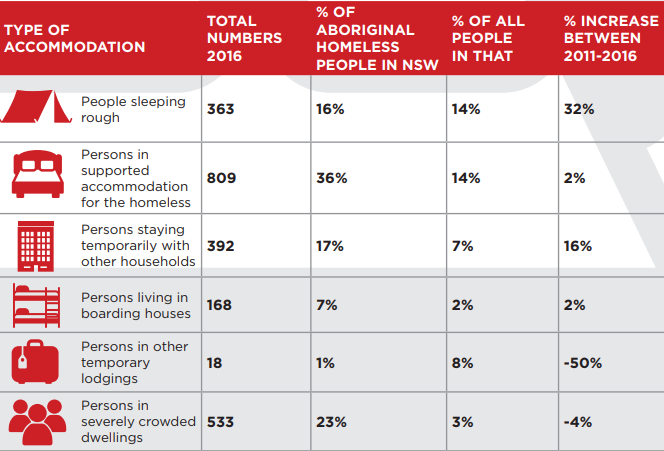
Shockingly Aboriginal and Torres Strait Islander people could make up over 24% of those accessing specialist homelessness services in 2015–16, and 6% of the entire homeless population in NSW. These alarming and growing rates of Aboriginal and Torres Strait Islander homelessness need to be addressed. But first we must understand how we got here.

There are a myriad of issues and injustices that have contributed towards these figures. Aboriginal and Torres Strait Islander people face:
However it is hard to go past the historic and ongoing injustice associated with the way Australia has treated land and property since it acquired it under a false legal claim in 1770. It isn’t surprising that a people whose land was stolen are now largely excluded from the wealth generated by property ownership on which modern Australia relies so heavily.
ABS Data

Included in the rising homelessness figures are persons living in boarding houses, persons in severely crowded dwellings and persons in temporary lodgings – all renters in some form. A large number of Aboriginal and Torres Strait Islander people reside in public housing under Family and Community Services, and the Aboriginal Housing Office, largely because they are unable to afford or be accepted in the private rental market. All told, 60% of Aboriginal and Torres Strait Islander people in NSW are renters.

Homelessness NSW

At the Tenants Union, working directly with the four Aboriginal Tenants Advice and Advocacy Services across NSW, we hear first-hand of the myriad of tenancy issues facing Aboriginal and Torres Strait Islander renters. There are continuous instances of illegal lockout, failures to repair, no grounds terminations, retaliatory evictions, domestic violence from co-tenants, and uninhabitable premises. These issues face tenants across the array of Aboriginal Housing in NSW, from public, to community, to private housing, Land Council houses, reserves, and Aboriginal Co-operatives. All contribute towards the increasing percentage of Aboriginal and Torres Strait Islander people experiencing homelessness.

Until these issues can be eradicated, and we can adopt a more just approach to land and housing for Aboriginal and Torres Strait Islander, and for all of us,the sad truth is that the rate of Aboriginal homelessness in NSW will continue to increase.

The Tenants Union is currently working on developing an Aboriginal Renting Policy, in consultation with Aboriginal tenants and Aboriginal organisations, to find out more about what the community feels are the most pressing issues in need of change in tenancy law and policy in NSW. This policy will form the platform for the TU to advocate for change for Aboriginal and Torres Strait Islander tenants in NSW.

Friday, August 10, 2018

Auditor-General calls 'three strikes' on anti-social behaviour policy

The Auditor-General office today released its report into FACS' anti-social behaviour policy. If we lived in a world led by evidence-based policy decisions it should be the nail in the coffin of the punitive anti-tenant approach to social housing.

But let's take a brief look at the key point in the report, which does make other recommendations about the systems and training in FACS, and focus on the key question of - is the scheme doing what it is meant to?

As the Report says the stated aims of the three strikes approach was  supposed to:
• improve the behaviour of a minority of tenants engaging in antisocial behaviour
• create better, safer communities for law-abiding tenants, including those who are ageing and vulnerable.

It is clear from the report that these aims have failed, and the government should reconsider its approach.


Only 21% of tenants thought that things had improved since the strikes system was bought in. But even worse - what do FACS think. Has it made neighbourhood safety and security better?


A resounding no.
But this shouldn't come as a surprise to the government or the Department - at its introduction, we told the government the policy would not help and that more support, not more punishment was the answer.

Since it's still relevant here is our recommendation to government at the time:
The Tenants’ Union of NSW agrees that a better response to dysfunction in neighbourhoods should be a high priority for Government. We accept the prevalence of dysfunction is a genuine concern for residents in neighbourhoods with high concentrations of social housing tenancies, and areas of relative socio-economic disadvantage. But the schemes set out in the Residential Tenancies and Housing Legislation Amendment Bill (Public Housing – Antisocial Behaviour) Bill 2015 go too far.
The Tenants’ Union does not support the bill. We call upon the NSW Government to withdraw the bill, and embark instead upon a genuine process of consultation with tenants, housing advocates, social housing landlords and other interested parties to develop and implement strategies to improve cohesion and resilience in all neighbourhoods where there are high degrees of disadvantage. By contrast, the bill will only encourage adversarial and punitive responses.
Where criminal and antisocial behaviour cannot be tackled through greater investment in neighbourhood and community cohesion, the Residential Tenancies Act 2010 already provides adequate avenues for social housing landlords to end tenancies, including on all of the grounds set out in the bill.
This aligns with the views of many other experts in this area. The experiences of Queensland and WA also demonstrated the ineffectiveness. It is unfortunate that government did not listen then, and continues not to listen now.

Instead it appears that rather than address the evidence presented, the government is doubling down on the punitive approach - introducing new mandatory evictions, bonds on public housing tenants, and changing the strikes process to make it more likely first strikes will be issued.

Tuesday, July 31, 2018

Renting with bats, mice and squirrels in the wild Midwest USA

Today we have a special guest appearance from Chloe Schumacher, an intern from the USA working at the TU. As Australia considers the possibilities offered by 'build-to-rent' landlords, she presents a timely example of the need to look past the marketing promises of 'institutional' or corporate landlords. This experience is not a one off - recent research found many housing advocates raising concerns about the approach corporate landlords take in the USA.

The first time I had ever rented a home was with five friends back home in Iowa. We are all in college and renting a home off campus is very normal after your first year in college. It was mid summer when we all moved in, and the first night I spent in the house was when the problems began.
I woke up around 3:00am to something hitting my chest. My hand hit something off my bed and that is when the fluttering started. I had woken up to realize there was not one, but several bats flying around in my room! My first terrified thought was to get out, but when I opened the door the pack flew into the kitchen and throughout the rest of the house. 

After this incident my roommates and I tried to call the rental company’s complaint and emergency hotline, but received no answer. Due to receiving no answer we all went into the office the next morning to sort out how to get rid of the families of bats living in our home. We explained the situation and our concerns – bats can carry rabies, their bite can’t be felt, and their faeces is a health hazard. After the story and explanations of concern, I was told that it was bat season; therefore there was nothing that they could do!
After being told that there was nothing that our renting company could do to rid our house of the infestation, we decided to be hopeful and leave our front door open to try and let them fly out on their own. This didn’t end up working; instead the bats went to sleep, hanging from the living room ceiling away from the door, due to it being so hot outside. They liked our house because it was nice and cool!
We had numerous run-ins with the bats. There were many times when one would be hanging inside the door frame and then when the door was shut, it would accidentally be smashed and injured or killed. Due to being concerned about rabies and other diseases, we decide to keep a few of the dead bats to send to be tested. After receiving positive results for the bats caring diseases, we became increasingly concerned and continued to seek out our landlord for help. The battle lasted for over 2 months and included several sessions of the five of us planting ourselves in their office and asking to speak to manager or company head. We even resorted to bringing in and leaving the bats in the office that had died in our home to try and prove a point.
We could go no longer go into our basement and finally after the two-month plea for someone to come out and do something about our bat invasion, our landlord sent over a maintenance crew.  These two men had no idea what to do about bats and were only trained in carpentry; they claimed they couldn’t find any bats. Since our landlord had sent someone out as we had asked, they acted as if they had done all they could to help.
It wasn’t until a few days after the carpenters had visited that a police officer was called and he kindly collected all of the bats in our living room and removed them. This process took him over two hours to catch and release the creatures, because they are protected in Iowa and much of the United States.
Even though our bat problem had been solved, we continued to have animal problems in the home throughout the rest of our tenancy. There was a large nest of mice living in the basement and they would also get into cupboards, but when we complained about this we were told the house is old and that is to be expected. If we wanted anything done about the mice, we were told we’d have to figure it out ourselves. Later we had squirrels and mice in our walls and again we received no help and were told it is just part of living in Iowa and in an older home. So, we dealt with the scratching noises that they created at night in the walls. Another problem we had was the power would randomly go out. When we complained about this, we were told it was due to the mice chewing away at cables and they weren’t responsible for such instances, even though we had complained about the mice problem previously!
The company we rented from was unhelpful and eventually became rude whenever any of my roommates or myself even entered the office building. We were treated more as a nuisance than customers, or even tenants. All of our requests for help were met with excuses and explanations of “that’s just how it is.” Unfortunately this isn’t an uncommon scenario in my college town, because a single company owns a very large majority of the homes and apartments for rent in the area. This allows the company to provide unsatisfactory tenancy experiences but still not go out of business. This is a huge problem where I am from and the company has been taken to court on many different occasions for their actions (or inaction). In fact, they would often only respond to tenants who were paying rent above a certain grade and the rest of the tenants who didn’t pay as much were never helped or even received a response to complaints or maintenance requests. Students have even come to expect that they will never see their deposit money back, even if they were perfect tenants and did not damage the home at all.
This company is the backbone of the renting industry where I am from, which allows them to get away with their mistreatment of tenants. Students are forced to just deal with their tenancy problems – like living in a pest menagerie –, because we have no other option of places to rent from within in a reasonable distance from campus.